Photomacrographic lenses, part 7
The accidental photomacrographic lenses
In the spring and early summer of 2010, members of the
www.photomacrography.net bulletin board were discussing a
lens that turned out to be very good in photomacrography, especially in view of the fact of being sold on
eBay for 10 US$ apiece. Apparently, a relatively large number of these lenses was available (at least a
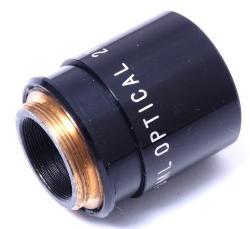
few dozens). This lens is mounted in a black aluminium barrel, marked as "JML 21 mm f/3.5". It
has a fixed internal aperture.
The low price made it feasible to buy one, or a few, of these lenses for experimenting. In fact, now and
then I do buy a cheap lens of unknown performance, just for testing (or, in the case of enlarger lenses,
just for assembling a small collection of unusual or interesting ones). I am well aware that I am not
alone in this habit. However, positive "surprises" in terms of a cheap but very high-performance
lens are rare and far-between, and this may not be a cost-effective way of hunting for a "hidden
treasure", especially if you buy at random (the odds may be somewhat improved by following the
suggestions I list below). In fact, if you need a top performing photomacrographic lens, you are perhaps
better off by saving up to buy one of the well-known and expensive top performers. Nonetheless, buying an
occasional cheap lens is not worse that buying a lottery ticket once in a while. Although the returns from
either activity are too scarce to be regarded as an efficient investment, testing a few unknown lenses may
be as much fun, for a photographer, as the thrill of scratching a new lottery ticket.
With the exception of a few Nikon EL-Nikkor lenses, which are generally good performers, and a few Apo
Rodagon D and Componon HM lenses, my hunt for "hidden pearls" was not very successful. Except
for the lenses discussed on this page and for a few microscope objectives (which, however, lie in a higher
price range), I have not heard of any other discoveries of exceptional lenses by other photographers,
either. I did test a few Wollensak close-up cine lenses, as well as lenses for microfiche projectors and
cameras, but I have no particular success to report. Some of the lenses I tested could be used, but there
are better lenses in similar price ranges (e.g., the El-Nikkors), and the "usable" lenses I
found are a few notches below the best photomacrographic lenses (Zeiss Luminar, Nikon Micro-Nikkor and
some of the Leitz Photar).
This particular JML 21 mm f/3.5 lens was originally sold at a list price of a few hundred US$. Before you
ask, I do not have any extra specimens of this lens to sell. I am not aware of any other,
current low-price sources for this lens, but it seems that small old stocks come up in improbable places
every other year or so. I do know that, of mid-2012, JML Optical (http://www.jmloptical.com/) still did have a few specimens to sell at list price.
JML 21 mm f/3.5.
The barrel of this lens was apparently meant to be friction-fitted into a cylindrical hole and focused by
moving it back and forth a few mm, with the focusing range limited by the edges of a groove in the barrel,
probably made to catch a retaining screw. Most specimens of this lens that I have seen come with a
longitudinal scratch on the barrel, which might mark some kind of alignment determined by factory testing
(it might indicate the optimal orientation when mounted in some specific piece of equipment). It seems too
regular to be the result of random damage caused while disassembling custom equipment.
JML 21 mm f/3.5 with an added RMS mount.
It is entirely possible to build an adapter to mount this lens in its intended way. However, in my case I
opted for an RMS mount by epoxying the base of a discarded microscope objective into the rear of the lens
barrel. This allows me to mount the lens on a microscope nosepiece, which is my favorite way of using
photomacrographic lenses. The barrel front is wider than ordinary microscope objectives and the working
distance slightly smaller than normal for photomacrographic lenses of similar focal lengths, but these
differences do not cause major illumination problems. The lens mount I chose does somewhat restrict the
field of view of the lens, which may limit the use of this lens at low magnification and with large
sensors. This is not a problem for me, since I have other lenses for optimal work at low magnification. In
addition, I would not use a 21mm lens for magnifications lower than abut 3-4x because of the short working
distance and closeness of the lens to the camera body.
Images taken with this lens have been published and discussed at length on
www.photomacrography.net. My own impression is that, within
an optimal range of magnification (which in my opinion is between roughly 4x and 7.5x with an APS-C
camera), the JML 21 mm f/3.5 produces a good image quality and an unusually low amount of chromatic
aberration. Using this lens significantly above or below its optimal magnification range may cause a
visible image degradation and/or vignetting in the corners. I discuss a simple test and a comparison with
competing lenses below.
This lens was apparently not designed for use as a photomacrographic lens, and definitely not as a
microscope objective. Its image circle is quite too large for these uses. It is definitely not an
eyepiece, in spite of having occasionally being called this way. It might have been meant as an objective
for a film scanner or a comparable imaging device.
Competing photomacrographic lenses
Dedicated photomacrographic lenses of similar focal lengths typically provide nominal apertures around
f/2.8-3.5 (sometimes in combination with a non-unity pupil ratio, which changes the effective aperture at
a given magnification). The Leitz Photar 25 mm f/2 in principle allows a higher magnification at high
resolution because of its lower nominal aperture, but this lens does not perform very well unless stopped
down by about one stop. A few 4x and 5x microscope objectives are also good in photomacrography, and some
of them can be pushed as low as 2x-3x. The Mitutoyo M Plan Apo 2x and 5x, with a suitable tube lens, are
superior to the JML 21 mm and provide a much higher working distance. Some Nikon infinity objectives may
likewise be better choices. Some Apo Rodagon lenses may also be strong competitors of the JML 21 mm in the
2x-5x magnification range.
Within its limitations and optimal magnification range, the JML 21 mm f/3.5, used intelligently, is at
least as good as well-known and expensive lenses like Zeiss Luminars and Leitz Photars (see below).
Considering the high prices of the latter lenses and their uncertain availability on the second-hand
market, the JML 21 mm could even be worth its list price. At this price, however, second-hand Mitutoyo
M-Plan Apo infinity-corrected objectives (especially the 2x, 5x and 10x ones) become competitive, and with
an appropriate tube lens give even better results (especially with focus stacking) on APS-C and smaller
sensors. Certain Nikon microscope objectives provide comparable results, and may be even cheaper.
Other accidental photomacrographic lenses
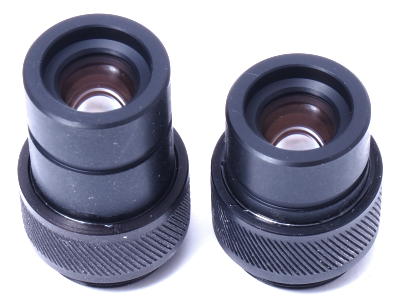
JML 26 mm f/4.5.
A small stock of the JML 26 mm f/4.5 was available for a while on eBay, and also proved quite good,
although not as good as the 21 mm. It is penalized by its higher f/ratio, and therefore limited to lower
magnifications. The above figure shows two specimens epoxied into RMS extension tubes (the one at the
right after shortening the lens barrel). The original lens markings are silk-screened around the end of
the barrel hidden within the adapter.
Olympus 40 mm f/3.4.
An Olympus 40 mm f/3.4 lens, possibly designed for a microfilm projector, has also been used in
photomacrography (see, e.g.,
here). Also this lens has been available at low prices on eBay.
Otamat 101 20 mm f/2.8.
In August 2012, a 20 mm f/2.8 lens in 22 mm dia. non-threaded barrel, originally made for the Otamat 101/R
microfilm projector, was found to be a reasonably good performer. A small lot of these lenses was
advertised on eBay at the time (as available in London but in reality shipped from an address in Tabor,
Czech Republic) for 17.95 £ each. A comparable lens with a focal length of 10 mm, available from the same
source, is unsuitable for photomacrography because of its very short focal length.
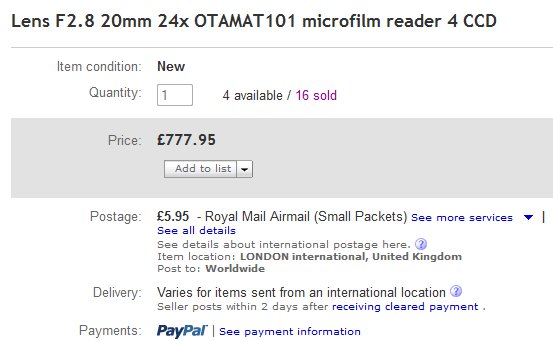
eBay ad, after price increase.
In a bizarre twist, after this lens was initially discussed on
www.photomacrography.net and just a few buyers were able to
purchase one specimen each, at least one further buyer was told by the seller that the lens had sold out
and was issued a refund. However, the item remained advertised as available for a few more hours, at the
substantially increased price of 777.95 £ (see copy of part of the ad at the right), until this matter
became the subject of a few comments on the same bulletin board. At this point, the seller canceled the
listing. It seems possible that the seller was keeping a close watch on the bulletin board.
After a few weeks, the lens reappeared in the eBay shop of this seller, this time at the original price of
17.95 £, and with a stock of a few tens of lenses. There are different interpretations of these strange
events, with someone saying that this seller had developed a habit of rising the price of an item to
unreasonable levels whenever its stock was about to run out, in order not to lose the item's sale history.
If this is true, it is a highly unorthodox way of managing a seller's eBay account, and one very likely to
make some buyers turn to other sellers.
The Otamat 20 mm is a little unusual in its strongly asymmetrical and relatively complex optical design (6
elements), which gives this lens a pupil ratio, or pupil magnification, of at least 1.4. Symmetric lens
designs have a pupil ratio of 1. This high pupil ratio has two consequences: at a given magnification, the
effective f/ratio is lower than in lenses with unity pupil ratio, which results in a lower degradation of
resolution by diffraction, and the working distance is lower than expected for a lens of this focal
length. The lens is specified as providing a center resolution of 200 line-pairs/mm (LP) and an
"image size" (perhaps image circle?) of 18 mm, which would potentially make it a respectable
performer in photomacrography. 200 LP on the subject side (when this lens is used in photomacrography) is
not so much, but the same figure on the image side would be excellent. Unfortunately, when used in
photomacrography, this lens does not entirely live up to expectations of high resolution. Although usable,
according to specifications and theoretical performance, up to about 10x, it is in practice limited by its
resolution to a maximum of about 6x.
The optical design is so asymmetric that this lens can only be used in one orientation (i.e., with the
slightly narrower outer element, visible at the left in the above figure, facing toward the subject). In
the opposite orientation, it cannot be focused on a subject at any magnification, and its virtual focus
point lies within the lens. In practice, its characteristics are somewhat reminiscent of a reversed (as
normally used in photomacrography) retrofocus wideangle lens, albeit without the much wider front and
narrower rear elements common in general-purpose retrofocus lenses.
This lens was originally specified for use at 24x, but it must be remembered that, at this magnification,
the acceptable image resolution for the intended use (visual observation of documents on a projection
screen roughly the size of a paper sheet) was quite low compared to its use in photomacrography. This
applies to all lenses designed for microfilm and microfiche projectors, which are often specified for
magnifications roughly between 20x and 50x but are diffraction-limited in photomacrography above 6x-10x.
The Otamat 101/R was a "portable" (at 4 kg) 16 mm microfilm projector that folded down to a
briefcase size and could run on different mains voltages or 12 V DC. It was marketed in the 1970s, among
others by the Microfilm Cassette Company LTD of London, and targeted to the aeronautics industry.
Potential candidates for photomacrographic lenses? (Note: Try at your own risk - I have these and more,
but did not test any of them, and cannot endorse any).
The above figure shows a small collection of lenses from a variety of sources. The model in second and
third position from the left has been used by other photographers and found to be moderately good, but not
comparable with more famous alternatives (it appears to consist only of two elements). I have no data on
the others.
Discovering accidental photomacrographic lenses
One may ask how to avoid obvious "junk" and concentrate on promising photomacrographic lenses
advertised on eBay and other online sources that make a try-before-you-buy approach impractical. Here are
a few suggestions. In this discussion, I deal with imaging objectives used for image scanners, microfilm
readers and similar applications. This discussion does not include microscope objectives (for which
different criteria apply) or copy/repro lenses and darkroom enlarger lenses (which have been tested quite
extensively, and some of which are known-good for this application). Lenses from xerocopy machines are
likewise unlikely to be suitable, because they are designed to provide very large image circles (500 mm or
more) at low resolution, mainly at 1x.
Note that, in this discussion, I do not include generic movie and videocamera lenses. Videocamera lenses
are usually designed for low resolutions, and unlikely to be any good in photomacrography. Movie lenses
have traditionally been recommended for use (always reversed) in photomacrography, but my experience with
these has not been satisfactory. Their image quality is often not so good, field curvature and other
aberrations are evident, and in addition old movie lenses are currently advertised at overinflated prices
for use on mirrorless digital cameras (where they generally do not live up to the standards of modern
lenses specifically designed for these cameras). Film projector lenses are often even poorer than movie
lenses, and rarely available in "interesting", i.e., sufficiently short focal lengths. Data
projector lenses generally do not match the resolution of which modern digital cameras are capable.
Some photographers swear by the use of reversed SLR/DSLR wideangle lenses in photomacrography (sometimes
mounted atop lenses of longer FLs), but I have not been impressed by my experiences with these (better
than nothing, but not on par with the JML 21 mm or the other known-good lenses mentioned above).
The criteria I suggest for selecting candidates to test are:
Focal length (FL): roughly between 20 and 40 mm, exceptionally up to 60 mm for the lower magnifications.
Higher focal lengths require a longer distance to the sensor plane. Shorter focal lengths are only
usable at high magnification, and usually with very short working distances that make illumination of
the subject a problem. For instance, an 8 mm FL lens for microfilm projection is probably not useful,
and a microscope objective is more likely to be a satisfactory substitute for this particular FL.
Nominal aperture f/ratio: the lower the better (for image resolution, although not for DOF). Not higher
than about f/3.5 for a focal length around 20 mm, or not higher than f/4 for focal lengths around 30-40
mm. Higher f/ratios may be acceptable if the lens is used only at low magnifications, but in this case
the FL should probably be between 40 and 60 mm. The pupil ratio affects the effective aperture of these
lenses in photomacrography, so the nominal aperture alone is not the only controlling criterion (but
remains a good starting point, nonetheless). For instance, a 26 mm f/6.3 lens is unlikely to be of much
use, but a 26 mm f/2.8 is definitely worth trying. It also depends on sensor size: With an extremely
good lens, at 1x on a 20 Mpixel Micro 4/3 sensor, one can easily see a better image resolution at f/2.8
(effective f/5.6) than at f/4 (effective f/8). On a full-frame 24 Mpixel sensor, it is more difficult to
see a clear difference between the two apertures at the same magnification. With ordinary macro lenses,
it is instead often better to shoot at f/4 than f/2.8, because the lens fully open may have visible
spherical aberration that decreases by stopping down.
The number of lens elements and lens groups is usually an indication of image quality: 6 or more
elements are reserved for high quality lenses, while a doublet (2 elements) simply cannot correct
aberrations to a sufficient degree. The Tessar design (3 elements in 3 groups) seems to be the minimum
feasible for high-quality lenses (it is used in the Zeiss Luminar series, but some models use additional
elements to allow a lower f/ratio). The Xenotar (5 elements in 4 groups) and double Gauss (6 elements in
4 groups) designs are often used in photomacrographic lenses.
A lens diaphragm is not terribly useful in photomacrography. In most cases, to get the best image
resolution one is forced to use the lens fully open. Do not dismiss a lens just because it has a fixed
aperture.
In photomacrography, these lenses often work better in one orientation. They should be tested in both
orientations to find the optimal one. Often these lenses have asymmetrical barrels, with an external
optical surface near one of the barrel ends and the opposite external surface deeply recessed within the
barrel. In these cases, a portion of the barrel may need to be machined away if the optimal lens
orientation forces the subject too close to the edge of the barrel. This type of barrel may also cause
vignetting at low magnifications.
In a few lenses, the optical scheme is highly asymmetric and the lens simply cannot be focused when used
in one orientation (the subject would have to be placed at a virtual focus point between optical
elements). The same is true for lenses where the distance between front and rear elements is unusually
high for the FL. There is no solution to this problem - just try a different lens or a different lens
orientation.
Lenses with unusual bayonets or threaded mounts may be difficult to adapt to camera equipment. The most
versatile lenses are those with common threaded mounts (e.g., 39 mm for enlarger lenses or RMS
microscope objective mounts). A simple cylindrical lens barrel is often not too difficult to
friction-fit within an extension tube, step-down filter adapter or similar commonly available
accessories. Plastic insulating tape and Teflon sealing tape for water pipes can be used to take up a
minor amount of slack. Epoxy or black silicon (be careful not to contaminate the optical surfaces) can
sometimes be used for permanent mounting in an adapter. In general, try to get a fit as tight as
possible before resorting to tape or glue, because the lens axis should remain aligned and centered with
precision, and perpendicular to the sensor plane.
Adhesive telescope flocking foil or matte black paint should cover all reflecting surfaces
exposed within an adapter (even the surfaces not directly exposed to light passing through the
objective, but still visible by looking through the rear of the adapter).
When making random purchases, only buy lenses that you won't regret simply throwing away if they do not
work satisfactorily. Buy an expensive lens type only if it has been tested and found to be good in
photomacrography by modern and reliable sources.
Unless you feel like a lens collector rather than a lens user, don't buy too many lenses. I may
certainly be accused of not following my own advice on this point, but I would suggest that it is not
particularly useful to own more than one or two lenses optimal in each specific magnification range, or
more than a total of about 5-6 photomacrographic lenses (with exceptions justified by specialized uses,
like stacking in the laboratory versus field use, or mounting on different and mutually incompatible
equipment).
A simple comparison
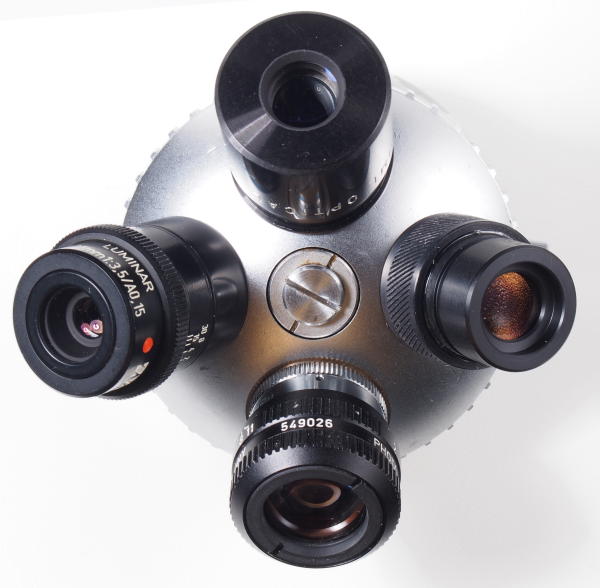
Clockwise from the top: JML 21 mm f/3.5, JML 26 mm f/4.5, Leitz Photar 25 mm f/2 and Zeiss Luminar 25 mm
f/3.5.
I decided to perform a simple test and comparison of the JML 21 mm and 26 mm. For this purpose, I selected
two additional lenses of similar focal lengths, well known for their performance in photomacrography and,
unfortunately, at present both scarce and expensive: the Zeiss Luminar 25 mm f/3.5 and the Leitz/Leica
Photar 25 mm f/2. All four lenses were mounted on a modified microscope nosepiece (shown above) to make it
easy to switch among the lenses. A short RMS extension tube was used for the Photar, since its barrel is
shorter than the other lenses. The Luminar is also mounted on its dedicated extension tube.
There is a detailed test of some of these lenses, and additional ones, at 5x
here, and another one at 4x-5x
here. I
simply don't have the time to carry out very detailed tests, and you are welcome to check these link. My
own conclusions discussed below are not necessarily the same as these reviewers'. More information on the
JML 21 mm f/3.5 is also available
here and
here. Results
with the JML 26 mm f/4.5 are discussed also
here,
here,
here and its
mounting
here. There
are just too many examples of images taken with the JML 21 mm f/3.5 on
www.photomacrography.net to list them individually, but you
may use the search function on their bulletin boards.
Since the f/ratio of the JML 26 mm is relatively high, magnification in this test was limited to
approximately 5x on a 16 megapixel APS-C sensor, in order not to push this lens beyond its diffraction
limit and keep the comparison fair. Magnification with the other lenses (especially the 21 mm) is slightly
higher because I used the same bellows extension with all lenses. Rather than using focus stacking, I took
a single image with each lens, fine-focused to the same subject detail. The detail is a set of iridescent
scales on a tropical curculionid bug, which I also used as a test subject
here. Both the Luminar and the Photar lenses were stopped down to
approximately f/4.5.
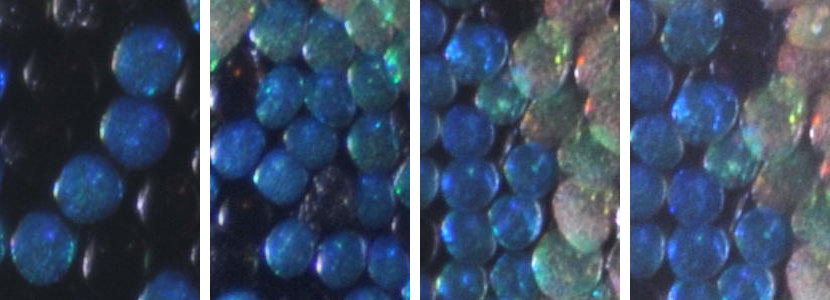
Test results. 1:1 center crops.
Left to right: JML 21 mm f/3.5, JML 26 mm f/4.5, Leitz Photar 25 mm f/2, Zeiss Luminar 25 mm f/3.5.
Test results. 1:1 selected crops.
Left to right: JML 21 mm f/3.5, JML 26 mm f/4.5, Leitz Photar 25 mm f/2, Zeiss Luminar 25 mm f/3.5.
Reduced image with the JML 21 mm f/3.5. The subject is highly convex, causing only its center to be in
focus.
The results show only very minor differences. The largest deviation is probably given by the Luminar,
which produces a lower contrast than other lenses. Even with live view at maximum magnification, I was not
quite able to focus the same detail perfectly with all lenses, so the top row in the figure displays the
"target" area, and the second row a different area, chosen among the sharpest ones but in
different regions not far from the center of the image. The bottom image shows that the bokeh of the JML
21 mm is rather good and there are no polygonal outlines of the lens diaphragm. Additional tests (not
shown) display comparable results in the corners of the images.
In the real world, you would not be able to identify which of these four lenses was used by examining just
one picture, possibly with the exception of the Luminar because of its somewhat lower contrast (using a
dark background instead of a white one for the subject would probably make things better with the
Luminar).
At this magnification, further stopping down the Luminar and Photar lenses would cause diffraction to
become visible. The JML 21 mm can be used up to 6x before showing any signs of diffraction, and up to 7x
with very minor signs. The Photar 25 mm in theory could be used fully open (f/2) up to 13x, but in
practice it loses some of its theoretical performance to optical aberrations, and it is better to stop it
down a little and not to push it beyond 10x.
Contrast and dynamic range are also very similar among these lenses (but older models of the Luminar and
Photar might show a lower dynamic range with high-contrast subjects). At the tested magnification,
performance at the center and corners of an APS-C frame is excellent, and very similar among the lenses.
Transversal chromatic aberration is very well controlled in the JML 21 mm and slightly higher in the
Luminar 25 mm, but can be corrected in post-processing. DOF depends on effective aperture (which in turn
depends on nominal aperture and pupil ratio), and obeys immutable optical laws that are the same for all
lenses. In brief, we have four winners that differ principally in price and availability. Choose the JML
21 mm f/3.5, Photar 25 mm f/2 or Luminar 25 mm f/3.5 for use between approximately 4x and 7x, or the JML
26 mm F/4.5 for a slightly lower magnification range, and you will notice no obvious differences in image
quality.