Godox LED64 mini LED panel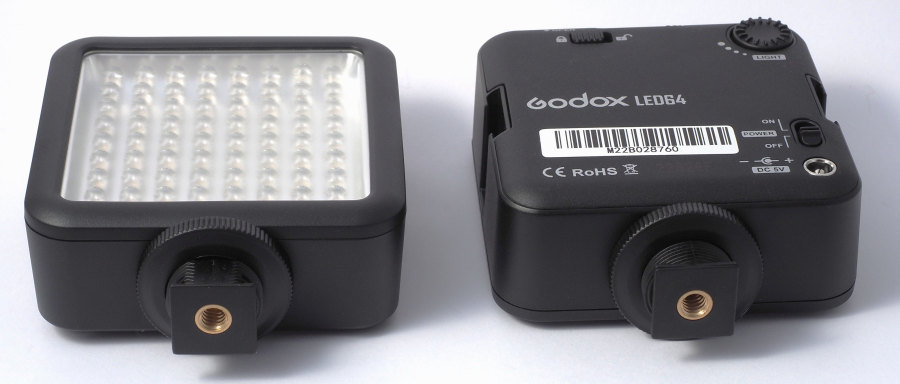
The Godox LED64 is a mini LED panel marketed for macrophotography, product shooting, and video recording. It contains 64 individual 6 mm white LEDs in a square array, mounted between a silver-colored reflector and a plastic diffusor. The base of the panel has a cold shoe for mounting it to a support, as well as a 1/4" standard threaded socket. The frame of the panel carries three more cold shoe sockets, where additional panels of the same type can be inserted. This is feasible, with some caution, for a cluster of three or four LED64 sharing a single attachment point, but adding more panels (especially if powered by internal batteries) will put too much mechanical strain on their plastic casing. Using a single larger LED panel, or multiple LED64 units each mounted on a mini arm, are better alternatives. The built-in diffusor is quite transparent in order not to waste too much light, and the individual LED beads are clearly visible. Highly reflective subjects display tell-tale reflections of the grid of LEDs. If this is a problem, an additional, better diffusor should be mounted a few cm in the front of the LED64. The light emitting surface of the LED64 is square, with a 68 mm side. A suitable additional diffuser can be an opal sheet of 10 by 10 cm placed roughly 5 cm in front of the LED64. This will, however, absorb at least half the light. The maximum power consumption according to the specifications is "less than 4.5W", which means that each LED is using up to approximately 70 mW. The illumination intensity is adjustable via a small rear knob. At minimum intensity the LEDs are still emitting a usable amount of light, and the intensity potentiometer works fairly evenly throughout its range. At minimum power, the panel casing does not feel appreciably warm even when the light is left constantly on. 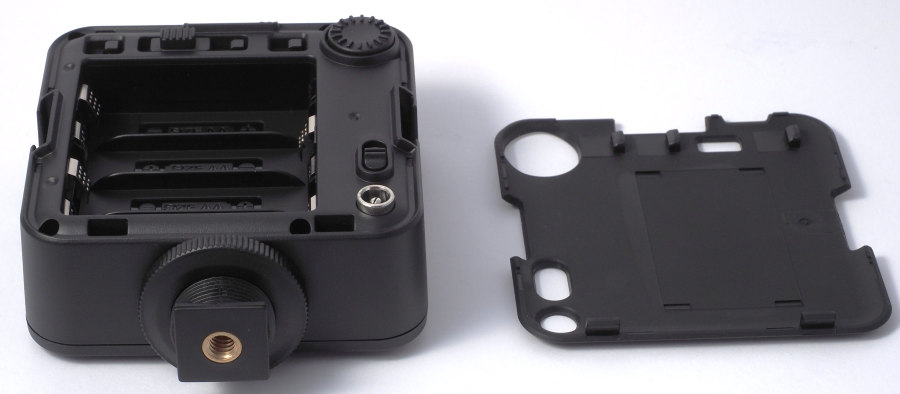
The LED64 can be powered by four internal AA batteries (it works fine with rechargeable batteries like the Eneloop Classic), or an external 5V DC power supply that must provide at least 1A. The power switch at the rear of the panel has just On and Off positions (i.e., no separate "On" for internal and external power). Operating the panel with both batteries and external power seems to work just fine. I found no specifications for the power supply, but as far as I can determine, it must be equipped with a 5.5x2.1 mm female power plug and be capable of driving a 1 A DC current load (1.5 A including a reasonable safety margin). Obviously this is not a LED panel for illuminating large subjects, and the suggested use as a video light and as a light source for product photography is limited to fairly close-range and small subjects. Where the LED64 proves especially useful is close-up and macro photography of static subjects. I have several of these LED panels, and normally place two or three of them around a diffusing cup or hemisphere that surrounds the camera lens and subject, and often operate them at full power, or sometimes leave one at full power but decrease the intensity of the others when I need to give a more directional illumination. Exposure time at 200 ISO varies between a fraction of a second and a couple of seconds, depending on magnification, type of subject and distance between subject and panels. Even at maximum power, heating of the subject through an additional diffuser is generally low enough not to affect potentially heat-sensitive subjects like dried insects, even after several minutes of continuous illumination. When working with living subjects, it may be a good idea to decrease the illumination intensity or use electronic flash at low power. These LED panels are my favorite type of illumination for focus stacking of static subjects. Although electronic flash can be useful to "freeze" subject vibration when focus stacking, the repeated flashing can cause heat-sensitive subjects to warp and twist during the shooting session, and the problem becomes apparent only when attempting to post-process the stack of images. In my experience, this is less likely with a low-intensity continuous illumination, and LEDs are particularly useful in this because they emit virtually no near-infrared (electronic flash does emit copious amounts of NIR). Of course, this requires a very stiff support system, preferably of high mass to dampen vibrations caused by the equipment, and well decoupled from structural vibrations of the building. 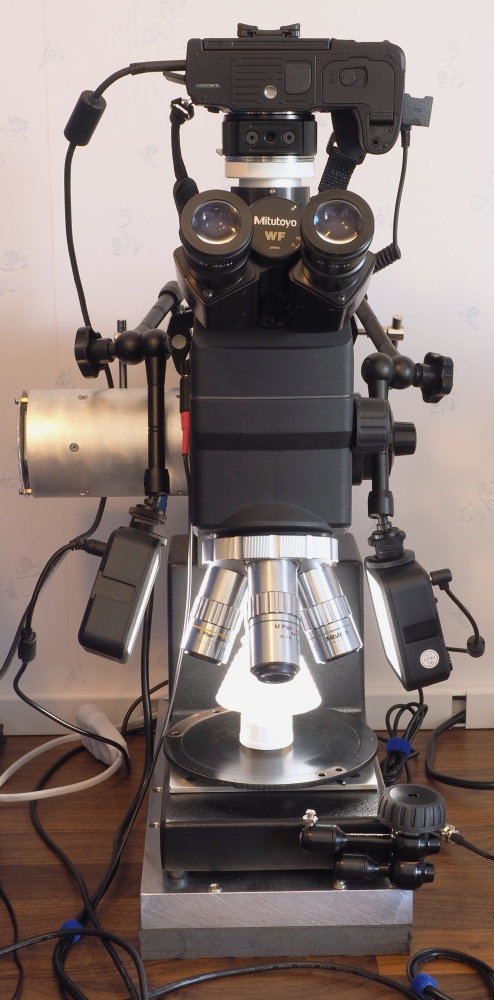
A diffusing cup surrounds the subject (raised on a white support) and the objective. A third LED64 (removed for clarity) is usually mounted on the mini arm in the foreground. My preferred stacking setups at present are a Zeiss measuring microscope stand for stacking at low magnification (also using LED64 panels), a Mitutoyo FS-60 microscope for intermediate magnification (see above picture), an Olympus BXFM modular microscope for higher magnification (also using LED64 panels), and an Olympus BX-50 for "real" microscopy (equipped with dedicated LED, UV LED and xenon flash illumination). Color temperature and CRIThe LED64 is apparently not CRI rated in Godox literature, but some retail sellers state that it has a CRI greater than 95. I do not know on what evidence these assertions are based. Godox only specifies a color temperature of 5500-6500 K. With most subjects, my Olympus E-M1 II and OM System OM-1 in Auto WB manage a fairly good color rendition with the LED64, slightly better than, or as good as, other LED sources I am using (including the Ikea Jansjö that are still popular with photographers specializing in photomacrography, now discontinued except for a USB-powered model). As a whole, LEDs as an illumination source for photography still need improvement before they can be fully satisfactory, but the LED64 in my opinion are not worse than many other LED panels, including some more expensive ones. Other Godox LED lightsGodox makes two additional, more recent and moderately more expensive models with a similar size and general appearance, the LED6R (with RGB LEDs) and LED6Bi (with color temperature adjustable between 3,200 and 6,500 K). Additionally, the LED36 is an even smaller model with only 36 LEDs, powered by two AA batteries and without provisions for an external power supply. Although the LED36 is potentially easier to place close to a small subject in intricate lab setups, its limitations make it less versatile than the LED64. Godox also sells numerous models of larger LED panels, including a couple of hybrid LED-flash panels, high-intensity LED continuous light sources externally shaped like studio strobes (among them, fanless LED lights up to 120 W), and two high-intensity hybrid LED-flash models externally similar to studio strobes. The hybrid LED-flash panels and strobes operate in flash mode by briefly overloading the LEDs and making them emit a pulse of multiple times their continuous light intensity. The short current pulse in flash mode and its relatively modest peak brightness, compared to a xenon-tube flash, prevent the LEDs from self-destroying. I have no hands-on experience with these hybrid LED-flash units, but they do sound potentially useful for achieving shorter exposure times than ordinary LED in focus stacking, with less heating of the subject compared with xenon strobes (in part because of the LEDs' lack of NIR emissions). These hybrid units are compatible with the Godox wireless flash system, but I still have unanswered questions, for example how is exposure metered (with a pre-flash, I assume) and performed with respect to front/rear curtain synchronization. The details might be different from typical xenon flash operation, because the peak emission duration of hybrid LED-flash is significantly longer than xenon flash. Third-party mini LED panels superficially similar to the Godox LED64 are sold under dozens of make-believe brands on Amazon, eBay etc. All those I have checked, however, only have 49 LEDs (i.e. a 7 by 7 LED matrix) compared to the 64 LEDs (8 by 8 matrix) of the LED64. SummaryThe Godox LED64 is a miniature LED panel suitable as an illumination source for static subjects in close-up and macro photography, both in the studio/lab and in the field because it can be powered from internal AA batteries and external 5VDC adapter. The small size and modest price make it practical to own and use multiple units. Although not CRI-rated by Godox, in practical use it works just as well as other LED sources I have been using. |