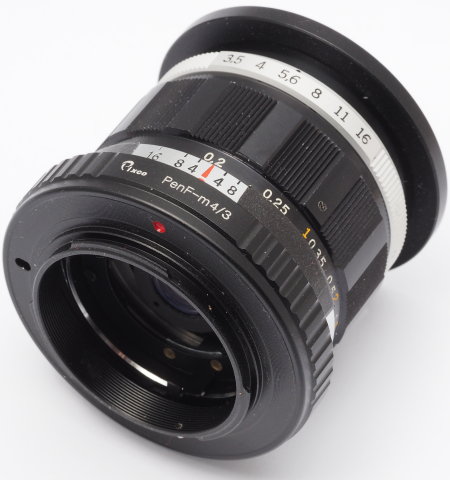
Olympus G.Zuiko Auto-W 20 mm f/3.5
tested in UV imaging
This page describes tests carried out on the Olympus G.Zuiko Auto-W 20 mm f/3.5.
This page is part of a set describing tests of small-format lenses in UV photography. The main page
describing these tests is available here.
Olympus G.Zuiko Auto-W 20 mm f/3.5
Figure 1. Olympus G.Zuiko Auto-W 20 mm f/3.5.
This lens was designed for "half-frame" (24 x 18 mm) Olympus Pen film cameras. It is well-built
in a moderately small but solid metal barrel. It cannot be used with ordinary DSLRs because of its low
registration distance. Adapters are available for virtually all mirrorless camera types. This lens is
already known to be a good performer in NUV photography, although its transmission does not extend very
far into the NUV. Its UV performance was discovered and made public by Oleksandr Holovachov.
A few examples of UV urban landscape can be seen here. Unfortunately, this lens is scarce, and prices are now substantial. The above specimen was modified by
removing its locking and aperture preview buttons and some of the internal mechanical parts, for a special
project not related to the present test. The minimum focusing distance is 20 cm, but in the present
specimen the focusing helicoid was recalibrated as part of the modification. Once the front of the lens is
partly disassembled, it is possible to rotate the aperture ring half a turn, to display uppermost either a
conventional aperture scale or a custom scale marked from 0 to 4.
Specimens of this lens are known to commonly have two problems:
An oily film may be present on one of the internal elements. It must be cleaned out to restore a good
image quality.
The black paint coating the perimeter of the front element is often worn out and easily comes off when
cleaning this element after disassembling the lens. This results in unacceptable flare and low contrast,
but can be repaired by re-painting with matte black model paint. Blackening with a permanent marker has
been proposed as an alternative solution, but is much less effective.
A shiny aluminium ring is visible from the rear of the Pen to Micro 4/3 adapter. It may be a good idea to
paint it black in orter to reduce the risk of flare and loss of contrast.
This lens uses an optical scheme with 6 elements in 6 groups, see
here and
here (the
illustration at this second link is correct, but the description is not).
Reference lens, Baader U.G.Zuiko Auto-W 20 mm f/3.5, Baader U.reference lens, Asahi Spectra XRR0340.G.Zuiko Auto-W 20 mm f/3.5, Asahi Spectra XRR0340.reference lens, Omega 325BP10.G.Zuiko Auto-W 20 mm f/3.5, Omega 325BP10.
Figure 2.
The UV tests and samples show a relatively high image resolution and (once the lens is properly cleaned
and restored) contrast and dynamic range, not very sensitive to flare. NUV transmission is approximately
2-3 stops less than the reference lens at 365 nm. False color in flash illumination is more strongly
violet than with the reference lens, indicating a lower transmission of the shorter wavelengths. Curvature
of field seems to negatively affect image resolution near the edges, and is especially visible in
landscape photography.
Figure 3. 1:1 center crop of NUV image with Baader U and electronic flash, f/5.6.
NUV image resolution is quite good, but other lenses
tested in this set are slightly better. Contrast is
somewhat lower than other lenses tested in this set.