Nikon Z MC 105mm f/2.8 VR SThis is the main macro lens, introduced in 2021, in the Nikkor Z lens system. This system at present contains a second macro lens, i.e. the small and relatively affordable Nikkor Z MC 50mm f/2.8, introduced at the same time as the 105 mm. Both lenses focus continuously from infinity to 1x, but the focal length of the 50 mm is a bit too short for photomacrography, especially on full frame, and I regard it as more suitable for close‑up imaging of mostly static subjects (e.g. plants and flowers in the field, or studio product photography of small items). On the other hand, the 50 mm does fill a niche for a macro lens so small and lightweight that it can be carried in a camera backpack "just in case", on an outing where no macro work is actually planned but an opportunity might arise. This is not the case with the Z 105 mm, because of its much higher size and greater weight.
In the Nikon F system, all macro lenses were called "Micro Nikkor". This originated the pun that, in the
Nikon universe, to shoot macro photography one needs a Micro lens.
There are no known plans for Nikon to introduce further models of macro lenses in the Z system. Two FX (full frame) models of macro lenses in this system are a historically low number for Nikon. For example, the Nikon AF D series of lenses did contain four models (60 mm f/2.8, 105 mm f/2.8, 200 mm f/4, 70-180 mm f/4.5-5.6). The AF‑S G series did not contain macro lenses of focal lengths higher than 105 mm, but introduced two DX models (40 mm f/2.8 and 80 mm f/3.5) to the AF‑S G FX versions of the 60 and 105 mm. Unfortunately, none of the AF‑S G macro lenses are regarded as excellent (they are not outright poor, especially the AF‑S 105 mm, but just not as remarkably good as earlier and subsequent Nikon macro lenses). The AF‑S 105 mm is remarkable for being the only Nikon macro lens designed to allow the use of Nikon teleconverters, and with a 2x teleconverter it reaches 2x. The Z 105 mm does not provide this feature, so the only ways to use a macro lens of focal length higher than 105 mm and/or a higher magnification than 1x in the Z system is by using legacy Nikon macro lenses in F mount on an F-mount teleconverter and an FTZ or FTZ II lens adapter, or a third‑party lens like the Laowa 85 mm f/5.6, which reaches 2x without accessories.
In an earlier discussion, I mentioned that, at the time, I had no plan
to replace the AF‑S 105 mm with the Z 105 mm. I did change my mind on this, in part because I
discovered that the AF‑S 105 mm does not support all the focus‑bracketing settings of Z
cameras (in particular, the automatic return to the start focus position after shooting a
focus‑bracketed sequence, which makes it difficult or impossible to repeat exactly the same
in-camera focus bracketing sequence), and in part because I was able to purchase a new Z 105 mm with a
temporary 200 € discount. Once I started using the Z 105 mm, I also discovered that its autofocus is
orders of magnitude faster and more reliable than in the AF‑S 105 mm (see below). The Nikon Z 105 mm in practice
The 105 mm is 140 mm long, with a barrel diameter of 85 mm and a weight of 620 g. This is a bulky lens, 27 mm longer and 2 mm wider than the AF‑S 105 mm, but 170 g lighter than the latter. On a relatively large camera body like the Z8, the 105 mm does not look exaggeratedly large. It is a little shorter than the AF-S 105 mm mounted on an FTZ adapter. This adapter adds another 140g of weight. 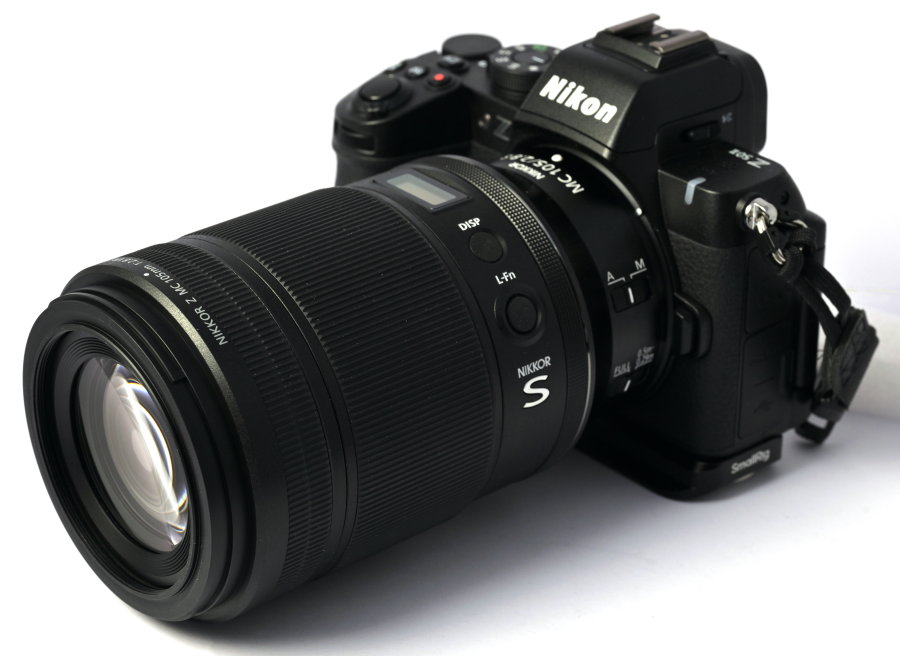
On a smaller body like the DX Z50 II, on the other hand, the physical size of the 105 mm is more obvious. With DX cameras, the field of view is roughly 24 by 18 mm when the lens is set to 1x. Note that the maximum magnification of the lens remains the same. What changes when switching between FX and DX cameras is the field of view, not the magnification. A drawback of the Z 105 mm is that it does not have a tripod collar, so the camera must support the weight of the lens when mounted on a tripod. When the AF‑S 105 mm is mounted on an FTZ adapter, the adapter provides a better balanced tripod mount. The Z 105 mm makes the camera front‑heavy, which can be corrected by using an Arca‑compatible combination rail. I believe that the Z 105 mm is lightweight enough not to put an excessive strain on the lens mount of a smaller Z camera like the Z50 II.
A third‑party tripod collar is described by the maker (iShoot) as compatible with multiple lenses,
including the Z 105 mm. However, this collar has two important limitations and one fatal design flaw.

The filter mount has a diameter of 62 mm, like in the AF‑S 105 mm. Also like the AF‑S 105 mm, the Z 105 mm comes with an oversized lens shade. The lens shade can be reversed onto the lens barrel when not in use, but in this case the focus ring is not accessible. A button at the base of the lens shade must be pressed when removing the lens shade. 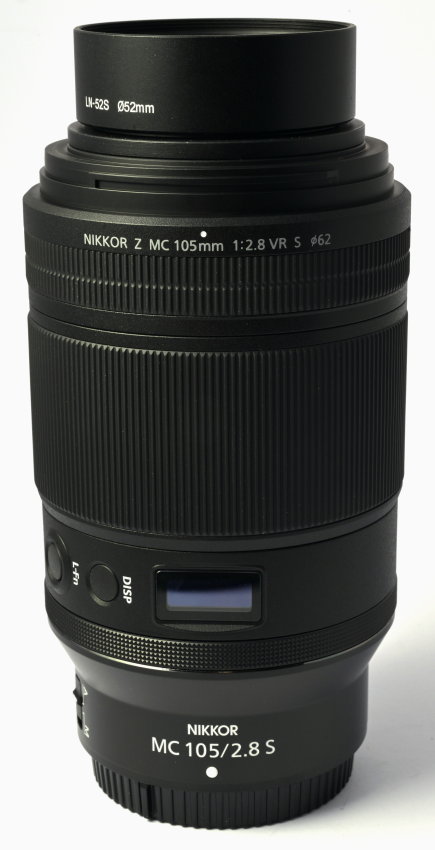
I replaced the original lens shade with the same combination of step‑down ring and third‑party cylindrical lens shade I found to work well on the AF‑S 105 mm, because the original lens shade "eats up" too much working distance and may interfere with illumination of the subject. This replacement lens shade allows the continued use of the original lens cap, but cannot be reversed onto the lens barrel. I leave this lens shade permanently mounted onto the lens. 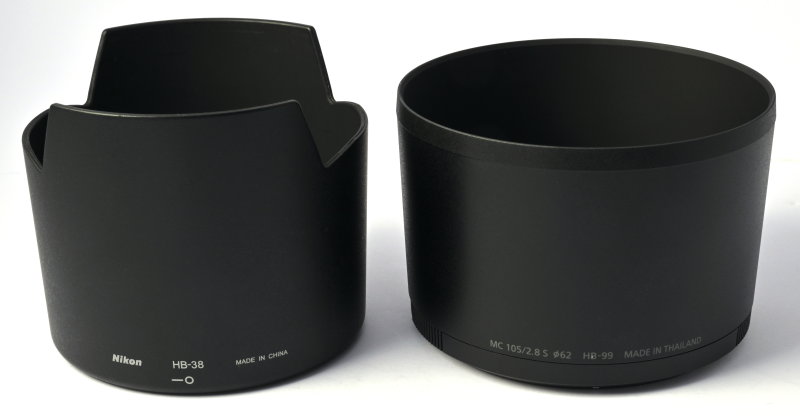
It is interesting to compare the shape of the lens shade in the AF‑S 105 mm and Z 105 mm. While the HB‑36 lens shade of the AF‑S 105 mm is petal shaped, the HB‑99 of the Z 105 mm is a truncated cone with a circular front end. This suggests that the principal plane of the AF‑S 105 mm is located much deeper within the lens than in the Z 105 mm (hence the necessity of a petal lens shade to avoid vignetting), and confirms that the optical scheme of the two lenses is very different. Lens controlsFirst of all, the rubber-clad, relatively thin apparent ring located closest to the filter mount is not a control at all, just a grip to use for mounting and dismounting the lens. 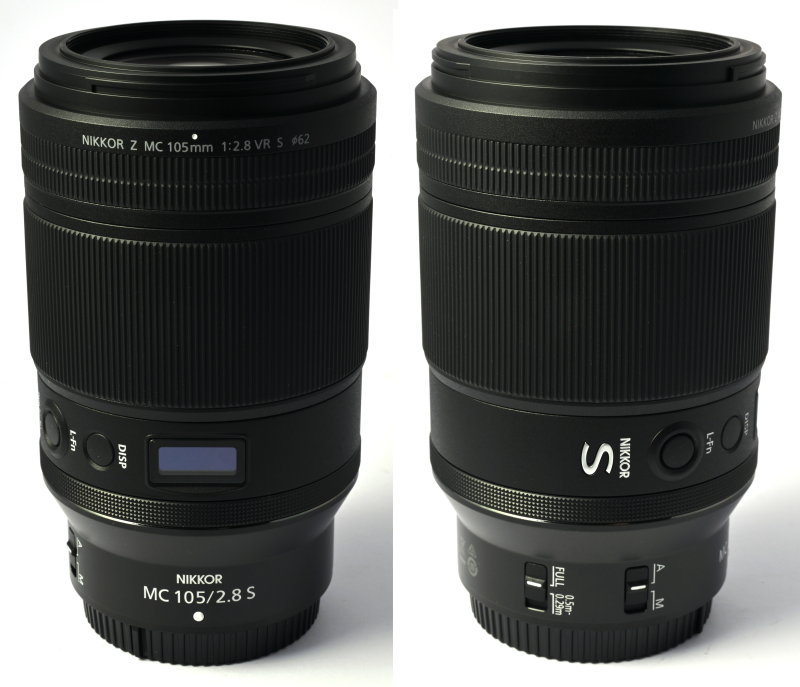
The focus ring is large, operates by‑wire, and changes the focus dynamically. Rotate it slowly for precision focusing, rapidly to make large adjustments of focus. The difference in focusing speed is very large. A quick twitching of the focus ring with the left hand brings the lens from infinity to close‑up focus in about a second, and a further twitching into the macro range. The control ring is narrow, and its function is programmable. On Nikkor Z lenses, the control ring of each lens can have a different programmed function, independent of the function configured for other lenses. Some photographers suggest using it for ISO changes. Alternatively, it can be used for changing the aperture if you are used to lenses equipped with a hardware aperture ring. However, the aperture by default can be controlled with the secondary camera dial, so it does make sense to use the control ring for a function not easily accessed with the camera controls. The Z 105 mm is equipped with two sliders on its left side, near the lens mount. From top to bottom:
Unlike the AF‑S 105 mm, the Z 105 mm lacks a slider to switch VR on and off. In this lens, VR must be switched on or off, and its mode set to full or sports, on the camera (e.g. in the control panel). The lens is equipped with a DISP (display) button at the left of the small LCD display. Click this button to activate the display. By long‑pressing the Display button, the lens LCD display shows the current settings (either length units or display brightness). In this mode, click the Display button to alternate between these settings. The length unit can be chosen between m and ft by rotating the lens control ring. The display brightness can also be set by rotating the control ring. Long-press the Display button to exit the configuration mode. The lens is also equipped with an L‑Fn programmable button, located further at the left of the Display button. Like some of the other S lenses, the Z 105 mm is equipped with a small LCD display, showing one of the following combinations of settings:
After some time of inactivity, the display switches off. To re‑activate it, click the DISP button. FocusFocus is internal, with both the rear and the front optical surfaces remaining immobile. Focus is operated by a stepper motor. Optics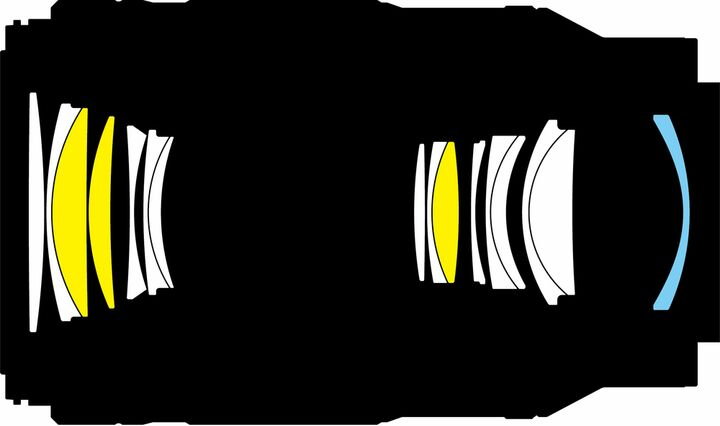
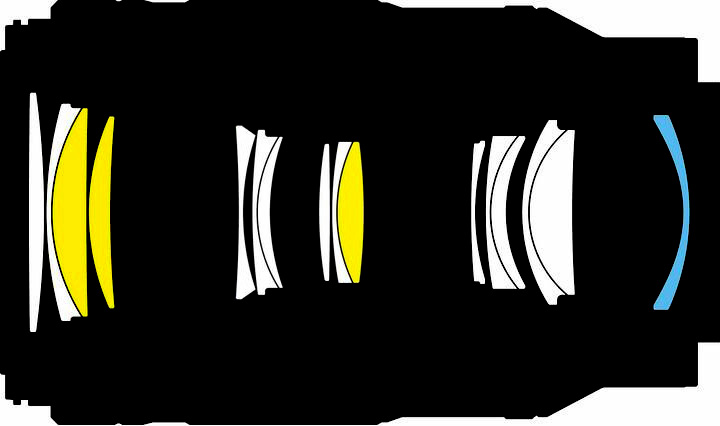
The optical scheme is a complete redesign, compared to the AF‑S 105 mm. It uses 16 elements in 10 groups. In the above figure, yellow indicates three ED glass elements, and blue an aspherical element. The above figure shows the lens focused at infinity and 1x. The lens aperture is located roughly in the middle between the two moving groups, and apparently does not move when focusing, but slightly reduces in diameter with increasing magnification. The optical scheme of the Z 105 mm is similar to the AF‑S 105 mm in having two subassemblies that move toward each other when the lens focuses closer (but many details differ). According to photonstophotos.net, the effective focal length of the Z 105 mm at infinity focus is 102 mm, at 0.5x 70.46 mm, and at 1x only 49.28 mm. As a comparison, the focal length of the AF‑S 105 mm at 1x is 75.86 mm. The working distance of the Z 105 mm is 138.19 mm at 1x, with a 0.23 pupil magnification factor. The working distance of the AF-S 105 mm G is 146 mm. In spite of the substantial difference in effective focal length at 1x, the working distance of the two lenses at 1x only differs by about 8 mm. The diameter of the Z 105 mm lens barrel at the front of the lens is 74.4 mm, not counting the mount for the lens shade. This is quite a bit more than the 62 mm filter thread. The front of the lens barrel of the AF-S 105 mm G is roughly 65 mm, or approximately the same diameter of a 62 mm filter. The slightly lower front diameter of the AF-S lens, together with its slightly higher working distance, makes the AF-S lens, at least in theory, slightly less likely to restrict the illumination of the subject. In practical terms, however, the difference is quite small. The effective lens speed of the Z 105 mm at 1x is f/4.6 (NA 0.11 at nominal f/2.8). It should be f/5.6 in an ideal thin lens, so the optics are clearly designed to make the effective lens speed at 1x faster by about 2/3 of a stop, compared to an ideal lens, and to reduce the blurring effect of diffraction accordingly. The optical design of the lens, at the same time, moves the front nodal point closer to the front of the lens at 1x, compared to the AF-S 105 mm, and largely compensates in this way for the substantial decrease in effective focal length of the Z 105 mm at 1x. The trade‑off of this optical design is a much lower focus distance, compared to an ideal thin lens that keeps a constant 105 mm focal length at all magnifications (and a theoretical working distance of 210 mm at 1x). However, this f/2.8 ideal lens has an effective f/5.6 speed at 1x, while the Z 105 mm, as mentioned above, is an effective f/4.6 lens at 1x. Much as the optical design of the Z 105 mm looks highly sophisticated from the basic lens data, only a test of the actual image resolution of this lens at 1x and f/4.5 can tell whether this show of prowess by the Nikon lens designers actually pays off in practice. I discuss this question in the Image quality at 1x section of this page. The entrance pupil moves from a position roughly 18 mm at the rear of the diaphragm at infinity focus to close to the rearmost element at 1x. The rearmost optical element is too close to the lens mount to allow the use of a teleconverter. AF performanceThe AF speed and precision of the Z 105 mm are very likely the best I ever experienced with a macro lens capable of focus between infinity and 1x. Compared to this, the AF‑S 105 mm on FTZ lens adapter and Z8 is unbearably slow, continuously misses the focus point and racks back and forth between the ends of its whole focus range, even when used as a medium tele lens with distant subjects, and in my experience is close to unusable in AF mode. To put it simply, the AF‑S 105 mm is not a lens I would consider using as a medium telephoto or close‑up lens in AF mode. The hardware focus limiter switch on the Z 105 mm only makes AF faster by less than a second. Z cameras have a focus limiter configurable in firmware. The remarkably good AF behavior of the Z 105 mm is not limited to the Z 105 mm on top‑of‑the‑line cameras like the Z8. It is pretty much the same also on my Z50 II. This lens uses a stepper motor for focusing, probably because the internal focusing subassemblies need to move by substantial distances. In recent lenses, stepper motors are also commonly used, for the same reason, in extreme telephoto lenses, both zoom and primes. A stepper motor is not as silent as a linear servo motor, but the Z 105 mm is not particularly noisy, compared to other lenses using stepper focus motors. Weather sealingThis lens is fully weather‑sealed. For what it is worth, I have seen a second‑hand specimen of this lens with a visible humidity condensation on its internal optical surfaces. The presence of a weather sealing does not mean that the lens is invulnerable to exposure to high humidity and water. Exposure to high humidity followed by a significantly lower temperature, for example (e.g. moving the lens from hot and humid outdoors to a cool air‑conditioned room), does cause humid air to enter the lens barrel and to make its way to the optical surfaces. Once it condenses there, it is very difficult to eliminate without disassembling the lens. Place of manufactureMy specimen of the lens was made in Thailand. Image qualityImage quality with distant subjects

Used as a hand‑held medium tele on the Z8, the Z 105 mm is very sharp already fully open (above figures). The blue arrow in Figure 8 points to an area on top of the plastic chair where a few scattered sand grains are individually visible (from a distance of over 20 m). Each sand grain is about 1 pixel wide. Image quality at 1xFor this test, I imaged a positive Thorlabs NBS 1963A resolution target with the Z 105 mm at the maximum magnification the lens is capable of (nominally 1x). The following figure shows the effective aperture as reported in the JPG EXIF. In this test, like every other lens test of this site, I am not really concerned with measuring the resolution of a given lens in optical terms. Instead. my goal is measuring how the lens behaves when mounted on one of my cameras, i.e., I test the result produced by the whole imaging system, starting with the lens and ending with a JPG Fine quality image, because this image is the only thing that really matters to me. Figures 10-11 show the approximate center of the frame (the frame was actually centered on the smallest lp/mm line set of this NBS 1963A target, i.e. 220 lp/mm). In Figure 10, all images are 1:1 pixel crops magnified at 200% of their actual size (a 1:1 pixel crop would be too rich in very fine detail to be visually observable on a normal PC screen). The original data, not magnified, is shown in Figure 11. Note that there are several different methods of magnifying an image in software, and that no such thing as "the absolute best" method exists. Some methods neither add not subtract any image information, but result in a "blocky" magnified image. Other methods interpolate in various ways among the surrounding "real data" of pixels when inserting new rows and columns of pixels in the image, and produce visually more agreeable images, at the price of inserting information that was not originally there. Since manual focusing cannot be guaranteed to yield perfect focus, especially with a focus-by-wire lens, for each lens aperture I performed an automated focus-bracketing sequence with a microcontroller-driven motorized linear rail at intervals of 20 μm between shots, under LED transmitted-diffused illumination, then chose the visually sharpest image in each sequence. Although the number of resolved lines per mm is generally measured with a resolution target with vertical or horizontal line sets, at the Nyquist resolution limit the thickness of the target lines projected onto the sensor is of the same order of magnitude as the sensel size. At this scale, in the best case, target lines precisely overlap columns or rows of pixels, and can be resolved in the recorded image. In the worst case, target lines exactly overlap the border between adjacent columns or rows of pixels, and the lines of the resolution target become completely invisible in the recorded image. Any degree of intermediate overlap is also possible, producing a continuous gradation between resolved and non-resolved lines. As a compromise between the best and worse case, instead of vertical and horizontal line sets I prefer to use slightly oblique line sets (as in the following figure). This makes line pairs more likely to be resolved (albeit, typically at a lower contrast than at the best overlap case). Additionally, this often results in oblique moiré patterns when the line spacing approaches or slightly exceeds the Nyquist limit. The amount of obliquity of the line sets is not especially critical, but in addition to vertical and horizontal line sets one should also avoid line sets inclined at 45°, which are a special case and result in a different Nyquist limit (equal to the Nyquist limit for vertical and horizontal lines, times the square root of 2). 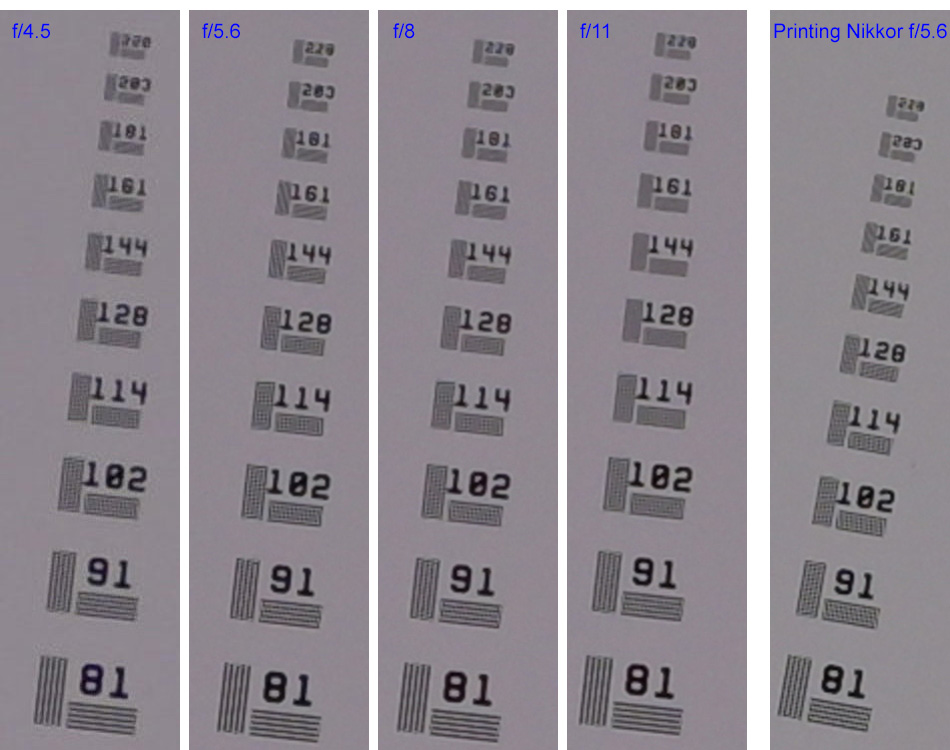
1:1 pixel crops magnified to 200%. 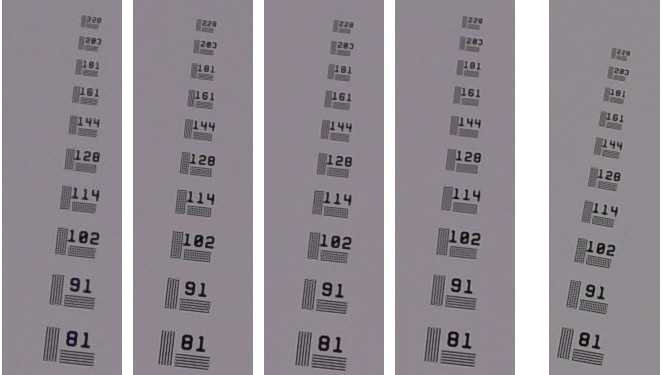
For comparison, I took a test shot in similar conditions with a Printing Nikkor 105 mm f/2.8 A, which is my sharpest lens at 1x (rightmost in the above figures). One can notice that the Z 105 mm provides a slightly higher magnification, so it apparently slightly exceeds the 1x magnification. The Printing Nikkor 105 mm also produced a more neutral image. I tested the Printing Nikkor 105 mm at 1x and effective f/5.6 (nominal f/2.8). The test images from the Z 105 mm show a slightly higher resolution at effective f/5.6, compared to fully open at f/4.5. The difference, however, is very small. At higher apertures, diffraction is visibly higher. The 91 lp/mm line set is resolved in all these test images. The 102 lp/mm set (and up to 128 lp/mm at f/5.6) displays aliasing artifacts created by the digital anti-aliasing and de-Bayering algorithm of the Z8, which means that the camera detected the presence of a pattern in the sensel data, but was unable to decide the orientation of the target lines. Typically, this happens with oblique line sets approximately at the Nyquist limit of the sensor (see below). Between 144 and 200 lp/mm at f/5.6, a moiré pattern replaces the anti-aliasing artifact. This means that the lens is still resolving some detail, but the anti-aliasing algorithm is no longer trying to artificially enhance the resolution. At f/4.5 and f/5.6, the moiré patterns are visible at up to 200 lp/mm, and the aliasing artifacts up to 128 lp/mm. At f/8, the moiré patterns are slightly visible at 102 lp/mm, and definitely visible at 161 lp/mm. At f/11, a final hint of the artifacts is visible at 128 lp/mm, and nothing at 144 and higher lp/mm.
In the construction of the test system using the NBS 1963A test target used for these tests, I made sure
to introduce a sufficient amount of illumination diffusion to provide an illumination NA substantially
higher than the NA of the optical systems being tested, in order to avoid illumination introducing
artifacts that could affect the test results. An insufficiently diffuse illumination can result in
underestimating the level of detail recorded by the system being tested, thus invalidating the results.
The Z 105 mm at f/5.6 and the Printing Nikkor 105 mm at f/5.6 are producing fairly identical results. The rendering of the 91 and 102 lp/mm groups appears slightly different in the two images, because the obliquity of the test pattern was different, but this difference largely disappears in groups at higher lp/mm count. In conclusion, both lenses perform very similarly, in terms of image resolution, on a Z8 camera. Possibly, the Printing Nikkor 105 mm may have a slight edge, since it produces these results at a slightly lower magnification than the Z 105 mm. I did not test the Z8 in pixel-shift mode, which might or might not show further differences between the two lenses.
Nikon's efforts to reduce the effective aperture of the Z 105 mm from the theoretical f/5.6 at 1x to an
actual f/4.5 by tweaking the optical design of the lens (in particular, by substantially shortening its
focal length at 1x) do not quite pay off in terms of providing a better image resolution fully open, at
least on a Z8 camera. A similar optical improvement, on the other hand, also carries on to effective
f/5.6, so I am not saying that the show of optical prowess by the Nikon lens designers was an entirely
useless exercise. Nyquist limit of Z8 sensor
Given that the active sensor area of the Z8 is 35.5 by 23.9 mm and this area records images of 8,256 by
5,184 pixels, the pixel size in μm is
Sometimes, resolution is specified in lines, rather than the more correct line pairs. In this case, the
Nyquist limit for single lines is Alternatives to the Z 105 mmI discussed this subject in the context of the AF‑S 105 mm. This lens is a realistic alternative to the Z 105 mm, but a few Z‑specific settings are not available with the AF‑S lens, and AF with the AF-S lens is slow and hit‑or‑miss. However, the AF‑S lens is the safest alternative I would recommend if you require in‑camera focus bracketing and can live with the limitations of this lens. A number of autofocus third‑party macro lenses in Z or F mounts are available, and may or may not work in focus bracketing. If autofocus and focus bracketing are not required, an almost endless variety of good legacy macro lenses is available on the second-hand market, and virtually all of these can be used with lens adapters on Z cameras. Among Nikon F macro lenses, which Nikon calls Micro Nikkors, AF-S series lenses are not particularly good, and AF series lenses are significantly better. Although these AF lenses cannot autofocus on an FTZ of FTZ II adapter with Z cameras, all other functions of these lenses are available. This series includes a few interesting lenses, among them the AF Micro Nikkor 200 mm f/4 (if you can get a good, non-decentered specimen), 105 mm f/2.8, and 70-180 mm f/4.5-5.6 D ED (if a 0.75x maximum magnification is sufficient, and/or its zoom capability is desirable, this lens is often optically better than specimens of the 200 mm f/4). ConclusionsThe Nikon Z MC 105mm f/2.8 VR S, introduced in 2021, is physically large but relatively lightweight, optically very good, and among the best autofocus macro lenses to use on a Nikon Z camera, especially for focus bracketing. A test of the Nikon Z MC 105mm f/2.8 VR S versus the Printing Nikkor 105 mm f/2.8 A, both at effective f/5.6, with a Thorlabs NBS 1963A trans-illuminated test target reaching 220 lp/mm, shows virtually identical results. With both lenses, the factors limiting image resolution are the 45.7 Mpixel camera sensor and its de-Bayering and anti-aliasing algorithms, not the lens optics. At effective f/4.5 and 1x, the performance of the Z 105 mm is very slightly worse than at f/5.6, which is the best aperture for this lens at 1x. The effective focal length of the Z 105 mm reduces to 49 mm at 1x, compared to the 75.86 mm of the legacy AF-S 105 mm f/2.8. This results in an effective lens speed of the Z 105 mm of f/4.6 at 1x, compared to f/5.6 for an ideal thin lens, i.e. about 2/3 of a stop faster. This, in theory, slightly lowers the amount of diffraction blurring (albeit, the best aperture for the Z 105 mm at 1x is not f/4.5 but f/5.6). In spite of the much shorter focal length at 1x, the working distance of the Z 105 mm is only slightly shorter than the AF-S 105 mm (approximately 138 mm versus 146 mm, respectively). The highest image resolution at 1x is obtained at effective f/5.6. At this magnification, effective f/4.5 and f/8 produce essentially the same image resolution (but a higher DOF at f/8). Unlike the AF‑S 105 mm, this lens does not accept teleconverters. AF with this lens is orders of magnitude faster and more reliable than with the AF‑S 105 mm f/2.8 on an FTZ/FTZ II adapter. The lens shade supplied with this lens is far too large and deep to use in the macro range. I replaced it with a 62 to 52 mm step‑down ring and a shorter third-party lens shade, which happens to accept a 58 mm lens cap at its front end and causes no vignetting. This lens is weather sealed. However, it is not immune to condensation forming on internal optical surfaces if repeatedly exposed to high humidity and large temperature changes. This is a focus‑by‑wire lens. The focusing speed changes dynamically with the turning speed of the focus ring. Therefore, it cannot have a physical focus distance scale printed on its barrel, but it does have an equivalent scale on its LCD display. Focusing is internal. |