Nikkor Z 600mm f/6.3 PF VR SThis page discusses the Nikkor Z 600mm f/6.3 PF VR S, introduced in 2023 and still marketed. This is a long telephoto lens with a price tag roughly intermediate between the relatively affordable Nikkor Z 180‑600 mm f/5.6‑6.3 and lenses priced to be accessible only by true professional wildlife photographers, like the Nikkor Z 600 mm f/4 TC VR S. This lens has been around for over a decade, and there is no dearth of online reviews. Among the more technical ones, I suggest LensTips and PhotographyLife. This lens is not so common on the second‑hand market, and finding a lightly used specimen in prime condition and at a reasonable price on eBay or Amazon may be a challenge. Prices of second‑hand specimens of this lens are sometimes so close to the price of a new specimen that their purchase offers questionable savings in return for no original Nikon warranty. It took me a couple of months of wait before I was able to purchase a second‑hand specimen in excellent condition from the European MPB. I actually missed the first specimen that became available, which apparently sold within minutes, but the second time, about one week later, I was ready for it and it also was cheaper. It may be easier, and almost certainly much cheaper, to find one of these lenses at the US branch of MPB. However, if you have it shipped from the US to the EU, it is likely to become more expensive than an EU specimen after shipment fees and taxes, and I don't know whether the US MPB warranty covers it outside the US. Features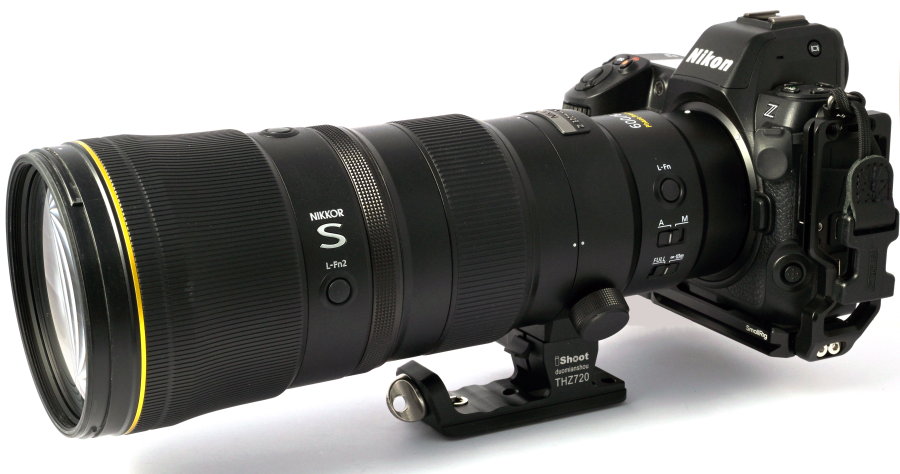
This 600 mm is extremely lightweight (1.47 Kg including the original tripod foot) and physically short (278 mm) for a refractive lens of this focal length. This is due to the use of one phase Fresnel element, as well as by largely replacing metal with advanced plastics in the barrel construction. See my discussion of a Fresnel phase element used in the AF-S 300 mm f/4E PF. The lens length and diameter are two metrics directly relevant to storage in a camera backpack. The lens barrel maximum diameter is 107 mm. The lens shade increases this diameter to 130 mm. Yet another storage-related metric is the total length with the lens shade mounted in forward orientation, and including the rear lens cap (369 mm). This is the minimum length of a backpack compartment if you want/need to store the lens with the lens shade in ready-to-use orientation. Mounted on a bulky camera like the Z8, and with an added TC-2.0x teleconverter, total length of the needed storage compartment becomes 453 mm, which means that only a quite large backpack can store the lens and teleconverter attached to the camera and ready to use just by extracting, removing the front lens cap, and switching on the camera. Incidentally, the length of this lens with TC-1.4x or TC-2.0x teleconverter is not very different from the length of a 180-600 mm zoom without teleconverter, and the 600 mm plus either teleconverter is still significantly lighter. People not familiar with Nikon lenses usually guess that this is a 300 or 400 mm lens, and do a double-take when told it is a 600 mm. The front filter mount is 95 mm and the maximum barrel diameter 107 mm (not including lens shade, and tripod collar knob and shoe). The tripod shoe can be separated from the lens collar by loosening a knob on the right side of the collar and pressing down a lever on the shoe. Third‑party replacement shoes ending in an Arca‑compatible plate are available (Figure 1). Other than this, the tripod collar cannot be removed from the lens. To allow rotation of the lens within the tripod collar, unlock the knob on the left side of the collar. There are white marks (but no detents) for aligning the collar with precision at 90° intervals on the lens barrel. Removing the tripod shoe exposes a small flat surface with a 1/4‑20" threaded hole in a steel insert. In a pinch, if you are in the field and left the tripod shoe at home, this hole can be used for attaching the lens to a tripod head. When I plan to shoot hand-held, I leave the tripod shoe at home and attach a neck strap to this threaded socket. It is important not to let the camera mount bear the weight of the lens, but the lens can comfortably carry the weight of the camera without risks. This lens has no strap mounts on its lens collar, nor on its tripod shoe. The third-party tripod shoe shown above has none, either, but a 1/4‑20" bolt with a suitable hole can be mounted in one of the threaded sockets of the shoe, facing e.g. upward, backward or forward. I regularly use the 600 mm PF hand‑held, without its tripod shoe, and attach to its 1/4"‑20 threaded socket a steel 1/4"‑20 bolt with an eyelet, and an Op‑Tech neck strap attached through the eyelet. Comparison with the Nikkor Z 180‑600 mmUnlike the Nikkor Z 180‑600 mm zoom, the 600 mm prime is an S lens, a denomination used for Nikkor Z best lenses. Cosmetically, this is visible from the golden ring near the front of the lens barrel and the lens model and base specifications displayed on a tag in relief attached on the lens collar. Aside for obvious differences in the optics of these two lenses, the 180‑600 mm and the 600 mm PF do share several evident external similarities, but also differences in the arrangement and type of their lens controls. For example, the 180‑600 does not have a dedicated focus ring, although its control ring can be used for this function. The large zoom ring takes the place of honor on the lens barrel. On the 600 mm PF, this place is taken by the equally large focus ring. In practical use, the 180‑600 mm zoom is obviously more versatile. On the other hand, the significantly better optical quality of the 600 mm prime allows the frequent use of a 1.4x teleconverter, yielding an 820 mm f/9 with only a slight loss of image quality. The same cannot be said of the zoom, which already begins to show its limitations at 500‑600 mm even without a teleconverter. According to Steve Perry, the focusing time of 600 mm PF versus 180‑600 zoom is 0.417 s versus 0.8 s. Thus, the 600 mm PF will re‑establish focus in roughly half the time of the 180‑600. This does make a significant difference e.g. with small active birds. Optics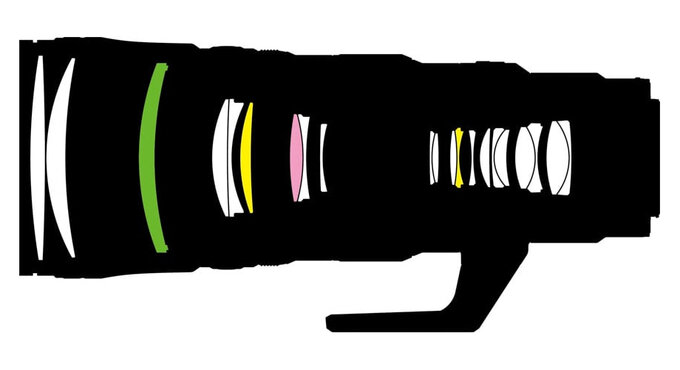
The above figure shows the optical scheme of the 600 mm. This lens uses 21 elements in 14 groups, of which one PF element (green), two ED (yellow) and one SR element (pink). SR (short‑wavelength refractive) elements are made from a type of glass with a higher than normal refraction of short wavelengths of light (blue and violet). This allows lens designers to specifically correct the type of chromatic aberration responsible for blue and violet haloes. The filter mount is 77 mm. There is no provision for internal or rear‑mounted filters. This lens accepts the Nikkor Z TC‑1.4x and TC‑2.0x teleconverters. See my tests with either teleconverter near the bottom of this review. According to photographylife.com, the 600 mm af f/6.3 without teleconverters provides a center resolution of "3,303", and in the corner "2,454". Resolution decreases at narrower apertures. With the TC‑1.4x, at nominal f/6.3 (effective 840 mm and f/9), center and corner resolution become "2,443" and "2,224", respectively. Also in this case, the best resolution is obtained at nominal f/6.3.
It is not immediately clear to me what these figures actually mean, because a number of line pairs
makes sense only if referred to an absolute measurement (e.g., line pairs per mm, or cm, or inches, or
across the sensor width, or across the sensor height). The review at photographylife.com mentions no
measurement units.
FocusingFocusing is internal. The minimum focus distance is 4 m, with a maximum reproduction ratio of 0.15x. The focus ring is large and rubber‑coated. Manual focus is by wire and the focusing speed changes dynamically. Turning the focus ring slowly causes focus to change very slowly, which allows precision focusing. When AF is engaged, holding the shutter button half‑pressed and turning the focus ring allows overriding the present focus chosen by AF. To re‑engage AF, release the shutter button and half‑press it again. The AF speed of a long telephoto lens is a critical performance parameter. It is difficult to properly compare AF speed among different lenses, because their minimum focus distance can differ substantially, and therefore comparing the time it takes for autofocus to rack all the way between its two ends is like comparing apples and oranges. This is the case, for example, of the 600 mm PF versus the 180‑600 f/5.6‑6.3 zoom (4 m versus 2.4 m at 600 mm, respectively). However, AF speed is not only important in the context of how fast the lens acquires focus, but also when AF does not achieve focus, and starts hunting. In this case, the lens will rack focus between its two end stops, which is the time measured by the metric we are discussing. According to Steve Perry, the focusing time of 600 mm PF versus 180‑600 zoom is 0.417 s versus 0.8 s. Thus, assuming that both lenses will rack focus only once, the 600 mm PF will re‑establish focus in roughly half the time of the 180‑600. This does make a significant difference, e.g. with small active birds. My qualitative impression is that, on the Z8, AF in the 600 mm is more reliable and much less likely to hunt than in the 180-600 mm. The same is true on the Z50 II albeit, as a whole, this camera is naturally slower to autofocus than the Z8. Lens controlsAside for the focus ring and the configurable control ring, this lens is equipped with several round buttons and sliders. Focus modes slider
Focus limit slider
Memory set buttonPress and hold briefly to store the current focus position. The position remains stored if the camera is switched off, but is deleted when the lens is detached from the camera. The current stored value is overwritten the next time a value is stored. This setting is only meant to be temporary, and the stored distance to be used during the same photography session. To refocus the lens at the stored distance, you must have configured a camera control via Custom Controls > Recall focus position or Custom Controls (shooting) > Recall focus position. To shoot at the stored focus distance, keep the custom control pressed and click the shutter button. Naturally, you should choose a custom control that can be easily pressed together with the shutter button, for example the Fn‑2 buttons on the lens (see below). Fn‑1 buttonThis button can be configured. Fn‑2 buttonsFour of these buttons are placed around the lens barrel, forward of the custom ring. The same configured function applies to all four buttons. They cannot be individually configured. VRThis lens has no physical control to enable or disable VR. This function can be controlled via the camera menu or control panel, or a suitable custom control can be configured. Scope of custom controls configurationThe custom controls located on this lens have their configuration stored in the lens. A different lens can have its custom controls configured in a different way. Weather sealingThis lens is fully weather sealed. It is still likely to be damaged by blown dust, sand, a water jet under pressure, or immersion in a liquid. TestI carried out the following test with the same subject I used in recent tests of other Nikon telephoto lenses. The test subject is a pavement of concrete garden bricks, shot hand‑held (but with the wrist of the left hand resting on a window sill), with VR active, from four floors higher up (12.4 m). I shot all test images at ISO 200 in sunny weather. The following figures show 1:1 pixel crops from the same region of the image, about 1/4 of the way from center of the frame, at one full‑stop intervals. 


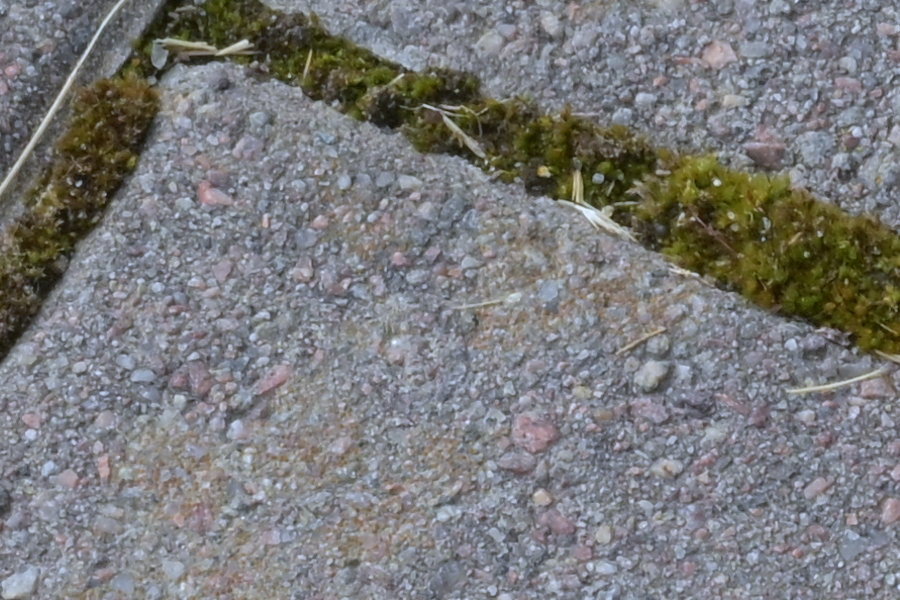

Lens resolution at f/6.3 is just barely recognizably worse than at f/8. The difference is minimal, and at least in part is due to the lower depth of field at f/6.3. This is especially noticeable on the sand grains spread on top of the moss, which are a few mm closer to the camera than the surface of the pavement bricks. Performance remains essentially identical at f/8 and f/11. A very slight fuzziness appears at f/16, and a more visible fuzziness at f/22. However, the latter is only noticeable when pixel‑peeping. The picture at f/16, observed as a whole, appears sharp and would be usable for virtually all real‑world purposes. I have used a good many lenses that never get this sharp, at any aperture. Test with teleconvertersI repeated the test after mounting the TC‑1.4x teleconverter between camera and lens. A re‑adjustment of my hand position caused a slightly different framing from the first picture of this series to the following ones, and by the time I detected this on my PC, the sun had already set on this pavement. 



The depth of field at effective f/9 and f/11 is so limited that the rightmost portion of the twig near the top of the test images is slightly out of focus. Disregard this twig and concentrate on the concrete brick. Nikon cameras report the effective aperture when using a teleconverter, and I follow this convention. There is a slight fuzziness at f/9, that disappears at f/11 (this corresponds to nominal f/6.3 to f/8). A slight fuzziness returns at f/16 and remains essentially the same at f/22. As a whole, as long as there is enough light for an exposure at effective f/9 to f/22 and the subject does not move significantly during the exposure, all these aperture give fully acceptable results. These results are very different from those I obtained with the 180‑600 mm zoom. Seeing these results, together with the fact that the 600 mm PF is significantly shorter and lighter than the 180‑600, was enough to convince me that, of these two lenses, the 600 mm PF is the one I need to keep. 
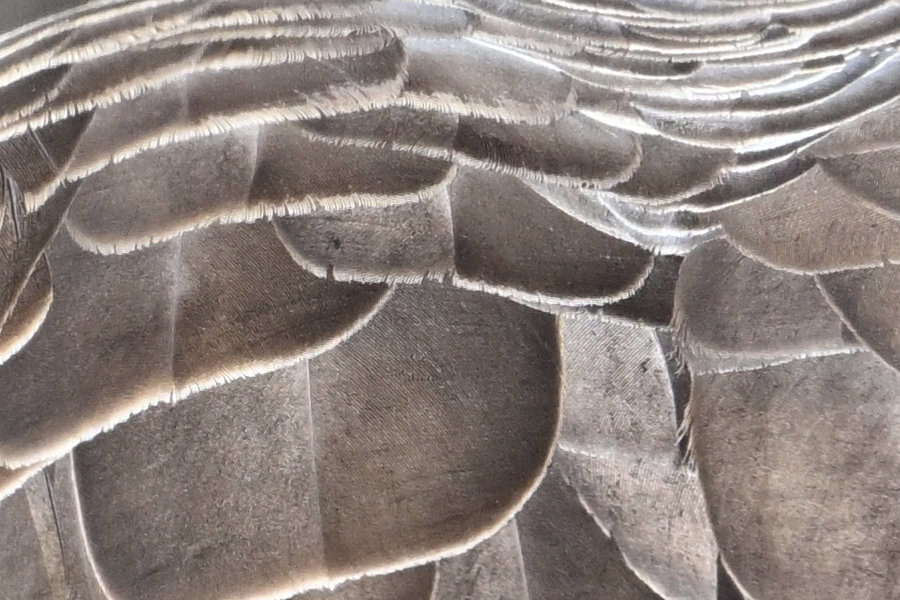
Above, a real‑life example of the 600 mm PF with TC‑1.4x at effective f/9 (i.e. fully open), Auto ISO 1,000 and 1/1,000 s, mostly sunny with scattered clouds, can be seen in the above two figures. Autofocus was set at the center of the image frame. Individual feather barbules are visible in the 1:1 pixel crop, close to the limit of the resolution of the 45.7 Mpixel camera sensor. There may be reasons why one may choose not to use a 1.4x teleconverter with this lens and camera, but a loss of image resolution cannot be claimed as one of these reasons. The following figures show the results with the TC-2.0x teleconverter, which yields an effective focal length of 1,200 mm. Shot hand-held without problems, but of necessity with auto-ISO because the f/13 effective lens speed does not allow low ISO and a long exposure time. The urban background of the test picture is of course questionable, but I had no choice. Just take it as an example of the bokeh of this lens. The poor background is offset by the candid moment (if we can call it this way). Also, the subject was located on a harbor signal pole across deep water, so I had no practical way to get any closer. The image is a fine-quality JPG straight out of camera (JPG quality was reduced from 100% to 85% for web publication). The original image could be significantly improved with judicious post-processing, in particular by adjusting contrast and selectively reducing the high-ISO noise in out-of-focus areas. 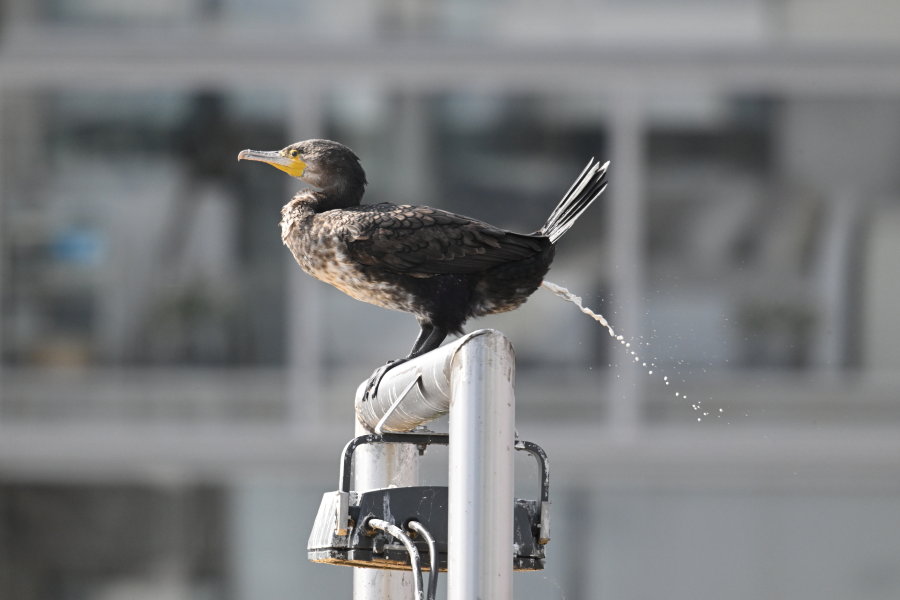
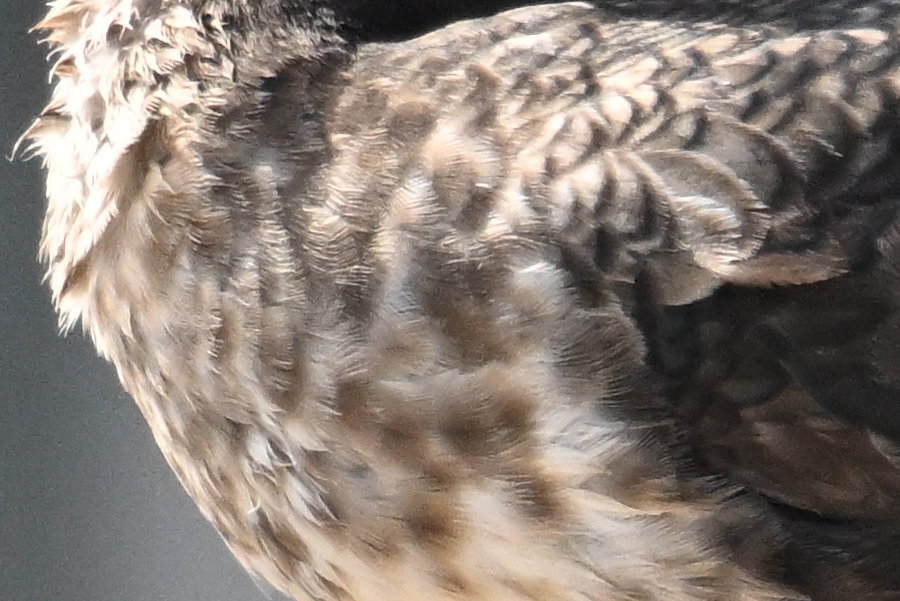

The results are remarkably detailed for a 2x teleconverter and a hand-held effective 1,200 mm lens fully open. This test image is of course not as sharp as the preceding ones, in part because of the 2x teleconverter, and in (probably larger) part because auto-ISO chose an ISO 2,800, but this cannot be helped. There are no visible chromatic aberration and no color haloes. Contrast is perhaps a little low, and may have something to do with the PF element, in addition to the relatively high ISO. Now I know that, in real-world hand-held shooting conditions, I need not fear using the TC-2.0x in reasonably good light, at least not with this lens. 
At a significantly lower ISO, the background is much less noisy. Compared with these results, the lower native resolution of the 180-600 zoom and its slower and less reliable AF and in-lens VR (unlike the 600 mm PF, this lens lacks Synchro-VR), together with the TC-1.4x, produce only borderline acceptable images (to me, at any rate). I did not have a TC-2.0x to test at the time I owned the 180-600 mm, but I doubt I would have liked the results with the latter lens. Alternatives to the 600 mm PFThe 600 mm PF has no obvious close alternatives among legacy F-mount lenses, at least not if a 500 mm focal length is too short for your use (it is for mine). All recent Nikon AF‑S 600 mm lenses in F mount are bigger and heavier, and second‑hand specimens on eBay often cost almost as much as a new Z 600 mm PF. With legacy lenses eliminated from this discussion, only three contestants remain. All of them are Nikon Z lenses, and to make the discussion more readable I summarize their main data in the following table. This table also shows the Z 100‑400 mm S, mentioned in the following discussion.
The Nikon Z 600 mm f/4 TC is far too expensive for most non‑professional photographers, including myself, so I cannot regard it as a realistic alternative. This lens is also far too large and heavy for me to consider carrying it around. This lens is not especially heavy when compared to legacy Nikon F lenses, but its faster speed by one and a half stop comes at the price of twice the weight of the 600 mm PF (see the above table). The Nikon Z 180‑600 mm can be an alternative. This lens is not in the same price class as the 600 mm PF (the 600 mm PF costs almost three times the 180‑600). The 180‑600 is not an S lens, and therefore, it is not in the same performance class of the 600 mm PF, either. However, it is reasonably sharp in the 180‑450 mm range, and this makes it more versatile than a prime lens. The 180‑600 mm weighs significantly more than the 600 mm PF, and is a bit longer than the latter. The 180‑600 mm, even without teleconverters, at 600 mm is quite a bit less sharp than the 600 mm PF. The 180‑600 mm loses a significant amount of image quality with the TC‑1.4x teleconverter, and is at or past the limit of usability with the TC‑2.0x. The 600 mm PF, on the other hand, loses almost no image quality with the TC‑1.4x. According to multiple reviews, it loses a little more with the TC‑2.0x, but remains acceptable for many use cases. A bigger problem is that the autofocus of both lenses often struggles with the TC‑2.0x in non‑optimal lighting, even on a Z8. For extensive work in dim light, the 600 mm f/4 TC is significantly better. Its built‑in teleconverter is a 1.4x, optically different from the TC‑1.4x, and specifically designed to work with this lens. A further limitation of the 180-600 mm is that its VR does not work in Synchro VR mode (i.e., by combining in-lens and in-body VR along different axes). With this lens, only in-lens VR is active (or disabled), and in-camera VR is permanently disabled regardless of the VR camera setting. The 180‑600 mm focuses much closer than the 600 mm PF. The latter only achieves a width of the field of view of about 26 cm on FX, a little too wide for filling the frame with a really small bird without cropping in post‑processing. This is one of the factors that may make you choose the 180‑600 mm over the 600 mm PF in spite of its lower image quality. On the other hand, the higher image quality of the 600 mm PF means that you can use this lens on a high‑megapixel‑count camera and crop significantly more in post‑production. Also, if you need a close-focus telephoto zoom, you may be better served by the 100-400 mm S (with TC-1.4x if necessary). The 180‑600 mm is significantly heavier than the 600 mm PF. The former can be made a little lighter and "leaner" by removing its tripod collar. In the 600 mm PF, only the tripod shoe can be removed, and doing this exposes a relatively sharp‑edged proprietary shoe attachment, so you should also rotate the collar away from your left hand. The difference of over half a kg between the two lenses can be felt while carrying a small backpack, but on the other hand, packing an additional zoom like the Z 100‑400 mm far exceeds the difference in weight between the 180‑600 mm and the 600 mm PF. As for myself, I started out with the 180‑600 mm for my Z8, but after almost a year I switched to the 600 mm PF. This was the result of circumstances and different (and changing) availability and pricing of either lens, rather than the result of carefully planning from the start. As I mentioned at the top of this page, it took time for me to find a reasonably‑priced second‑hand specimen of the 600 mm PF. Additionally, it took me a few months with the 180‑600 mm to really understand its capabilities and limitations, as well as those of the Z8. Many web reviews of this lens turned out to be a bit too "optimistic" about the 180‑600 mm, compared to my own findings. Of course, a lens kit with a massive gap of focal lengths between my workhorse 24‑120 mm f/4 S and the 600 mm PF cannot be expected to suit all shooting situations. Therefore, I flanked these two lenses with a 100‑400 mm S zoom, and financed this lens by trading in my 180‑600 mm and my last Micro 4/3 equipment for a like‑new second‑hand 100‑400 mm. The combined weight of the two lenses is 0.6 kg more than the 180-600 mm, and the two-lens kit requires a significantly bigger backpack, but the image quality and performance (especially of the 600 mm PF) is worlds apart. Multiple factors will be involved in your choice. For example, the 180‑600 mm is optically good between 180 and 400 mm, but not quite convincing at 600 mm on a 45.7 Mpixel sensor, so it is not a replacement for the 600 mm PF, especially if you use a Z9, Z8 or Z7 II. However, if you shoot mostly at 400 mm or lower focal lengths, and only occasionally at 500‑600 mm, the 180‑600 mm might be quite sufficient. This lens probably gives subjectively better, or at least more tolerable, results at 600 mm on a 20 to 24 Mpixel camera. The 100‑400 mm is a little faster, smaller and lighter than the 180‑600 mm, and since it is an S lens and the 180‑600 mm is not, the 100‑400 mm can be expected to be optically better than the 180‑600 at all their shared focal lengths. The 100‑400 mm is known to perform better than the 180‑600 mm when paired with TC‑1.4x teleconverter, which yields a 560 mm f/8. Naturally, the 100‑400 mm is also more expensive than the 180‑600 mm. Although the 100‑400 mm is much shorter in focal length than the 600 mm, in good light the former performs well with a TC‑1.4x, and almost as well with the TC-2.0x. I may easily decide to take with me the 100-400 mm and teleconverters on a sunny day when I wish to go light and not to take along also the 600 mm PF. ConclusionsThe Nikkor Z 600 mm f/6.3 PF is a substantial improvement on the Z 180‑600 mm F/5.6‑6.3 used at 600 mm. The Z 600 mm PF is noticeably better in virtually all respects, from image quality, AF speed and in‑lens VR effectiveness to its lower physical length and weight (but of course, not in price). The Nikkor Z 600 mm f/6.3 PF loses almost no image quality when used with the Nikon Z TC‑1.4x teleconverter. Naturally, it does lose one stop of effective lens speed. The 180‑600 mm, instead, without teleconverter shows a marginal performance at 500-600 mm, and in my opinion is plainly unsatisfactory with the TC-1.4x teleconverter. With the TC-2.0x teleconverter on the 600 mm PF, image resolution, AF performance and subject recognition are still remarkably good, but the images are noisier because of the higher auto-ISO. |