Nikon Z DX 12-28 mm f/3.5-5.6 PZNikon Z DX cameras and lenses have remained amateur‑oriented equipment until the release of the Nikon Z50 II, which is the first DX camera in the Z system potentially interesting for professionals and advanced amateurs. The choice of extreme wideangles among these Nikkor Z lenses is very limited. DX extreme telephoto lenses are also missing from the Z system, but one can use their FX counterparts and, because of the smaller DX sensor, get the equivalent of a 1.5x teleconverter "for free" and without losses of effective lens speed. The only Z DX extreme wideangle zoom is the 12‑28 mm f/3.5‑5.6 PZ, introduced in 2023. At the time of writing (May 2026) it is still the widest Z DX wideangle. 12 mm on DX is equivalent in field of view to 18 mm on FX, so Nikon did not yet introduce anything equivalent to e.g. 14 mm on FX (two such lenses are already available in the Z FX system). The 12‑28 mm is an affordable, physically rather small (63 mm long, 71.5 mm maximum diameter, 67 mm filter mount) and very lightweight lens (200 g). Purists may be turned off by the fact that this lens is equipped with a plastic lens bayonet. I am aware that this type of bayonet cannot be as sturdy as a metal one, but I did use a legacy Nikon F DX zoom with plastic bayonet just after the turn of the century, and it did survive a few years of use (I eventually sold it on eBay). The Z 12‑28 mm is much shorter than this earlier zoom, less likely to exert a strong leverage on its lens mount, and with reasonable care should survive years of use. No metal parts are in sight on the exterior of this lens. For the moment, this is my only Nikkor Z DX lens. I already own several Nikkor Z FX lenses and legacy AF‑S Nikkor lenses in F mount that I can use on my Z50 II DX camera. I use this camera as a complement to my Z8, which remains my main Nikon Z camera. The Z 12‑28 mm in practiceI purchased a second-hand copy of this lens from MPB to use it with my Z50 II, and the following discussion and tests reflect this. This lens also works when mounted on Nikon Z FX cameras, by forcing them to switch to DX mode. In practice, with this lens my Z8 turns into a remarkably heavy, fast and expensive Z50 II, the main difference being that the Z8 in DX mode is 19 Mpixel, while the Z50 II is 20.9 Mpixel. The Z 12‑28 mm is equipped with a reasonably large zoom ring and a programmable control ring, which by default controls manual focus. The zoom ring works by‑wire, and turning it when the lens is detached from the camera does nothing. Your cue in this respect is the "PZ" in the lens denomination, which means power zoom. With this lens, the viewfinder and LCD screen can display an approximate scale of focal lengths. Manual focus by turning the control ring, naturally, is also by‑wire, and also in this case the LCD screen/viewfinder can display an approximate distance scale. The closest focus distance is 19 cm at all focal lengths. At this distance, the shadow of the lens shade almost always becomes visible in the images. The maximum magnification is 0.21x. 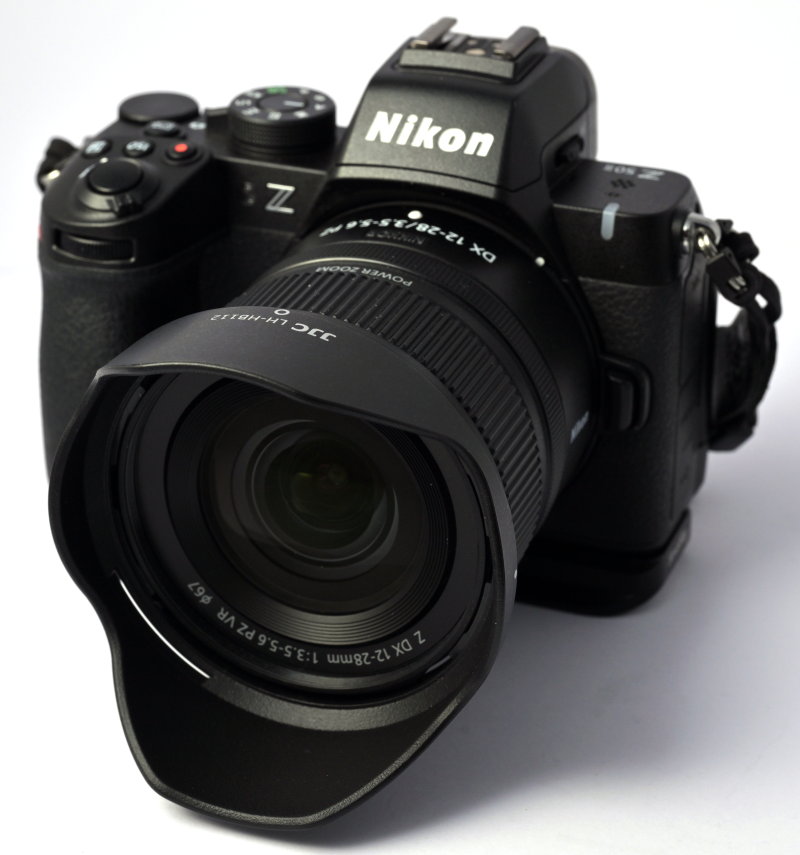
The 12‑28 mm looks good on the Z 50 II. It is proportionate to the small size of the camera, and because of its low weight feels like I am using a camera without any lens. Both zoom and focus are internal. Nothing moves externally, except for the zoom ring and control ring. 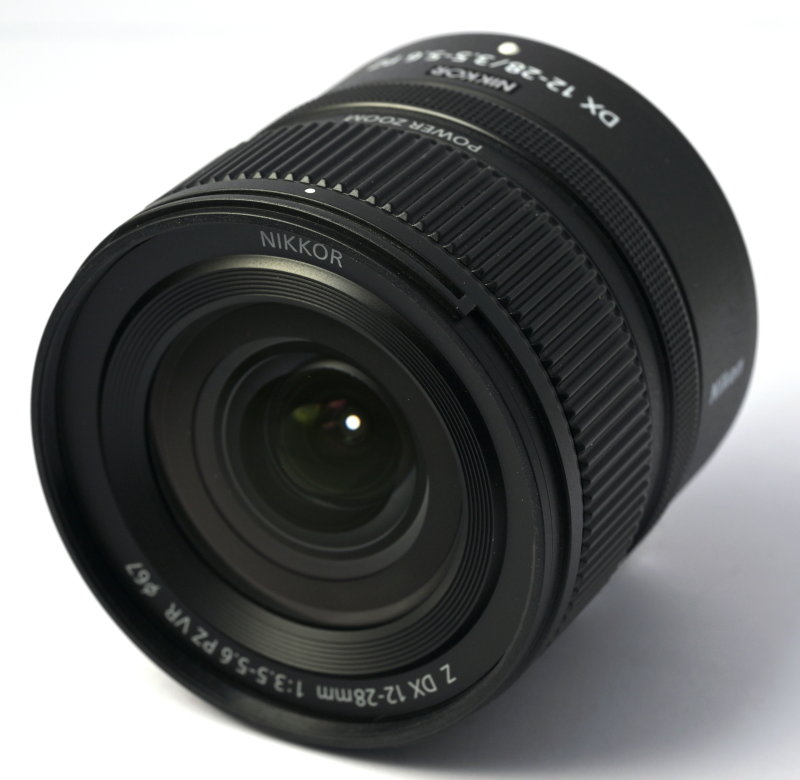
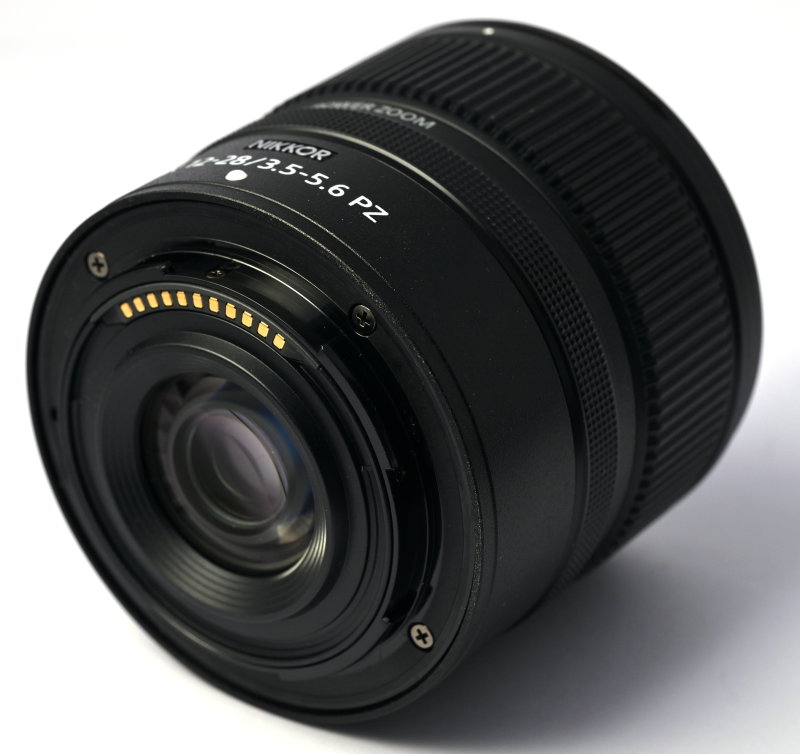
The plastic lens bayonet seems to be a lightweight construction, but its bayonet tabs have reinforcing buttresses not present in metal Z bayonets. It has been more than two decades since I last used a Nikon lens with plastic bayonet (in F mount, which is smaller than the Z bayonet, has only three tabs instead of four, and may therefore be subjected to larger leverage and strains than the latter). While I would instinctively prefer a metal bayonet, I have no choice because at present Nikon has no real alternative to the Z 12‑28 mm, and using a legacy AF‑S DX wideangle zoom on an FTZ II adapter would negate the size advantage of such a lens and be at least three times as heavy. Optics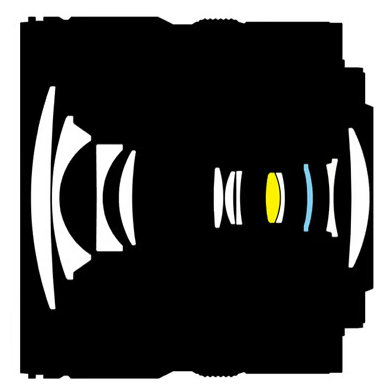
The optical scheme uses 12 elements in 11 groups, of which one ED element (yellow in the above figure) and one aspheric element (blue in the figure). The effective lens speed changes with focal length according to the following table. The change is gradual and distributed across the whole range of focal lengths (with the exception of 23.5 to 26 mm focal lengths, which display the same f/5.3 lens speed).
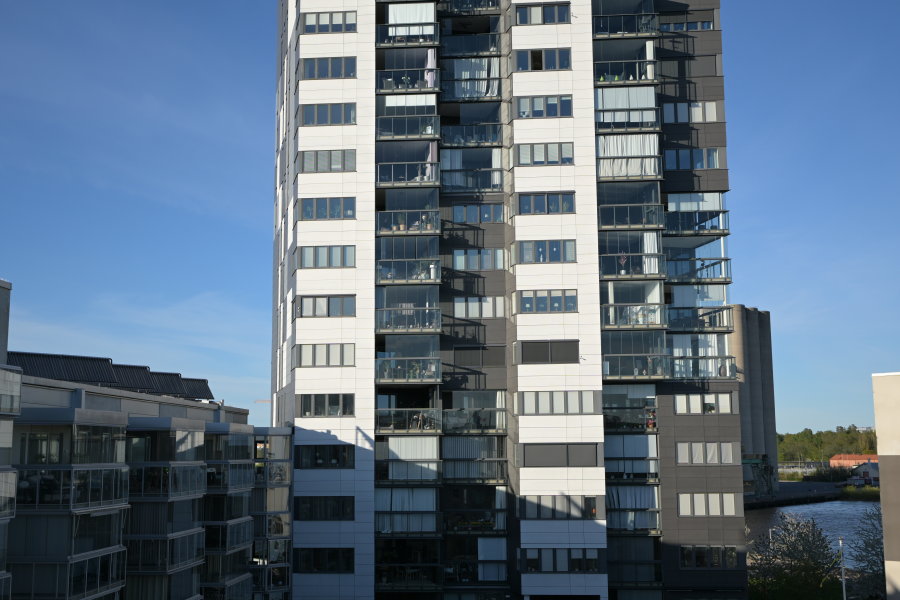
TestI tested the 12‑28 mm on my Z50 II (20.9 Mpixel) hand held. The Z 50 II has in‑camera VR (of electronic type, rather than physical sensor‑shift), which I always find to help greatly when hand‑holding, even with an extreme wideangle. The 12-28 mm has no in‑lens VR. 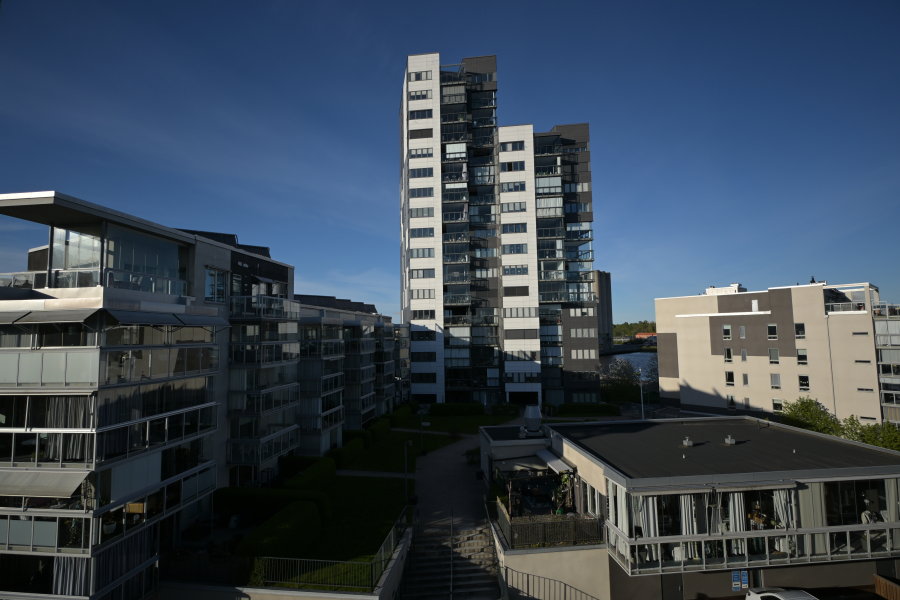
. 
The zoom range of this lens is rather large for a compact DX extreme wideangle. I decided to publish tests of this lens only at 12 mm and 28 mm, because intermediate focal lengths do not display any particular weaknesses. Now it is time to examine the 1:1 center crops a various apertures. At 12 mm focal length, I skipped the f/4 value (too close to the f/3.5 lens speed to make a difference). 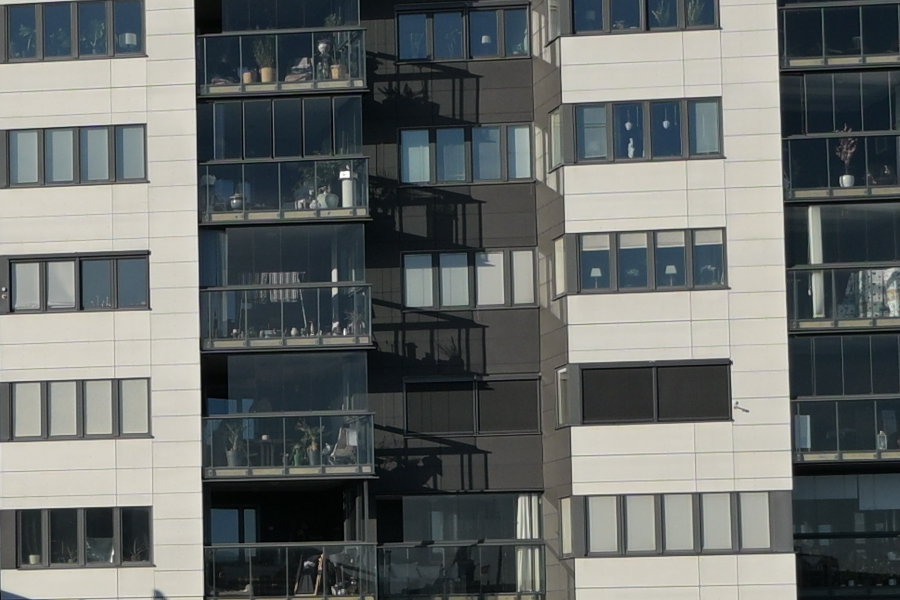
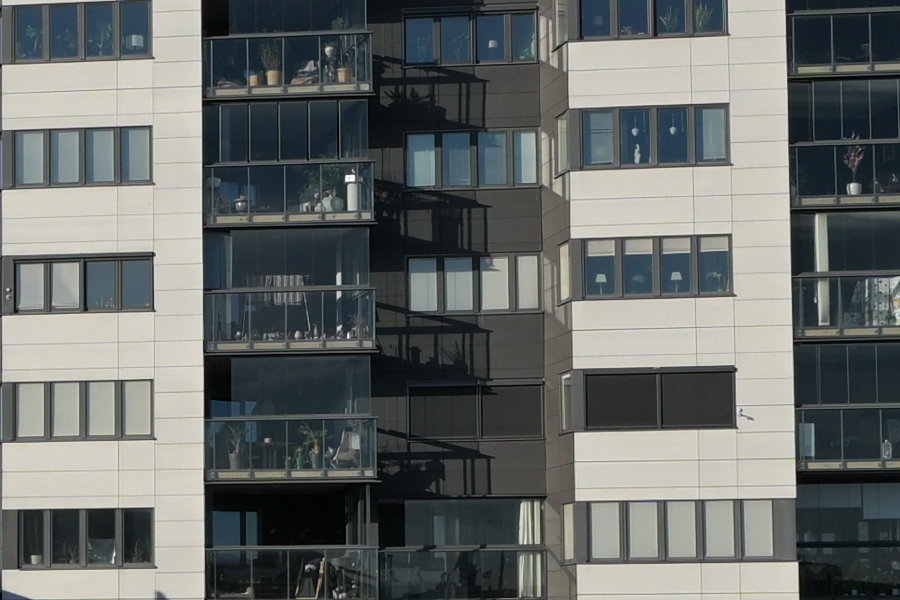
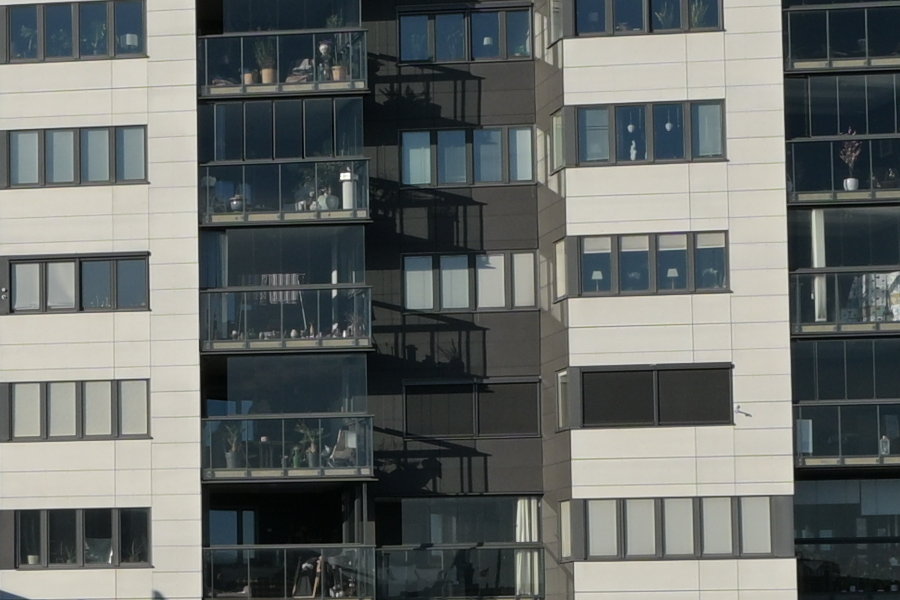
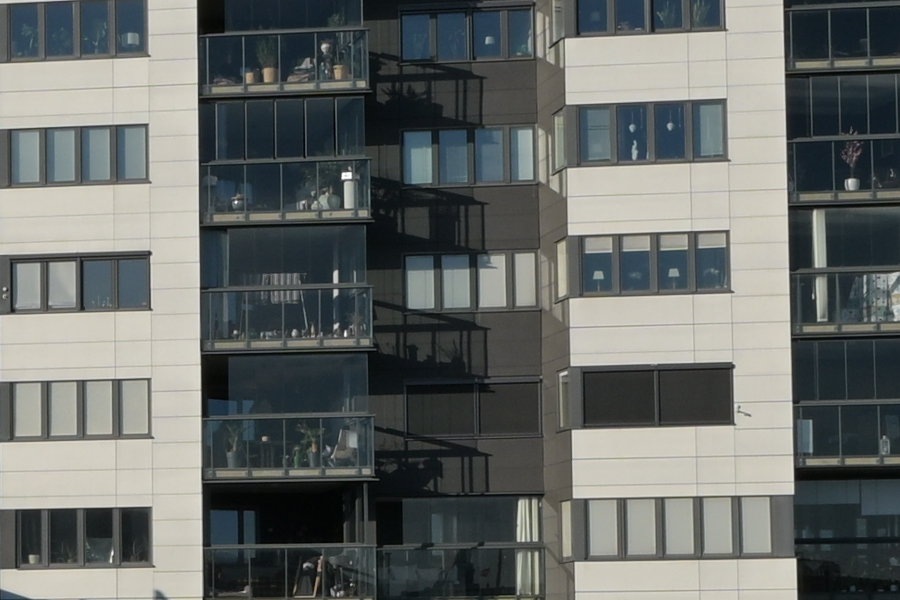
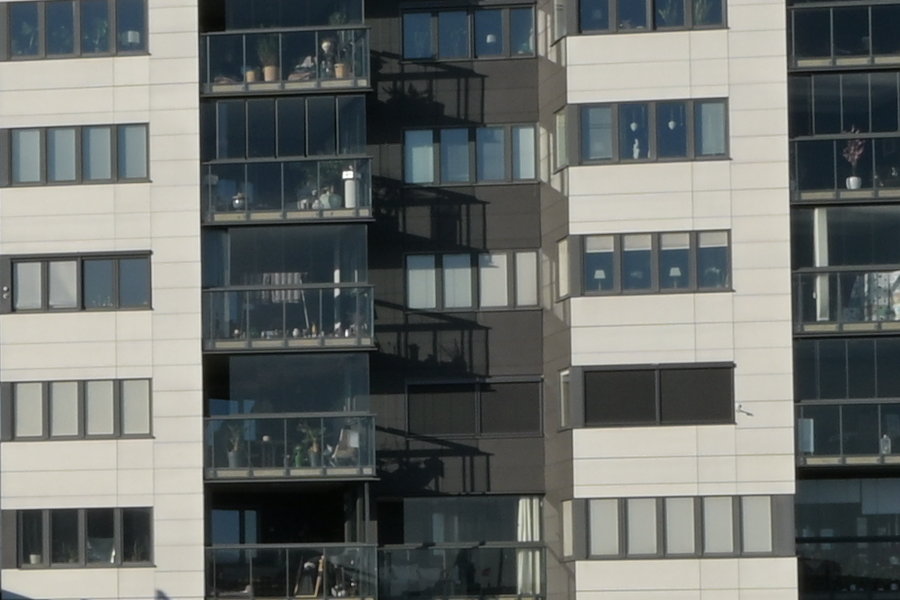
Image quality in the center of the frame is already at maximum with the lens fully open, and continues unchanged to f/11. Only at f/16 there is a small but detectable amount of blurring. Image quality in the extreme corners at f/3.5 to f/11 is only a little less than in the center, but hardly noticeably. 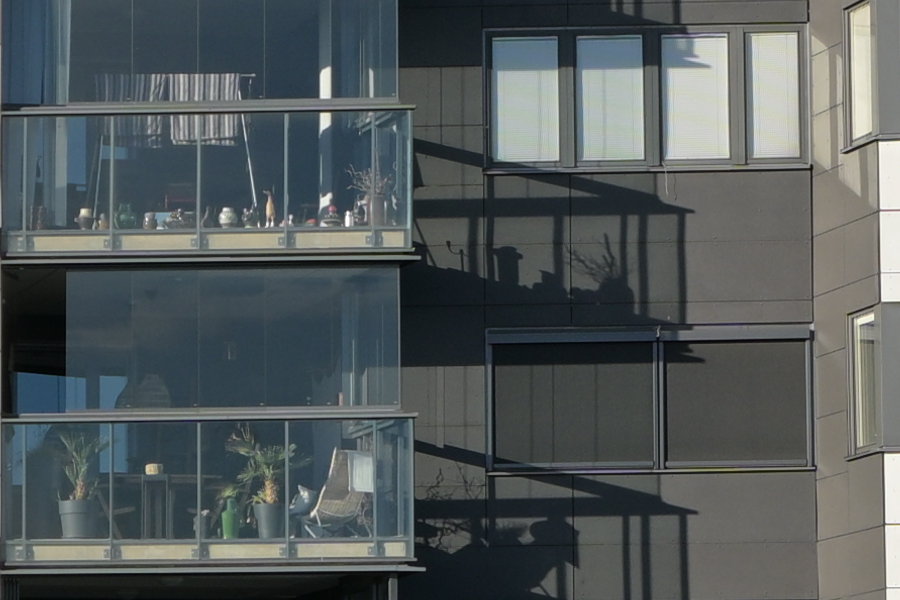
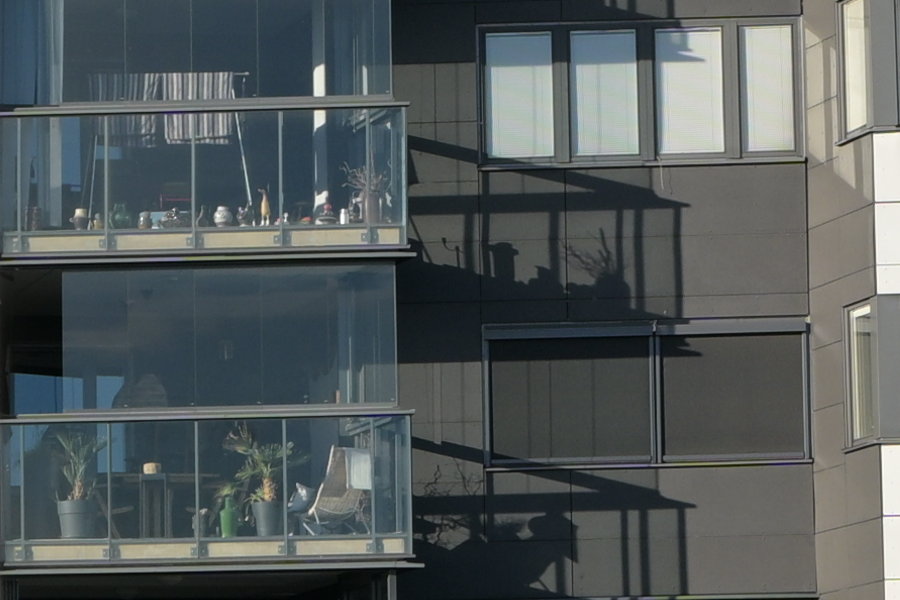
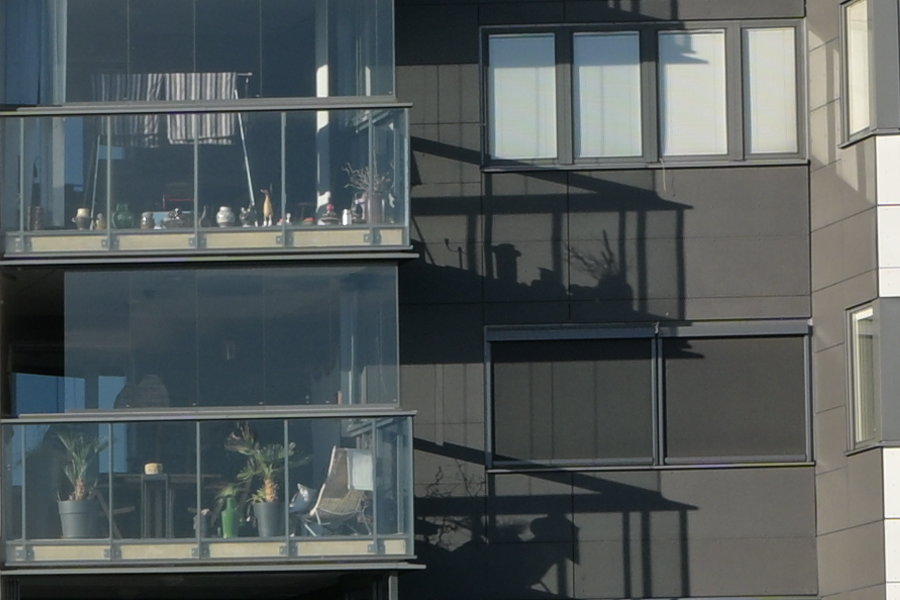
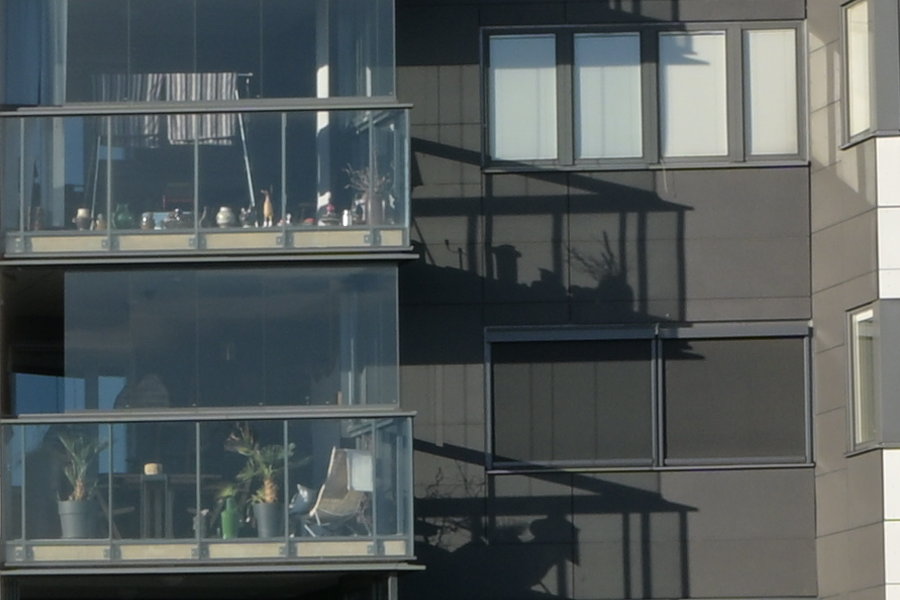
At 28 mm and f/5.6, the center crop is just as sharp as at 12 mm. It is so sharp that the bottom of the frame of the two windows just right and below the center of the frame displays a clear violet/yellow color moiré, in this case visible as a color banding. This is usually a sign that the lens is outresolving the sensor by a significant margin. This remains unchanged up to f/11. At f/16 there is a very slight loss of resolution and the color moiré all but disappears (at least in these test images - this may change with different subjects and shooting conditions). The Z50 II, like the Z50, lacks a physical anti‑aliasing filter, and performs anti‑aliasing electronically with its image processor. The anti‑aliasing algorithm evidently prioritizes a high image resolution over complete removal of moiré. It is not possible to achieve both results in all shooting conditions by using only a reasonably small amount of post‑processing. This choice agrees with the declared intent of Nikon to provide maximum image resolution when this camera is used with Z lenses. If you find this amount of color moiré disturbing, the simplest solutions are to remove it in post‑processing on a PC, or to shoot at f/16 with this lens. Image quality in the corners at 28 mm, as far as I can see, is the same as in the center. Additional information on the performance of this lens is available, for example, on photographylife.com. Weather sealingThis lens is not weather‑sealed. It has a plastic (not rubber) gasket around the lens mount. Lens shadeMy second-hand 12‑28 mm did not come with a lens shade. Nikon does not include a lens shade with this lens. The original "optional" HB-112 Nikon lens shade is remarkably expensive, so I purchased a third‑party (JJC) lens shade from Amazon. This lens shade (Figure 1) is specifically designed for this lens, fits perfectly, and does everything that the original lens shade is supposed to do. Place of manufactureMy specimen of the lens was made in Thailand. ConclusionsThe Nikon Z 12‑28 mm f/3.5-5.6 PZ, introduced in 2023, is relatively small and very lightweight, optically very good at all focal lengths and from fully open to up to f/11 or f/16, and its autofocus is fast and precise for a consumer lens. The bayonet of this lens is made of plastic. This can put off a fair number of potential users, in spite of the optically very good performance of this lens on current DX Z cameras. The effective speed of this lens gradually reduces with increasing focal length, throughout most of the zoom range. This lens is not weather sealed. This is a focus‑by‑wire and zoom‑by‑wire lens. By default, the control ring functions as a manual focus ring. Focusing and zooming are internal. |