Pentax-110 18 mm and 24 mm f/2.8 lenses
tested in UV imaging
This page describes tests carried out on the Pentax-110 18 mm and 24 mm f/2.8 lenses.
This page is part of a set describing tests of small-format lenses in UV photography. The main page
describing these tests is available here.
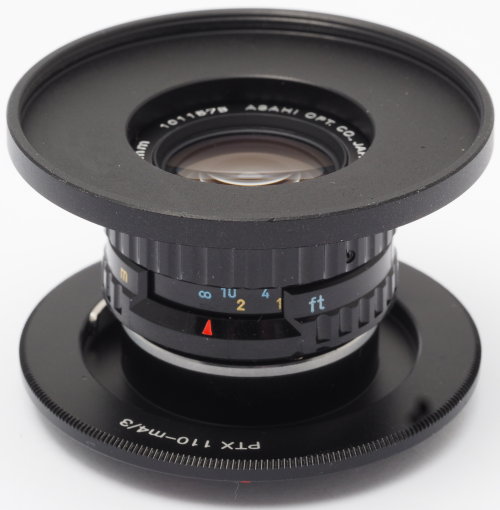
Pentax-110 18 mm f/2.8
Figure 1. Pentax-110 18 mm f/2.8.
This is a lens for the Pentax 110 format system film cameras (17 x 13 mm), produced between 1978 and 1985.
This format is only slightly smaller than Micro 4/3, which is 17.3 x 13 mm. Lenses for the Pentax 110
system are unusual because they have no built-in iris and aperture ring. Instead, an iris is built into
the lens mount of the camera body. Therefore, a fixed makeshift aperture must be placed immediately at the
rear of the lens for stopping it down. A metal washer painted matte black is the simplest solution. For my
tests, a hole diameter of 4.5 mm seems to be a good approximation for an f/5.6 aperture. The filter mount
is 30.5 mm. This size is not very common, but step-up rings are available. The filter mount, and in fact
the whole optical assembly, rotates when focusing.
This is a minuscule lens, only about 33 mm in diameter and 20 mm long from filter mount to mounting
flange. The focusing helicoid runs from infinity to 0.25 m in less than half a turn. There is also a
parfocal, fixed-focus version of this lens which is less versatile for the present use. The proprietary
bayonet has only two tabs. Micro 4/3 adapters are available, but none of those I have seen have a built-in
variable aperture, so the problem of finding a way to adjust the aperture is left to the lens user.
If you have sufficient metalworking skills, you may mount a small adjustable iris (for example eBay item
121445640590 by seller
amoyca2011) in a Pentax-110 adapter, just at the rear of the lens. This makes it possible to externally adjust the
aperture, although the operation may be tricky unless you use the tip of a pen to adjust the aperture.
Alternatively, the iris may be mounted so that its aperture can be adjusted from the rear of the adapter,
which reduces the chances of light leaking around the iris lever. In practical use of this lens, the
aperture can usually be left at the optimal f/5.6 or f/8.
All lenses for this format have an f/2.8 speed, which is a requirement of the Pentax-110 system since the
camera receives no electrical or mechanical information from the lens. This lens series also includes a
20-40 mm zoom. All these lenses are single-coated, which makes them potentially better suited to UV
photography than multicoated ones.
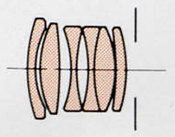
The 18 mm uses an optical formula with 6 elements in 6 groups. Lack of cemented elements is a favorable
characteristic for UV photography. According to
this test, the Pentax-110 lenses have a
high center resolution but a poorer corner performance on Micro 4/3 (which improves somewhat at f/5.6) in
VIS. Curvature of field is also a problem. On the other hand, vignetting on Micro 4/3 is tolerable.
reference lens, Baader U.Pentax-110 18 mm, Baader U.reference lens, Asahi Spectra XRR0340.Pentax-110 18 mm, Asahi Spectra XRR0340.reference lens, Omega 325BP10.Pentax-110 18 mm, Omega 325BP10.Figure 3.
NUV transmission is about 1 to 1.5 stop less than the reference lens. This is very good for an accidental
lens. This lens remains usable also with the Asahi Spectra XRR0340 filter. However, it transmits mostly
365 nm and longer wavelengths, rather than the 340 nm peak transmitted by this filter.
Figure 4. Pentax-110 18 mm f/2.8, 1:1 center crop of NUV image with Baader U and electronic flash, at
f/5.6.
NUV image quality is good at the center. It degrades near the edges, but remains acceptable for a
wideangle lens.
Pentax-110 24 mm f/2.8
Figure 5. Pentax-110 24 mm f/2.8.
The 24 mm is also potentially interesting in this context. It has a 25.5 mm filter mount, for which
step-up rings are more difficult to find. It may be necessary to combine two or more step-up rings to
reach one of the common filter sizes used in UV photography. The minimum focusing distance is 35 cm, which
is not sufficiently close for real close-up photography. This lens is so small that using it with a
step-up filter adapter and on a Micro 4/3 adapter makes it difficult to reach the focus ring. The best
option is probably to rotate the filter or its lens shade, since this also rotates the optical assembly
and focusing ring. This is one of the smallest lenses ever made for a system camera, and smaller than many
C-mount video lenses.
The focal length on Micro 4/3 is equivalent to a "normal" 50 mm lens on full-frame, rather than
a wideangle. Like the preceding lens, it produces no significant vignetting on Micro 4/3, but the extreme
corners are slightly darker (by 1-1.5 stops).
The 24 mm has 6 elements in 5 groups. Two elements are cemented together. The total thickness of the glass
is lower than in the Pentax-110 18 mm discussed above.
reference lens, Baader U.Pentax-110 24 mm, Baader U.
reference lens, Asahi Spectra XRR0340.Pentax-110 24 mm, Asahi Spectra XRR0340.
reference lens, Omega 325BP10. Pentax-110 24 mm, Omega 325BP10.
Figure 7.
NUV absorption is slightly higher than in the preceding lens (1.5-2 stops). Surprisingly, there is a very
faint transmission even with the Omega 325BP10 filter (probably just at the 350-360 nm "tail" of
this filter, not at its 325 nm peak), but not at usable levels.
Figure 8. Pentax-110 24 mm f/2.8, 1:1 center crop of NUV image with Baader U and
electronic flash, at f/5.6.
NUV image resolution is unfortunately not so good. The preview image on the LCD screen, focused under
illumination with a 365 nm torch, appeared sharper than the above test image, which was shot with
UV-enabled electronic flash. In spite of the nominal 35 cm closest focusing distance, correct focus at 365
nm with the focusing ring turned to this setting was obtained at almost twice this distance from the
subject. This suggests that a massive amount of focus shift (or more correctly, axial chromatic
aberration) is present between VIS and 365 nm. It is possible that the lack of sharpness in the above test
image is caused by the same aberration, since combining electronic flash and the Baader U filter results
in a much broader NUV spectrum than a 365 nm LED torch. If this is correct, then this lens is not suitable
for NUV photography.