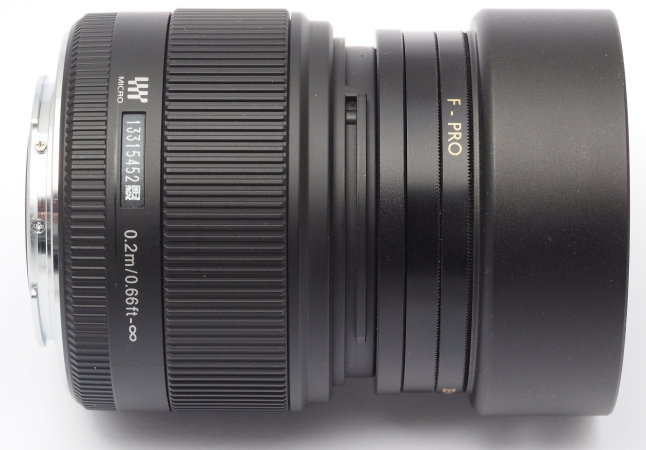
Note: The lens described on this page, with serial number 13315452, was stolen from me in
2016, in connection with moving to a new address. I now own another specimen of the lens.
This page is part of a set describing tests of small-format lenses in UV photography. The main page
describing these tests is available here.
Sigma 19 mm f/2.8 EX DN for Micro 4/3
Figure 1. Sigma 19 mm f/2.8 EX DN.
Unlike the preceding lenses, this is a native Micro 4/3 lens supporting autofocus and aperture control by
the camera. My second-hand specimen is the earlier version of this lens with plastic barrel and
comfortable, fluted focusing ring, not the metal-clad, completely smooth
opprobrium of the later model. Optically, the two models are supposed to be
identical. The filter mount is 46 mm and the minimum focus 20 cm. The optical schema is complex, with
8 elements (of which 3 aspherical) in 6 groups. Manual focusing is by wire and there is no distance scale. Aperture must be controlled by the camera,
and there is no aperture ring. A versions of this lens for Sony E-mount cameras is also available. A lens
shade is included with this lens, but cannot be used once a step-up filter adapter is mounted at the front
of the lens. The lens shade shown in the above figure is sufficiently wide to prevent vignetting on Micro
4/3. The lens shade and two 52 mm filters can be stacked on top of a 46 mm to 52 mm step-up ring without
vignetting.
Something large and heavy rattles inside this lens when it is shaken. This is normal for this series of
Sigma lenses, and does not indicate that the lens is broken. I believe that an internal autofocus group is
"loose" inside the barrel when the power is off. There is no in-lens image stabilization, which
is another thing that can cause internal parts to rattle around.
Reference lens, Baader U.
Sigma 19 mm f/2.8 EX, Baader U.
reference lens, Asahi Spectra XRR0340.
Sigma 19 mm f/2.8 EX, Asahi Spectra XRR0340.
reference lens, Omega 325BP10. Sigma 19 mm f/2.8 EX, Omega 325BP10.
Figure 2.
NUV attenuation is over 3 stops with respect to the reference lens. This is at the limit of usefulness.
However, this is counterbalanced by a very good image resolution and contrast with the Baader U.
In many situations, like hand-held photography, it is good to have AF in spite of the low NUV transmission
(assuming that there is enough continuous UV available to autofocus with sufficient precision). Among the
tested lenses, it is also among the ones with the lowest focal length that do not introduce a significant
vignetting, or a significant loss of contrast in NUV images.
Figure 3. Sigma 19 mm f/2.8 EX DN, 1:1 center crop and reduced frame of NUV image
with Baader U and electronic flash, at f/5.6.
NUV image quality is quite good (dust particles visible in the 1:1 crop are on the subject, not on the
sensor). This lens also allows by far the highest subject magnification (without extension tubes) among
the lenses tested in this set. The minimum focusing distance is only 20 cm. For this reason, I am showing
also a reduced version of the whole image, as an example of the good NUV contrast of this lens. Together
with AF, these characteristics make it one of the most interesting NUV lenses among those discussed in
this set, in spite of a borderline NUV transmission. A marked cutoff in NUV transmission well within the
band passed by the Baader U filter results in a violet general tone, indicative of a prevalence of longer
NUV wavelengths.