Telescopic posts as substitutes for pantographs:
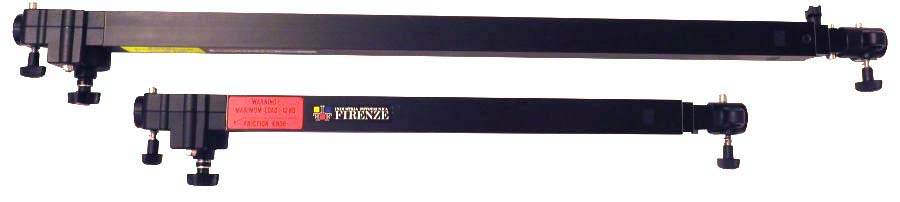
Manfrotto FF3248 and FF3249
Manfrotto FF3248 (top) and Manfrotto FF3249 equivalent, branded IFF (bottom)
Ceiling rail systems are ubiquitous in large and medium-sized photography studios. I also used for several
years a custom-built ceiling rail system above a table-top setup for product photography and
macrophotography. On another page, I discussed the use of
wall-mounted arms as a substitute for ceiling rail systems in small and
table-top studio setups, where equipment does not need to sweep over a large floor area. With both rail
systems and wall-mounted arms, it is necessary to use additional mechanisms to adjust the height from the
floor of studio strobes and other pieces of photographic equipment suspended from the rails or arms.
In my custom-built rail system, I had two rails fixed to the ceiling, with a third rail riding on them.
This configuration, commonly used in rail systems, allows the equipment raiding on the mobile rail to be
freely positioned anywhere within the footprint of the rail system.
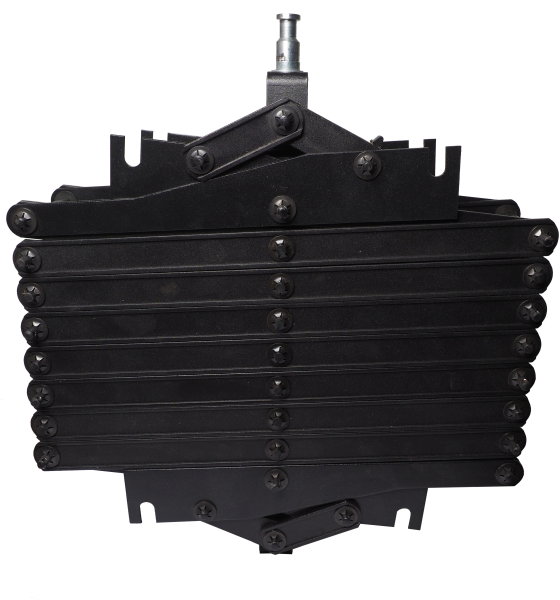
Example of amateur-level pantograph.
I used two relatively cheap, amateur-level pantographs (above picture) to suspend studio strobes to the
mobile rail . These pantographs are built largely like those for professional use, but the materials used,
and in particular the strength of the non-interchangeable spring, allow a maximum load limited to about 6
kg per pantograph. The pantograph itself weighs about the same as its maximum load capability, so the rail
carried a static load around 12 Kg for each pantograph. Pulling a pantograph-mounted strobe downward to
lower its height temporarily adds up to about 5 Kg to this load.
These pantographs, together with their rail carriages, when fully pushed up are about 40 cm high, while
the rail system takes another 15 cm and the bracket of my Bowens strobes, depending on the strobe model,
between 20 and 40 cm. This means that the highest placement of the strobes in this rail system is between
0.75 m to almost 1 m from the ceiling, i.e. about at eye height in a typical Swedish house or apartment,
and even lower in a house attic under the roof.
To place a strobe higher, I modified one of the pantographs by removing half of its scissoring sections,
which reduced its extension range to about 0.25-1 m. I also mounted additional carriages to the fixed
rails, and attached the strobes directly to them when necessary.
The pantographs are quite bulky, especially when fully pushed up, and together with the strobe this limits
the minimum horizontal distance between pantograph-mounted devices to about 0.6 m. In my case, I could
only use two pantographs and a single mobile rail above a large work table placed sufficiently distant
from all walls. A third pantograph would have made the rail system too crowded to use efficiently.
After moving from a house to a small apartment over a year ago, I needed to reconsider the design of my
strobe setup to fit a table-top studio area of about 1 m by 0.6 m, bordered by a cabinet on one side and a
wall behind the table. This severely constrained space required me to abandon ceiling rails and
pantographs, and to look for a new solution. Wall mounted arms, as mentioned
above, are a suitable substitute for ceiling rails in limiter areas. I was initially not aware, however,
of a suitable alternative to a pantograph. For a table-top setup, a distance of the strobe of at least 1 m
from its attachment near the ceiling is necessary to place the strobe just above the table-top, and almost
2 m for subjects placed on the floor.
Manfrotto 244N articulated arm connecting wall arm and strobe.
My first thought was using an articulated, lockable arm like the Manfrotto 244N. This arm does not brake
the descent of the strobe if the arm elbow-joint is unlocked without holding the strobe with the other
hand, with risk of damage and injury. Since the arm is rather short, however, the risk is limited. The
minimum length between the ends of this arm, when folded, is practically zero. The maximum length is about
48 cm, enough for illuminating a small diffusing cube placed on a table-top. When supporting a heavy
strobe, this type of arm should not be locked with its load substantially off-center, which would apply an
oblique stress to the uppermost support of the arm. Even with these limitations, the articulated arm can
be an acceptable way to allow a short adjustment in height.
I also looked at telescopic posts, some of which have an internal pneumatic brake that slightly reduces
the risks when unlocking the post length without supporting the strobe. However, typical arms of this type
only have two telescoping sections, which means that their maximum length is less than twice their minimum
length. This is insufficient for the present purpose
Manfrotto telescopic posts
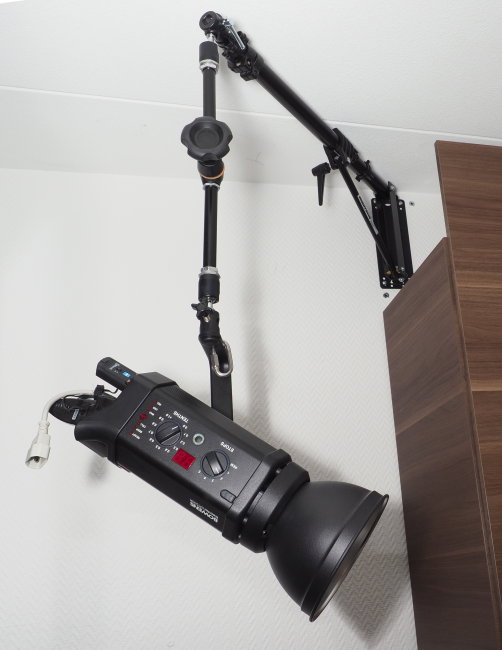
Manfrotto FF3249 equivalent (branded IFF) telescopic post in practical use
(left: minimum extension, right: maximum extension).
At some point, I discovered that Manfrotto makes two models of three-section telescopic posts, with the
unique feature that they have a built-in counterbalance spring (not advertised in the Manfrotto article
name), adjustable in strength and quite similar to the counterbalance springs used in pantographs.
However, the spring in these posts is completely encased in a protuberance at one end of the post, and
therefore safer to use. Telescopic posts are commonly used to hold photographic and microphone equipment,
but the term is usually applied to "dumb" accessories with just a clamp that unlocks the
separate sections and allows the post length to be adjusted, or at most a pneumatic brake that slows the
movement of the telescoping sections near the end of their extension range.
These posts with built-in counterbalance spring are significantly more expensive than amateur-grade
pantographs, although not as expensive as professional pantographs. Both post models have a specified
maximum load of 12 Kg, twice the maximum load of the lightweight pantographs. The aluminium pipes of the
post have a square cross-section, and slide against each other on nylon pads. The flat steel ribbon of the
counterbalance spring extends all the length of the post, within the three pipe sections.
Both models accept 16 mm studs at either end. The stud sockets are equipped with safety pins that prevent
the stud from being released when the tightening knob is unscrewed. A button on the opposite side of the
socket as the knob must also be pressed to release the stud.
An eyelet on each stud socket allows the attachment of a safety steel cable. Unfortunately, these eyelets
are too small to allow the passage of all but the thinnest (and least safe) steel safety cables, and at
the same time thick enough to require the use of significantly large carabiners. For comfortable use, it
is necessary to mount a sufficiently large maillon or carabiner on each eyelet, and to leave it
permanently in place.
The knob on the spring casing is used to set the spring strength. With the strobe attached at the bottom
of the post, the spring must be adjusted so that the post does not extend by itself under the weight of
the strobe at any amount of post extension, and then tightened a little more for good measure. It must
also not be tightened so hard that extending the length of the post by pulling down the strobe requires an
excessive force. If you replace the strobe with a heavier or lighter piece of equipment (or add a heavy
light modifier to the strobe), you must recalibrate the spring as described above.
It makes better sense to use the post with the spring knob at the bottom, because this brings the friction
knob within easier reach by the operator. However, the post operates indifferently also in the opposite
orientation.
The Manfrotto FF3248 telescopic post extends from 0.85 to 1.03 m, while the FF3249 is shorter at 0.6 to
1.28 m. Thanks to the triple telescoping sections, the maximum length is more than twice the minimum
length, while the stiffness remains optimal and the square cross-section prevents twisting of the ribbon
spring. While pantographs can combine a shorter minimum length with a longer maximum length, these posts
are far lighter than a pantograph, stiffer than a pantograph against sideways flexing, and their bulk in
use and storage is minimal (as a consequence, they project minimal shadows on the walls of the studio).
These posts also protect the operator against injuries by having no external moving parts other than the
telescoping sections, while with pantographs there is a constant risk of squeezing one's fingers in their
scissor mechanisms and spring rolls.
One of my telescopic posts is a second-hand early model branded IFF (Industria Fototecnica Firenze), an
Italian brand founded in 1949 and purchased by Manfrotto a long time ago. Manfrotto took over the IFF
machinery and continued producing many of the IFF products under the Manfrotto brand. At present, both
Manfrotto and IFF belong to the Vitec Group, and IFF is again branding its own models of professional
photographic and theatrical fixtures, while Manfrotto still continues to produce and brand a few of the
original IFF models as part of its own inventory. The current Manfrotto models of telescopic post are
identical to my IFF specimen, except for the addition of external plastic cable clamps that I find
difficult to use.
Disassembly and lubrication
In the IFF branded specimen, I discovered a potential durability issue, although this problem should only
arise after many years of use (this specimen could be some 30 years old). The grease lubricating the
ratchet of the friction mechanism had stiffened enough to prevent the ratchet from engaging its cogwheel,
and the spring strength was therefore not adjustable. Replacing the old grease is enough to completely
restore the functionality, but this requires the opening of the spring casing, which in turn requires the
casing to be extracted from the outermost pipe section. This can easily results in the post falling apart
into over a dozen pieces (especially if you disassemble a little more than necessary).
Reassembly is possible with some trial and error, but about as easy as solving a jigsaw puzzle that
requires six hands. It also helps to have another post at hand to check where each part goes. Hint: a
little hard grease can be handy to keep the nylon pads in the right positions while reassembling the
pipes, but do not put grease on any sliding surfaces. If the external surfaces of the pipe sections become
streaked with grease when extending the post, you have put grease in the wrong places. There should be no
grease on any of the visible surfaces.
I took the chance offered by the accidental disassembly of this post to completely re-lubricate the proper
internal parts, and ended up with a like-new, smoothly operating post that should last many more years.
Conclusions
The
Manfrotto FF3248 and FF3249 telescopic posts have a built-in, adjustable counterbalance spring
and can be used as substitutes for pantographs (with a few limitations, mainly minimum
and maximum length) to support strobes and other equipment from studio ceiling rail system and
wall-mounted arms. Both arms are specified to support up to 12 Kg, and are more
lightweigh, less bulky, and safer for the operator than pantographs. Although
more expensive than the cheapest pantographs, they are still cheaper than professional
pantographs.