The Nikon D200, D100, D80, D70, D70s, D50 and D40 cameras can use viewfinder accessories with a
rectangular bayonet mount, that slides onto the frame of the eyepiece from above. To use eyepiece
accessories, you must first remove the rubber eyepiece guard that comes standard with Nikon cameras, by
sliding it upwards. Other camera models (D1 and D2 series) have a different eyepiece mount. It is round,
and takes screw-on accessories (actually, Nikon used to make two different sizes of round eyepiece mounts,
and the DK-7 adapter was used to convert accessories with the smaller size to bodies with the larger one).
The standard rubber eyepiece guard is also available as an accessory. The D200 and D80 use a DK-21, the
D70s, D50, D40 and D100 (I believe) the smaller DK-20. Although they use the same basic mount, you cannot
really swap these two eyepiece guards, because they don't fit well on other camera models and may obstruct
the diopter adjustment near the viewfinder. Other models are available, e.g. a large asymmetrical rubber
cup for completely sealing out ambient light. The DK-10 is a minimalist model with a very narrow rubber
guard, which might be useful to glass wearers. It is standard on the D70. I wear glasses, and the standard
DK-21 and DK-20 eyepiece guards of the D200 and D70s are fine for me. The DK-21 of the D200 lets me get
slightly closer to the viewfinder while wearing glasses. It also provides a broader rubber-covered support
to rest the camera against my face for added stability, if I am not wearing glasses (which is not possible
with the D70s).
The DK-22 is a small and very light adapter that connects an accessory with round mount
to a rectangular eyepiece. It is not cheap (someone calculated that it costs more than its weight in
gold), but it allows the use of older accessories (like the DG-2, see below) on modern cameras. It can be
used to mount right-angle finders with round mounts onto rectangular viewfinders, but Nikon recommend
against it because of the fragility of the DK-22. I concur with Nikon - it is very likely you will break
the adapter in this way. The older 2370 model is slightly stronger than the DK-22, and
also allows the mounting of accessories with rectangular mounts, in addition to round ones.
Diopter compensation lenses (top left in the picture at the left side) are available in a
variety of strengths. Interestingly, the optical element of mine is made of anti-reflection coated plastic
and very thin. It also appears to be flat on both surfaces, so it is not a refractive lens. Instead, it
seems to be a holographic one. These lenses insert between the camera body and the rubber eyepiece guard,
so you don't have to give up the latter for using a diopter lens. Of course, you can combine a diopter
lens with the built-in diopter compensation built into the camera viewfinder, if you need a particularly
strong diopter value.
The DK-5 (bottom left) is used to cover the eyepiece when metering without putting the
eye near the viewfinder. It prevents stray light from entering the viewfinder and altering the exposure.
It is distributed as a standard accessory with cameras. This is also the best candidate as raw material if
you want to build your own viewfinder accessories.
The DK-21M (rightmost) is a combination of a lens and thin rubber eyepiece guard. It is
used to provide a slightly larger (1.2x) and darker view of the ground glass image, and is quite cheap.
However, it has several drawbacks, especially for eyeglass wearers. It has a very small entry lens. The
magnification with this accessory is hardly high enough to facilitate focusing. Composing is also more
difficult because you must place your eye very close to the viewfinder to see the whole frame. In
addition, it makes the viewfinder image unfocused, and you are forced to compensate by turning the diopter
compensation of the camera viewfinder all the way toward the minus.
Some users have had better success with the DK-17, which is a 1.5x magnifier in a round mount (so you need
an adapter). It uses a much larger lens. It needs some filing to be used on a camera with a rectangular
viewfinder mount. The DK-19 round rubber guard can be used on the DK-17. Some users reported that the
combined DK-17 and DK-22 sits better than the DK-21M on the finder mount of a D70s (the DK-21m cannot be
pushed down completely onto the viewfinder mount). In fact, there are reports that the DK-21m fits better
on Canon cameras (!).
In practice, if you are short-sighted like me, you cannot use the DK-21M without glasses, because there is
no more compensation available in the camera diopter adjustment. You cannot use it with glasses, either,
because it makes it impossible to view the whole frame and data display.
The DK-21M disassembles into a plastic part carrying the lens (marked DK-21M) and a rubber guard marked
DK-16.
The DG-2 eyepiece magnifier, mounted on a DK-22 as discussed above, magnifies the
viewfinder by 2 times. This accessory has a built-in diopter corrector, and is meant primarily to be used
without glasses. It is brighter and has a larger eye relief than the DK-21M, and is overall much more
usable. It is difficult or impossible to view the whole frame with the DG-2, but you can flip it upwards
and out of the way, as shown in the picture. It is useful for accurate manual focusing, e.g. on
microscopes and long telephoto lenses.
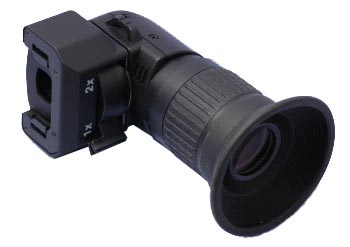
The DR-6 is a right-angle viewfinder. It contains a prism, a variable diopter correction,
and a lever to switch between 1x and 2x magnifications (of course, at 2x you can see only the central
portion of the frame). This is by far the best accessory to provide a magnified image, and the only one to
provide a right-angle orientation (except for older models like the DR-3 and DR-4, and the current DR-5,
which all have a circular mount). It is indispensable when using the camera mounted vertically on a high
repro stand (lest you climb onto a chair or a ladder to look into the viewfinder), and also invaluable
when shooting with the camera at ground level or in other awkward positions. The viewfinder can be rotated
freely 360 degrees around its mount, so you can also use it sideways or from below (although the camera
body may get into the way of your face).
The DR-6 provides a fully right-up image with non-inverted sides. In practice, you should use the DR-6
without wearing glasses if you want to see the whole frame.
There are third-party right-angle viewfinders comparable with the DR-6 (and of course much cheaper). I
have never tried them and cannot tell anything about their optical and mechanic quality (although the part
that mounts onto the camera seems to be lighter and less precise than the DR-6). Old right-angle
viewfinders made by other brands (e.g., Pentax and third-party ones) often contain a mirror instead of a
prism, and display an image with inverted sides. I don't know if this is the case with newer third-party
ones.
Conclusions
Viewfinder adapters like diopter adjustment lenses and rubber eye guards are in general useful and not too
expensive. They have no major drawbacks or compromises, and do what they are supposed to. The situation is
very different, instead, with viewfinder magnifiers.
If you want a viewfinder magnifier that gives you a sharp and bright image, forget about the DK-21. Your
real choices are the DG-2 and DR-6 (or DR-5 for cameras with a round viewfinder mount). This means that
your choice is between a "straight" viewfinder and a right-angle one. If you can use either one
for a specific application, then the DR-6 gives you a better image. If you can use only a straight
viewfinder for a given application, or a right-angle one, then in reality you have no choice. In practice,
if you want to see the whole frame, you cannot use these finder magnifiers without glasses. The DR-6 is
better also in this respect, because its entry lens is wider, and you don't need to get your eye very
close to it.
Older right-angle Nikon viewfinders can be used on a camera with a rectangular viewfinder mount, with a
DK-22 or a 2370 adapter (try to get the latter, because it is mechanically stronger). However, both Nikon
and I recommend against it, because these adapters are easily broken, and not meant for use with a large
right-angle finder. I am unable to comment on the quality of third-party right-angle finders.