iShoot Macro Focusing Rail 150
wormscrew stage for macrophotography
Wormscrew stages and racks are named after the mechanism used to move their sliding platform. These stages
are one-dimensional, with the platform typically sliding on prismatic supports in the simplest and
cheapest implementations, or, when durability must be high, on linear ball-bearings. When precision is the
main requirement, metal-against-metal prismatic rails are preferred, e.g. in microscope focusing blocks.
Linear ball-bearings are often used in industrial equipment where tolerances are less stringent but
friction must be kept low.
The large majority of focusing stages designed for photographic use are, unfortunately, low-cost products
of decidedly poorer quality than microscope focusing stages and industrial micrometric stages. These
photographic stages often display a multitude of problems including loose fit of moving parts, flexing,
and uneven movement (alternately "sticking and jumping"). This makes these stages essentially
useless for any serious applications.
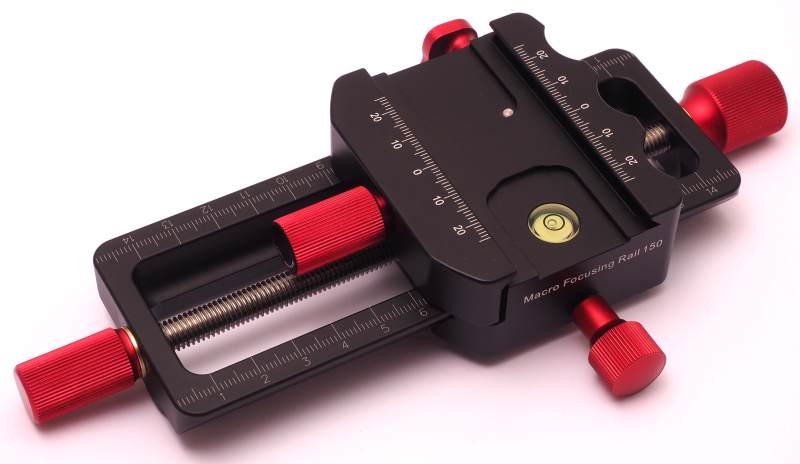
The wormscrew stage tested on this page is a relatively recent introduction by the Chinese brand iShoot on
eBay, apparently modeled on more expensive wormscrew stages manufactured, e.g., by Novoflex, RSS and
Sunwayfoto. It is marked as "Macro Focusing Rail 150", where 150 indicates that the rail is 150
mm long. The actual movement of the platform along the rail is about 115 mm.
I don't have the RSS stage (or any equivalent highly priced photographic focusing stage) to compare this
stage with, because their purchase does not make economic sense to me. For a similar or lower price, I can
purchase a second-hand microscope focusing rack or industrial linear stage of better mechanical quality
and higher durability, and the higher weight of the these devices is not a problem for laboratory use.
However, the price of this iShoot wormscrew stage is low enough to make it an interesting alternative if
it proves to work well enough for field work, without involving too much of a financial risk if it does
not.
First impressions
iShoot stage, top view.iShoot stage, bottom view.
This wormscrew stage looks well-manufactured. The base is an integral, long Arca-compatible plate,
complete of safety bolts that prevent the plate from sliding off a clamp when the latter is slightly
opened. To completely extract the plate, the clamp must be opened significantly wider. The metal is
blackened, with silk-screened scales and markings on the platform and laser-etched scales on the rails
(where friction would wear out silkscreened scales).
The clamp on the moving platform is large and massive, and oriented perpendicularly to the bottom plate.
The two sliding rails are likewise massive and spaced significantly more apart than the edges of an Arca
plate. This makes sideways wobbling less likely. The platform moves smoothly and silently along its rails
- too smoothly for a non-lubricated metal-against-metal mechanism. There must be nylon pads hidden under
the platform, which should last many years of moderately frequent use with a limited weight attached to
the platform. The pads appear to be sufficiently well-made to prevent any significant wobble in the
macrophotography range up to 1x magnification (although only tests, rather than visual examination, can
detect wobble at higher magnification).
The wormscrew is well-machined, with none of the surface roughness typical of stock threaded rods. Knobs
of different diameters are attached at either end of the wormscrew. There is no detectable loose play of
the threaded rod within its end bushings (either longitudinal or sideways). These are basic requirements
of any macrophotography stage.
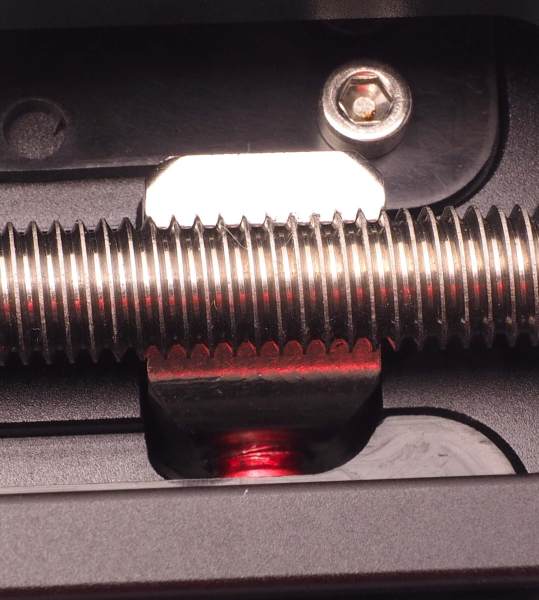
It takes some effort to rotate the knob of the wormscrew. The threaded nut that moves the platform against
the wormscrew is, functionally, less than a half-nut. It is not shaped as a nut (or half-nut), and is
instead a shaped piece of steel that fits in a slot under the platform, where it can be moved by a control
located on one side of the platform. It is convenient to continue calling this part as half-nut. It
disengages from the wormscrew by pushing in the side control. A small metal spring pushes the half-nut
back into contact with the screw when the control is released. The same control can also be twisted
slightly to lock the half-nut against the screw and prevent disengaging.
Support for the threaded rod in the middle of the rail.
A support in the middle of the stage prevents deformation of the threaded rod under pressure by the half
nut. A nylon bushing protects the thread from direct contact against the metal of the rail. This detail
suggests that the design was modified at some stage during testing, to correct for a problem caused by the
length and flexibility of the threaded rod. Although there is some obvious concern about this bushing
wearing off by scraping agaist the thread, it is nice to see they tried to solve a problem.
A thumbscrew on the opposite side of the platform is used to lock the platform against its rails.
Test
The operation of a focusing stage, rather than its looks, is the only thing that really counts. I mounted
this stage vertically on a photomacrography stand equipped with an Arca-compatible clamp, and placed an
Olympus E-M1 Mark II camera equipped with an RSS bottom plate in the clamp of the moving platform.
With a relatively heavy macro lens attached to the camera, problems became immediately apparent. I chose a
vertical orientation because it is more demanding of a focusing stage under load, besides being the normal
orientation I use with focusing stages. A camera and lens mounted on the platform result in an oblique
force applied by the platform on its rails, not just an increased vertical load. The observed tendency of
the platform to alternately seize-and-jump may not be a hopeless problem. Lubrication of the rails (which
I did not attempt) may improve the sliding movement to the point of making it sufficiently smooth.
Half-nut (shiny surface above the threaded rod). The same metal piece is also visible below the thread,
in too-wide a slot machined at the bottom of the platform.
The show-stopper is instead a
backlash of almost one millimeter of
the platform, which combines with the seize-and-jump effect to make precision focusing impossible. This
backlash cannot be eliminated by loading the platform, e.g. with a rubber band or spring (which I tried,
unsuccessfully), because it is combined with an excessive friction of the platform against the rails,
which increases dramatically with oblique loading. The half-nut is simply too short for its slot at the
bottom of the platform, and moves and twists back and forth in this slot.
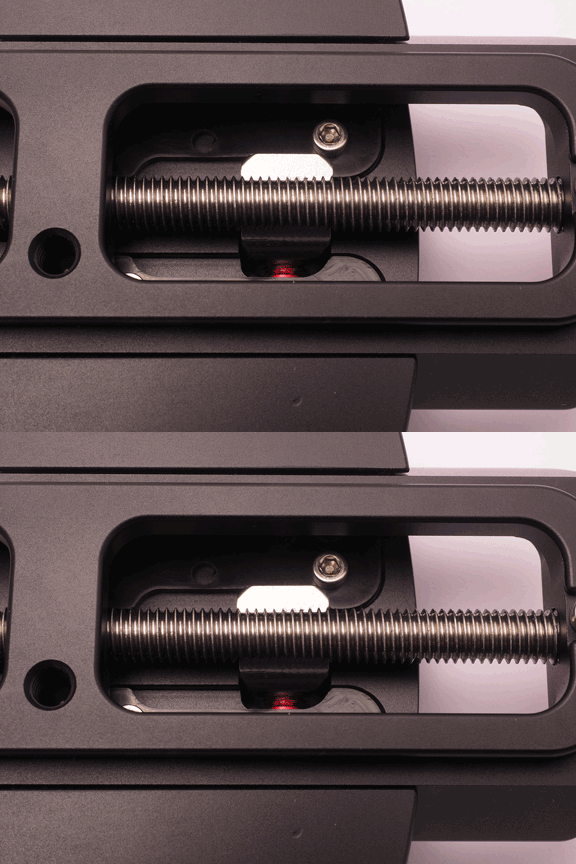
Animation showing the remaining amount of backlash after locking the half-nut. Your web browser may
prevent the animated GIF from playing, or may stop the animation after a given time. Changing the
browser settings and/or reloading the page may help in these cases.
I discovered that the amount of backlash can be somewhat reduced (to about half a mm) by tightening the
control that prevents the half-nut from disengaging the threaded rod. Still, the remaining amount of
backlash is too much for my liking. The above animation shows the remaining amount of backlash after
locking the half-nut.
No amount of lubrication can solve this problem. There is not enough space to add shims to the half-nut to
improve its fit, and no obvious way to permanently fix the shims. Given the shape of the half-nut and its
loose fitting on the spindle of the engagement control, shims would probably not be effective anyway. In
theory, it may be possible to discard the half-nut and its disengagement control and replace them with a
permanently engaged nut tightly fitting in the slot under the platform, but machining a one-of-a-kind nut
is hardly worth the effort. Backlash of the new nut against the threaded rod (which is not a precision
part, either) may become the next problem. It is safer to give up on this stage and use instead an
industrial-quality linear stage equipped with a micrometer.
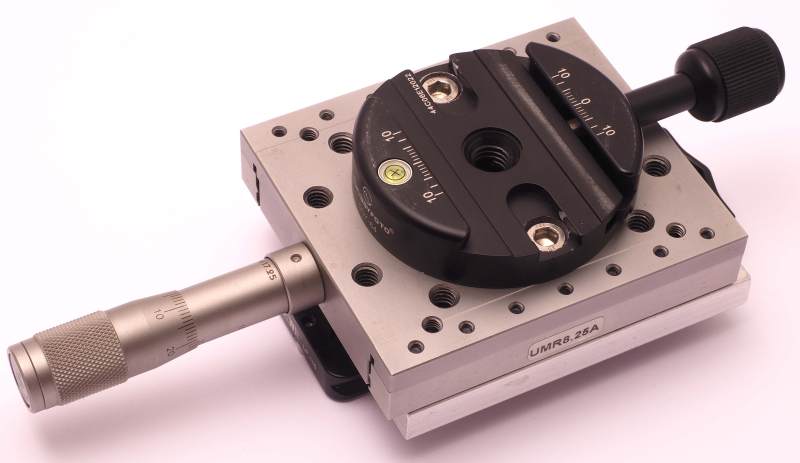
Example: a high-quality industrial linear stage
Newport UMR 8.25A stage with Micro Controle micrometer
The illustrated model works very well, and is of higher-than-average quality. It is made from machined
stainless steel for high stiffness, and has double rows of ball-bearings for increased load-bearing
capabilities (enough to carry my own weight). It is therefore both heavy and expensive. For many
applications in macrophotography, a cheaper and lighter micrometer stage with body machined from aluminium
alloy and single rows of ball-bearings is fully adequate.
I added an Arca-compatible plate on one side of this linear stage (via a plain aluminium plate because the
holes on the plate did not line-up with available screw sockets on the stage) and an Arca-compatible clamp
on the opposite side, so it is now equivalent in connectivity to the wormscrew stage discussed above. Most
industrial stages of this type have multiple threaded screw sockets for attaching to other equipment, but
an intermediate plate is often needed to attach photographic equipment. This is easier and safer than
drilling and tapping new holes in a linear stage.
These industrial stages must be loaded, i.e., either mounted vertically with the micrometer tip pushing up
the platform, or, if mounted horizontally, a spring or rubber band must continuously push the platform
against the tip of the micrometer. If properly done, there is no detectable backlash. Many stages,
including the illustrated Newport model, have built-in springs that do this. A strategically placed rubber
string is usually an easy fix for those that do not.
The travel length of the platform of these stages is relatively short. The most common compromise between
travel length and cost is probably 25 mm, with 51 mm being a close second. For use in close-up photography
and macrophotography, the stage should be combined with a longer Arca-compatible rail and clamp to allow a
quick or larger change of distance from the subject. Relatively cheap Arca-compatible rails of good
quality made in China are currently available in lengths up to 400 mm. With most micrometers used on these
stages, practical focus steps of 10 µm are easily obtained. The use of these stages therefore
extends well into photomacrography.
Microscope focusing racks with coarse and fine controls are even more precise than industrial linear
stages. While industrial linear stages usually can be used also in the field, however, microscope focusing
racks are normally used only in the laboratory/studio.
After publishing
this page, I found out that Really Right Stuff makes a wormscrew stage very similar to the iShoot stage
reviewed on this page. In fact, the two are too similar to be just a coincidence, and I regard the iShoot
stage as a clone of the
RSS B150-B. I don't have the RSS
stage to test, and therefore I cannot state how well it works, and whether it has the same fatal flaw as
the iShoot stage. The main visible differences between the two products are the red color of the knobs in
the iShoot product, the lever-locked Arca clamp of the RSS product, and machining details of the knob that
locks the half-nut. I have not found pictures of the RSS product that show details of the locking
mechanism (the little I can see looks identical in the two products), and therefore I cannot say anything
about its tolerances.
Reviews of this product on the RSS web site are generally positive but mixed, with a few reviewers
mentioning eccessive backlash, sideways shifting when locking the platform, non-smooth turning of the
wormscrew, and other loose tolerances.
The RSS stage costs roughly 8 times more than the iShoot. At this price, industrial micrometer-operated
stages with far better mechanical tolerances are directly competitive even when bought new (these items
are continuously available used on eBay, at a fraction of the price). It might be a better idea for RSS to
source an industrial stage from Newport and add to it an Arca-compatible plate and clamp, than try and
make a complete rail.
Conclusions
At first sight, the iShoot wormscrew stage is reasonably well-manufactured, with a good surface finish,
acceptable stiffness and acceptably good fit of the rotating and sliding parts. Its nylon bushings tend to
catch when obliquely loaded, but this might be eased by lubrication. All this, however, is
made useless by a single poorly designed part (the half-nut that engages the wormscrew)
that causes a backlash of about 1 mm, far too much for the intended use in macrophotography.
Opinions of the acceptability of this defect may vary, see for example
this thread on photomacrography.net
and other posts on that site linked from said thread. My own position is that the loss of usability caused
by this defect cannot be compensated by a low price - using a fiddly and unreliable gadget is always going
to be a frustrating experience, regardless of how cheap it sells. In this particular case, a better design
with lower mechanical tolerances would probably cost very little to the manufacturer, which strengthens my
inclination not to recommend this product.
If you want a reliable focusing stage for macrophotography and photomacrography,
forget the iShoot wormscrew stage.
Buy instead an industrial micrometer-operated linear stage, or a suitable microscope focusing
rack.


 After publishing
this page, I found out that Really Right Stuff makes a wormscrew stage very similar to the iShoot stage
reviewed on this page. In fact, the two are too similar to be just a coincidence, and I regard the iShoot
stage as a clone of the
After publishing
this page, I found out that Really Right Stuff makes a wormscrew stage very similar to the iShoot stage
reviewed on this page. In fact, the two are too similar to be just a coincidence, and I regard the iShoot
stage as a clone of the