Nikon Z FX and DXAt present, Nikon Z mirrorless system cameras are made in two different sensor sizes: FX or full-frame, and DX or APS-C. The same was true of Nikon DSLRs. The full-frame sensor format closely replicates the 135 film format, which used a nominal 36 by 24 mm frame size (slightly smaller than this in practice, but close enough to this size that any differences can be ignored in the present discussion). Toward the end of the film era, the 36 by 24 mm frame size had become by far the most popular, but until the end of the film era quite a few professional photographers regarded this format with some disdain (whether true or only feigned), and maintained it was not really "professional". In fact, this format was often called "small format". It was only in the digital era that the same format on digital cameras came to be called "full frame" and became a desirable high-end format. A few so-called half-frame film cameras used the same 135 mm film size, but with a 24 by 18 mm film frame. This is where the APS-C format originates. The large majority of early DSLRs used variations of the APS-C format, because 36 by 24 mm sensors were still too expensive to manufacture for use in consumer products. On this page, I summarize the most frequently used parameters of the sensors in my Nikon Z cameras, as a reference I can turn to for easily finding these frequently-needed parameters for my calculations. Sensor sizeThe physical size of the active area of an FX sensor in Nikon Z cameras is 35.5 by 23.9 mm (858 mm2). The full-frame sensors of cameras of other brands, and indeed also the sensors of Nikon FX DSLRs, can be slightly different. The silicon "chip" substrate of full-frame sensors can be of different sizes. In particular, some Nikon Z FX cameras (at present, Z9 and Z8) use a fully stacked sensor, with a main substrate slightly larger than non-stacked sensors. A fully stacked sensor consists of two chips of almost equal sizes, separately manufactured and afterwards permanently attached on top of each other by hundreds or thousands of electrical interconnects. The total area of these two chips is more than twice the area of an ordinary non-stacked sensor. The Nikon Z6 III uses a partly stacked sensor, which is basically a non-stacked sensor with two (in the specific case) chips stacked on its top outside the imaging area of the sensor. This requires an unusually large area of the base substrate, but the total area of these multiple chips is substantially less than that of a fully stacked sensor. The physical size of the active area of a DX sensor in Nikon Z cameras is 23.5 x 15.7 mm (369 mm2). Note that this area is not half the area of a full frame sensor, but only 43% the area of full frame. APS-C sensors of cameras of other brands and series can be larger or smaller than this, because there is no such thing as an APS-C standard in digital cameras. Compared to APS-C, full frame sensors are less variable in area and aspect ratio. The above also implies that an FX sensor operating in DX mode uses significantly less than half of its pixels. For example, the Z8 sensor has 45.7 active Mpixels, and in DX mode uses slightly more than 19 Mpixels (not 45.7 / 2 = 22.9 Mpixels). The aspect ratio of a 36 by 24 mm frame is 3/2. Plugging in the above sizes of FX and DX sensors yields aspect ratios of 2.98/2 for FX, and 2.99/2 for DX. Both ratios are so close to the nominal 3/2 that no correction factor needs to be used in practice. Light gathering capabilityI recently switched to Nikon Z FX and DX cameras after well over a decade with Micro 4/3. On the latter system, I used f/2.8 wide-angle and normal zoom lenses, because the small Micro 4/3 sensor is limited in its light-gathering capabilities. f/2.8 wide-angle and normal zooms for FX are significantly larger, heavier and more expensive than equivalent f/2.8 Micro 4/3 zooms. The same effective lens speed, coupled with the same ISO, requires the same exposure time, regardless of sensor size. But are the extra cost and weight of FX lenses really necessary to obtain an equivalent light-gathering capability? A DX sensor is roughly twice the area of a Micro 4/3 sensor, and therefore collects roughly twice the amount of photons at the same exposure time and effective aperture. Therefore, an f/4 lens on DX allows the sensor to collect roughly the same amount of photons as an f/2.8 lens on Micro 4/3 (at the same exposure time). An FX sensor is a little more than twice the area of a DX sensor. Therefore, an f/4 zoom on FX collects a little over twice the number of photons as the same zoom on DX (at the same exposure time and effective aperture), and a little over twice the number of photons of an f/2.8 lens on Micro 4/3 (at the same exposure time). Thus, the larger FX sensor does indeed result in an inherently better light-gathering capability (the above discussion applies to photography of subjects much larger than the sensor, but different considerations apply in photomacrography and photomicrography). Having said this, in the next section I am going to argue that the raw photon collecting capability of the sensor is but one of many criteria that affect the camera performance. Pixel count and sensel sizeThe following table shows the active pixel count as declared by Nikon of typical FX and DX Nikon Z sensors, and their number of pixels in the horizontal and vertical directions.
The number of physical sensels is always higher than the number of pixels in the recorded image, because a number of columns and rows of pixels around the edges of the frame are required by algorithms used by the camera processor, but their data is discarded after this processing and does not appear in the recorded images. The size of a sensel is only an estimate, because the exact size of the image-forming sensor area often is not specified by the camera maker. As a whole, the difference in the linear size of sensels does not vary by as much as one could be led to believe by the difference in size of the sensor (FX versus DX) and the number of megapixels. The factor that determines the amount of photons collected by a sensel, however, is its area (rightmost column of the above table). The moderately larger sensels of the Z6 III, compared to the Z8 and Z9, give the Z6 III a moderate edge in low-light photography, but it is not a substantial difference (each camera does apply an amount of noise removal appropriate to its sensor size). The sensels of the Z50 II are slightly smaller than in the Z8 and Z9, but the difference is negligible (albeit the difference in pixel count is of course major). Therefore, one should not expect the Z50 II to be significantly inferior to the Z8 and Z9 in low light. In fact, 1:1 pixel crops of images recorded with these three cameras are quite similar to each other. In addition, the Z8, Z9, Z6 III and Z50 II use the same camera processor (Expeed 7), so the image quality of these cameras is pretty similar once the raw sensor data has been processed in-camera, in spite of one of them being a "lowly" DX camera. This is not the case of other Nikon Z cameras. In particular, the Z7 is equipped with two Expeed 6 processors, one generation older than the Expeed 7. By general reckoning, the two Expeed 6 processors of the Z7, together, provide only half the computing speed of a single Expeed 7. The DX Nikon Z30, FX Nikon Z5 and DX Nikon Zfc are all equipped with a single Expeed 6. The sensor of the Z50 II is of course not as fast and sophisticated as the stacked sensor of the Z8 and Z9, but the lack of a physical shutter and the extremely high sensor data readout speed in the latter cameras make noise levels slightly higher and dynamic range slightly lower, while the electromechanical shutter and the more sedate data transfer rates of the Z50 II limit this type of problem. Consequently, the Z50 II is a perfectly capable camera when a speed demon like the Z8 and Z9 is not required. Energy consumption by the camera processor is another side of the coin. The Z50 II processor is substantially faster (read: multiple times faster) than the processor of the original Z50, but the faster data processing comes at the expense of a relatively higher energy consumption. The Z50 II uses up its battery charge significantly faster than the Z50, in spite of a slightly more updated and higher-capacity battery in the Z50 II. This means that you should probably carry at least two spare camera batteries on a day-long outing with the Z50 II. It also means that you probably should not be tempted to save a few bucks and equip your Z50 II with the older type of battery designed for the original Z50 (even though this battery does work in the Z50 II). Nyquist limitThe Nyquist limit is the minimum spacing of line pairs that still allows each line to be distinguished. This limit is one cycle, i.e. two pixels, since each line, at a minimum, is one pixel thick. Since diagonal pixel pitch is larger than horizontal and vertical pixel pitch, diagonal lines must be spaced further apart to still be rendered as distinct lines. One difficulty is that the closest possible line pairs inclined at 45° are rendered as a checkerboard pattern by sampling algorithms that enhance fine-scale detail, or as a uniform blur by algorithms that suppress it, so in either case one cannot distinguish in which direction the lines are actually slanted (Figure 1 C below). This phenomenon is closely related to aliasing. Nonetheless, I decided to use the same definition (one cycle) even in this worst-case situation. A few sources on the Internet state that, for imaging applications, one should set the Nyquist limit slightly higher than one cycle. A limit of 1.35 cycles has been stated at least once. There are also assertions that other applications, like NIR imaging, require an even higher number of cycles. I did not find mathematical/physical explanations for this, and it seems to be a rule‑of‑thumb (or, in some cases, wishful thinking unlikely to work in practice), more than a justified expectation. It is also possible that these photographers conflated the actual camera performance with a somewhat poorer‑than‑optimal performance of the lens in NIR (which the large majority of the lenses commonly used in NIR imaging is actually not designed for), as well as the unavoidably higher diffraction displayed by the longer NIR wavelengths. The large majority of sources only mention a limit of one cycle, which is the original definition by Nyquist. The latter is the convention I follow here. 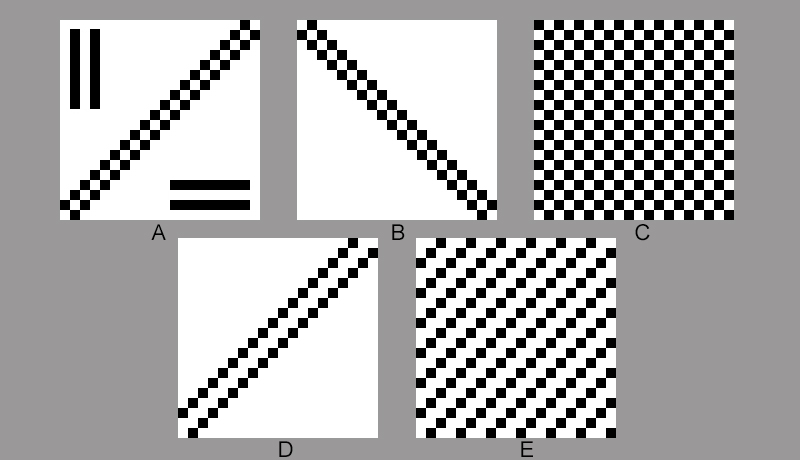
There is no question that non-aliased vertical or horizontal line-pairs at the Nyquist limit (Figure 1A) can be resolved on a raster-structured sensor or display. It can be fun to check what happens with patterns of 45° slanted non-aliased line pairs. In the above figure:
A - A one-pixel thick white line between two black lines of the same thickness, slanted clockwise. This is
the Nyquist limit for a vertical or horizontal line pair. The shorter vertical and horizontal line sets
are spaced at the same Nyquist limit. Figure 1C is more than just a theoretical exercise. For example, in my tests of the Nikon Z MC 105mm f/2.8 VR S at 1x with an NBS 1963A resolution target, I encountered the case of Figure 1C above, and the Z8 camera used for this test did produce an image detail similar to the pattern of the above figure. "Ideal" MTF of FX and DX sensorsSee my generic discussion of MTF (Modulation Transfer Function) and the Nyquist limit on my page about Micro 4/3. The very same concepts (but not MFT values and Nyquist limits) apply also to FX and DX sensors. Nikon versus NikkorIt is common for makers of system cameras to display their main brand name (e.g. Nikon) on their cameras, but a different name on the lenses used by these cameras (e.g., Nikon traditionally used the Nikkor name on their lenses). On their Z lenses, Nikon often uses both the "Nikon" brand and the "Nikkor" denomination. For example, on the Nikon Z 24-120 mm f/4 S, one can find the "Nikon" brand logo once, and the Nikkor logo twice (plus one more "Nikon" on the lens shade, and two "Nikkor" on the front and rear lens caps, respectively). As a further example, Olympus used the "Olympus" brand on all their cameras, but variations of the "Zuiko" name on their lenses (on Micro 4/3 lenses, "M. Zuiko"). The only other small-sensor system I have a direct experience with is APS-C, in the form of Nikon F-mount DSLRs (D70s, D200 and D300s). I used these cameras and their lenses for several years, before switching to Micro 4/3 and, to a lesser extent, Sony FE full-frame mirrorless. Then, over the course of 2025 and 2026, I switched back to Nikon, this time to their Z mirrorless system, and swapped almost all my Micro 4/3, Nikon F and Sony FE lenses to Nikkor Z. I currently use both FX and DX Nikon Z cameras. Systems based on APS-C and its minor variations in sensor size were initially the most popular system DSLRs, before "full frame" became virtually obligatory for the majority of professional and advanced amateur photographers. The APS-C sensor size remains a common choice today, and Micro 4/3 has a loyal following especially among wildlife and bird photographers, photographers specializing in photomacrography, and street photographers. The large majority of mainstream camera manufacturers, on the other hand, typically promote full frame (or FX, in Nikon-speak) as the only "professional" format, in spite of numerous professional photographers choosing APS-C or Micro 4/3 cameras and lenses for their specific types of photography. ConclusionsI collected or computed a few frequently-used parameters to use in calculations of Nikon Z cameras and their images, based on their sensor sizes and pixel counts at full native resolution. |