The Olympus OM-D E-M5 camera is somewhat of a revolution in a technological sense, and a return to origins
in a design sense. It combines state-of-the art 2012 technology in a Micro 4/3 semi-professional magnesium
alloy, weather-sealed and splash-proof body that looks much like an Olympus film SLR from the 1970s (and
is actually slightly smaller than these film cameras, which were famous in their time for being the
smallest and handiest film SLR bodies). The OM-D is generally regarded as the most advanced current Micro
4/3 body, and although the OM-D is not yet the perfect camera, among the objective and factual reviews
available on the Internet, very few have something substantially bad to say. Plenty of reviews of this
camera are already available on the Internet, so I will not publish my own here. Suffice it to say that
this is the camera that made me switch from Nikon DSLRs to the Micro 4/3 system (before the OM-D came out,
I was planning of eventually doing it at some point in the future, but previous Micro 4/3 models did not
fully convince me).
DSLRs are currently the mainstream digital cameras for advanced amateurs and professionals. However, the
architecture of a DSLR is a hodge-podge of old and new technologies. If I may speak out my (oversimplified
and highly politically incorrect) thoughts, DSLRs are only half-baked digital cameras that should be
regarded as just a temporary transition between film and fully digital cameras. They inherited the shutter
mechanism, flip-up mirror, mirror well and pentaprism virtually unchanged from film SLRs, removed the film
and its transport mechanisms, and slapped a sensor and accompanying electronics in place of the film to
save images. Since the introduction of the first consumer DSLRs, it took over a decade to see the first
semi-professional digital cameras that do away with most of this mechanical gear (a mechanical shutter
still remains, but hopefully not for long) and replace it with the sensor's intrinsic capabilities to
provide live images. While point-and-shoot digital cameras have always been more advanced than semi-pro
digital cameras, the digital revolution has begun to pick up speed in semi-pro cameras only recently. The
architecture of current Micro 4/3 (and other mirrorless) cameras can be regarded as a blueprint for the
future of professional digital cameras.
Back to the OM-D E-M5: it is difficult enough to remember one model designation, like "Lumix G3"
or "Nikon D300s". "Olympus OM-D E-M5" is quite a mouthful.Olympus' though was of
introducing an OM-D series and an E-M5 model, but the result is messy. For the time being, I will call
this camera OM-D, which is easier to remember (think "OM-Digital" and you will have no problem,
especially if you are old enough to remember the Olympus OM film SLRs).
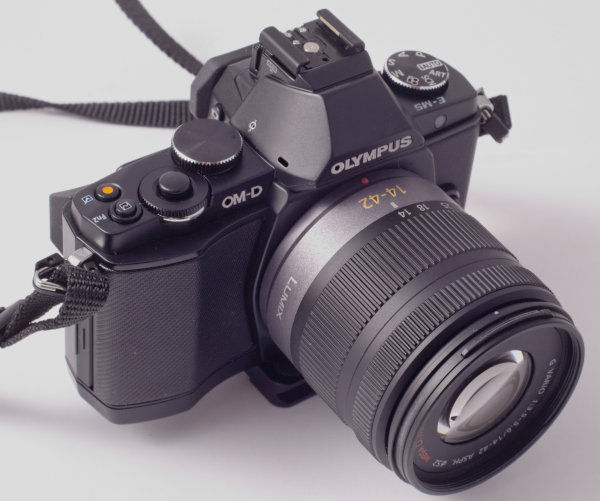
OM-D E-M5 with "disposable" Panasonic 14-42 mm f/3.5-5.6.
Above is my OM-D E-M5, wearing a Panasonic 14-42 mm f/3.5-5.6 "disposable" lens (which has a
plastic lens mount and is very cheap, but produces surprisingly acceptable results). An Arca-compatible
plate is slightly visible at the bottom of the camera. I also have a Panasonic 100-300 mm zoom (see below)
and a couple of wideangle primes, but probably will wait before buying more Micro 4/3 lenses until better
ones will become available than the current choices. I am planning to build up my Micro 4/3 system
gradually over a few years, rather than splurging on a complete set of the not-so-great lenses available
today. This year, I am specifically waiting for the Olympus 60 mm macro, Panasonic 12-35 mm f/2.8 and/or
Panasonic 35-100 mm f/2.8, but will buy one or more of these only after reliable tests and reviews will
become available. The initial reviews of the Panasonic 12-35 seem to confirm that this is the type of lens
I want to have. At least initially, these lenses are not going to be much cheaper than corresponding DSLR
semi-pro lenses, but they are certainly lighter and smaller.
A valid alternative strategy to a low-to-medium focal-length zoom is to cover this range of focal lengths
with two or three high-quality, high-speed primes (several are already available) instead of a zoom. Cost
and weight of the two alternatives are similar. Primes are of course more time-consuming to swap, but
provide a range of lens speeds and extreme focal lengths not available in zooms.
My main reason for leaving DSLRs behind me (I will still use the ones I have, but plan no new purchases of
DSLRs or their lenses) is quite simple: as the years passed, I got tired of lugging around a stone-heavy
camera backpack. I do photography for fun, and lugging stones around is not fun. I also want something
that fits more easily within the ever-shrinking carry-on luggage limits on flights and - not the least -
is more likely to be missed by flight attendants eagerly on the watch for a carry-on bag filled with
expensive photographic equipment to single out for forced check-in at the gate. The quality of Micro 4/3
lenses is only now reaching a true semi-professional level, and the OM-D is the first body that fits this
description (I am aware that the Panasonic GH-2 is perhaps better at HD movies, has native 4:3, 16:9 and
3:2 aspect ratios and the G3 is not far behind the OM-D in still image quality, but, correct me if I am
wrong, their bodies are plastic and not weather-sealed, and they do not have in-body image stabilization).
So, it is finally time to act.
My choice of the Micro 4/3 format is based on several factors, which I may summarize as follows:
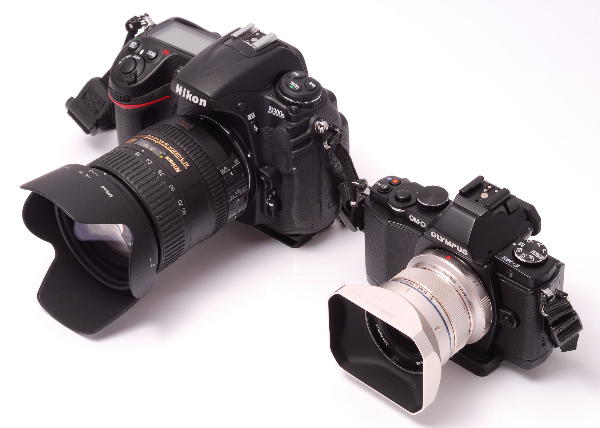
About half the weight and volume of corresponding APS-C DSLR bodies and lenses that provide the same
field of view.
Nikon D300s DSLR (left) side by side with OM-D (right).
Somewhat lower prices than semi-pro DSLR bodies.
The best current Micro 4/3 cameras provide an overall image quality (after suitable raw processing)
comparable with the APS-C DSLRs of four-five years ago. This level of quality is fully satisfactory to
me (besides, I am still using and publishing images I shot more than ten years ago with 3.3 and 5
megapixel compact cameras). I don't need to buy a newer and better DSLR just because Nikon would like me
to.
The current 4/3 DSLRs are simply not that different, in size and weight, from an APS-C DSLR. This
excludes the 4/3 format.
The current APS-C mirrorless cameras are indeed smaller and lighter than DSLRs, but most of their
semi-pro lenses are not.
The introduction of the Nikon 1 format eliminated (for me) the need to consider this mirrorless system
as a serious alternative. It has too many compromises on image and lens quality, too few lenses, and not
enough savings in weight, size or price. Perhaps the Nikon 1 system will be a valid alternative in five
or six years, if it is still around and grows substantially in both quality and diversity in the mean
time, but it isn't now. The only real temptation I felt about moving to the Nikon 1 system is the lens
adapter that provides autofocusing with AF-S Nikkor lenses. My best explanation for the existence of the
Nikon 1 system is that Nikon did not want to make a system that might compete with their DSLRs. They
succeeded, but what I want is exactly the opposite.
Micro 4/3 is today the only multi-brand standard, with cameras made by Panasonic and Olympus and lenses
by these brands and additionally by Sigma, Samyang, Voigtlander, Leica, Tamron and Tokina (including
also the brands that have announced their intentions but have no currently selling lenses, and those
that put their name on somebody else's lenses by license rather than by truly making them). There are
even a couple of tilt-shift lenses by Arax and/or some other former Soviet factories and a few
super-fast Noktor lenses that are actually modified large-sensor surveillance videocamera optics. Micro
4/3 CPU lenses have user-upgradeable firmware, and you can even upgrade a Panasonic lens while mounted
on an Olympus body, or vice versa. Olympus bodies now automatically correct the chromatic aberration and
geometric distortion of several Panasonic lenses, and vice versa. You can really mix and match many
Micro 4/3 components. The Micro 4/3 system is hopefully headed to became a true, long-lived standard (if
Nikon was able to keep essentially the same lens mount for half a century and counting, so can Micro
4/3). Another example is the M42 lens mount so common a few decades ago. It spurred a period of design
innovation and the appearance of many camera and lens brands, although in reality it was already
technically obsolete in its times. Note, however, that the Micro 4/3 specifications include only the
connections between cameras, lenses and electronic flash units (and some flash units do not provide the
full range of TTL and wireless functions). Other connections are proprietary, for instance the Olympus
Accessory Port 2 is not compatible with Panasonic products, and the remote shutter control connectors
and USB connectors are different in the two brands.
Dozens of adapter types are already available for using anything
from Hasselblad and Pentacon 6 camera lenses to C-mount video- and movie camera lenses, passing through
virtually every SLR and DSLR lens mount ever made (and even the M39 and L39 rangefinders), in manual
focus and aperture priority on Micro 4/3 bodies. This is a dream come true, and especially interesting
for experimenting and in close-up photography, macrophotography and photomacrography. An adapter that
allows autofocusing with Canon lenses was recently introduced, so I still hope that a similar adapter in
the future will let me autofocus with my Nikon F lenses, especially the long telephoto ones for wildlife
photography. 4/3 lenses can also autofocus with an adapter on modern Micro 4/3 bodies, although so far
more slowly than the native Micro 4/3 lenses. One negative side effect of this versatility is that many
old types of movie lenses have increased in price tenfold or more, with many sellers hawking old and
battered movie lenses, or cheap low-resolution CCTV lenses, as Micro 4/3 "jewels" worth more
than their weight in gold. Only some of the 16 mm format C lenses have any hope of producing a
sufficiently wide image circle on Micro 4/3 cameras, while many of the 8 mm format and CCTV lenses
pushed as "Micro 4/3 compatible" do not. Now that we are finally seeing the introduction of a
good choice of high-quality Micro 4/3 lenses, the incentive for photographers to use adapters and legacy
lenses (except for applications in photomacrography, extreme telephoto and other specialty fields) is
rapidly disappearing.
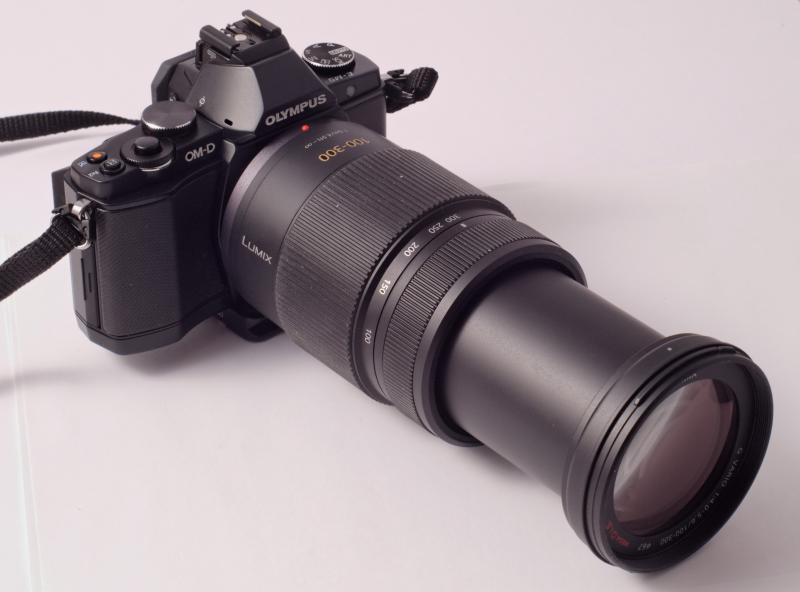
OM-D with Panasonic 100-300 mm zoomed to 300 mm.
The linear field of view of the Micro 4/3 format, at the same lens focal length, is 1.4 times smaller
(i.e., half the area) than on an APS-C camera, and exactly half the linear FOV (1/4 of the area) of a
full-frame DSLR. This means that with a 300 mm lens on the OM-D (above picture) I can get exactly the
same FOV provided by a 600 mm on a full-frame DSLR. The 300 mm, at the same lens speed, weighs roughly
one-eight and costs one-sixteenth of the 600 mm. While a 300 mm f/2.8 is commonplace enough and can
still be called portable, I don't think that a 600 mm f/2.8 actually exists, leaving aside the facts
that only Arnie would be able to carry it in the field, and that the NSA will arrest you before you can
start shooting with it, following neighbors' complaints of a terrorist with a rocket launcher. The more
modest Sigma 200-500 mm f/2.8, at about 16 kg without case and 25,000 US$, is the closest actual lens I
can think of. My 300 mm f/2.8 is ready and waiting for that Nikon F
autofocusing adapter, and I can already use this lens in manual focus on the OM-D.
At the opposite end of the range of focal lengths, there is no shortage of high-performance fisheye and
extreme wideangle lenses for the Micro 4/3 format, which are lighter, smaller, and cheaper to design and
build than DSLR wideangles.
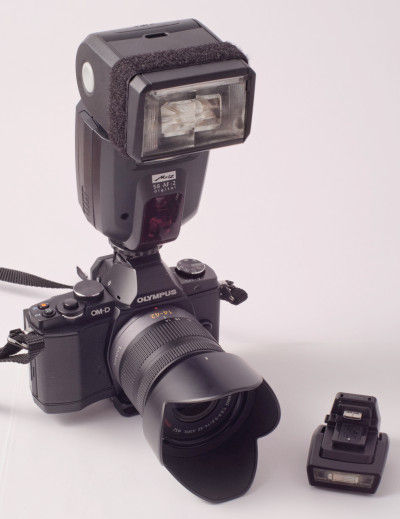
OM-D with Metz 58 AF-2 (left) and the diminutive Olympus flash (right).
TTL electronic flash is possible with proprietary as well as third-party flash units, including several
rather nice and not too expensive Metz models (above figure).
The range of TTL flash functions offered by the Micro 4/3 system is enough for most professional uses.
The OM-D has no built-in flash, but comes standard with a very small, dedicated and weather-sealed
external flash that works also in wireless TTL commander mode for external units. It is actually smaller
and lighter than a TTL flash hotshoe adapter and cable for using a flash unit off-camera.
To the above general characteristics of the Micro 4/3 format I can add a few advantages specific to the
OM-D:
OM-D E-M5 with Samyang 7.5 mm f/3.5, 1/3 s hand-held, IS focal length set to 50 mm. 1:1 center crop.
OM-D E-M5 with Samyang 7.5 mm f/3.5, 1/3 s hand-held, IS focal length set to 8 mm. 1:1 center crop.
In-body image stabilization (IS) currently is the most advanced of any consumer digital camera (five
degrees of motion freedom instead of the ordinary two - rotations about X, Y and Z axes plus the
traditional vertical and horizontal shifts). This means that image stabilization no longer requires more
expensive, VR/IS-stabilized lenses. It works very well even with non-CPU lenses (at least with primes),
because one can manually enter the lens focal length in a menu for this purpose. The camera must know
the focal length in order to compute the appropriate amount of sensor movement, and the above pictures
show how important this setting is. The camera switches automatically back to reading the FL from CPU
lenses when one is mounted, so this system requires no manual reconfiguration if you only use one
non-CPU prime lens in a session (e.g., a super-telephoto, or a super-high-speed prime). Image
stabilization can be configured to work also in live view (not only during the actual exposure), which
makes it easier to frame and focus with long telephoto lenses, and is very useful also when manually
focusing in zoom mode in live view.
Built-in viewfinder and touch-sensitive screen (OLED, not LCD). In some configurations both can
be used simultaneously (e.g., the viewfinder for framing, the screen as a status and configuration
panel).
A sufficiently large amount of dials and buttons to allow easy access to several important functions.
Not the best ergonomics in the default menus, but very high customization possibilities of both menus
and buttons. The optional battery grip has additional buttons that can be configured independently of
those on the camera body, so even control freaks should feel at home. I don't know whether the OM-D can
also use and/or configure the extra button(s) present on some Panasonic lenses.
In-camera remapping of dead, hot and stuck pixels. Almost all sensors contain defective sensels, which
the camera manufacturer programs in firmware so that the corresponding image pixels are interpolated
from nearby "good" ones, and the defects do not show up in images made with a new camera.
Eventually, however, additional sensels will develop faults over the years. Olympus lets you perform an
automated procedure that takes care of these new defective sensels (they recommend doing this once a
year or so). Other brands instead do not offer this option, or perform the procedure only at a camera
repair center. I missed this functionality in my Nikon cameras, for instance - all of them developed the
occasional defective sensels in the long run.
No camera (as yet) is perfect, and the OM-D is no exception. These are my main complaints:
Too small to hold securely with the right hand alone (I did want a small camera, but Pentax
puts a better grip on its NEX mirrorless models). The optional battery grip does help, but brings the
camera back to almost a DSLR size. A padded hand strap adjusted to fit snugly around the back of the
hand is a possible solution. The last time I used a hand strap was with a Coolpix 5700, which is much
easier to grip with the right hand than the OM-D. Perhaps someone should design a
hand-grip-and-hand-strap combination that is only half as thick as the Olympus battery grip and carries
no fancy buttons and dials. A heavy lens with a tripod collar is easily equipped with its own neck
strap, so I could do away with the camera neck strap, and virtually all collar-less lenses for Micro 4/3
are light enough to carry with one hand.
The sensor that automatically switches between eye-level viewfinder and screen is too sensitive.
Pointing to the screen with a finger may activate the viewfinder. Wearing the camera on a neck strap
close to one's chest/tummy always switches on the viewfinder, which uses more power than the screen. The
operation can be switched to manual, though. A related complaint is that the OLED screen cannot be
folded with the display surface against the camera back to protect it from scratches when carrying the
camera on a neck strap (unlike several other cameras, including Panasonic Micro 4/3). In principle it is
not impossible to design a tilt-only screen that pivots 180 degrees back against the rear of the camera,
although this is mainly done with swing-out screens. Touch-sensitive screens of course cannot use a
thick Nikon-style scratch protector.
Most of the buttons are too small, and give no tactile feedback. It is just too easy to be left
wondering whether a button press registered or not. They do not feel the way the controls of a semi-pro
camera are supposed to feel. The stiffness of the weather sealing may be partly responsible for this.
The online firmware upgrade hangs at the "Updating..." prompt on an (unmodified) Packard-Bell
desktop PC. It works instead on a Dell Latitude laptop. I wish that Olympus would make a simple offline
update possible, e.g. by saving the firmware to an SD card and popping the card into the camera. Another
oddity is that when I try to register on the Olympus site my OM-D bought from Amazon.de, I am only given
a choice of Latin American countries for my address.
Genuine Olympus spare batteries, power supplies and other accessories are so far extremely expensive.
There are already cheap no-name "compatible" batteries, but they require a special charger
(they
don't recharge in the Olympus charger) and probably have a poorer overheating and overcharging protection (or none). No doubt within a few
months better no-name fakes will be available, but why is Olympus pushing us to buy these fakes instead
of selling us their genuine accessories at reasonable prices? By the way, fake remote shutter release,
fake TTL flash cable, fake rear lens caps and other fake doodads are already in my bag. I received this
week two fake batteries and a fake charger for less than a quarter of the price of a genuine battery.
Olympus, do you get the hint? You sold me the camera but missed out on the rest.
Olympus forces you to buy a stereo microphone if you want to buy the only available (so far) microphone
adapter that fits the OM-D. Even if you already have a better microphone, the (expensive and
unnecessarily large) Olympus adapter sells only together with their small microphone, which looks like
it was lifted straight off one of their office voice recorders. The Olympus microphone adapter must sit
on the flash shoe of the OM-D, so good luck finding another place to attach your nice Rode or Sennheiser
microphone. Olympus seems to have missed the obvious idea of adding a flash shoe on top of the
microphone adapter, which would allow a video lamp or larger microphone to be attached there. Also in
this case a factory somewhere in China is probably already working on a cheaper clone, and hopefully
they have read my suggestion above.
The user manual (including the PDF-only extended version) does not really cover all features in
sufficient detail. This leaves a market available for a really good, in-depth technical book on the OM-D
(books aimed at beginner photographers need not apply). We are already beginning to see interesting
materials on some web pages like
this
and this.
The image stabilization system emits a low level "hiss" (audible only in silent environments
and while holding the camera close to one's face). This sound is easily drowned out by the fan of an
ordinary PC in the same room. An unusual consequence of the design of the stabilization system (which
basically holds the sensor hovering in a set of magnetic fields) is that the system, and its sound, are
active also when stabilization is switched off (to prevent the sensor from falling to the bottom of its
holder, which it does when the camera is switched off). This design is probably simpler than a mechanism
to latch the sensor into a stable position when the stabilization is switched off. The sound is not a
problem for me, and since I am not into stealth photography of people it makes no difference to my
planned use of the camera, but some photographers may want to choose a different camera. A further
oddity is that the sound disappears while shooting movies (but image stabilization is still on), so in
principle Olympus could update the firmware with a new configuration setting to switch to this
(presumably less effective) type of image stabilization when a silent camera is necessary. Incidentally,
the shutter of the OM-D has a muted sound, softer and "classier" than other Micro 4/3 cameras.
The looks of the OM-D may be controversial, and are certainly a departure from the arching, drooping and
melting lines and plasticky appearance so common in current (even metal-bodied) DSLRs. Since this is a
matter of personal taste, you are free to love or hate the OM-D looks. It is too early to tell whether
this is the beginning of a new trend or just a temporary experiment in style. I used an Olympus OM-2N for
over twenty years (the longest among my cameras), and the OM-D brings back many fond memories. I would not
mind using the OM-D for another twenty years, if it lasts that much and unless something will come along
that fits my needs even better.
Together with a Panasonic G3 modified for multispectral photography,
the OM-D is likely to remain the foundation of my camera system for at least the next few years. Better
cameras are certainly possible, and hopefully will be designed, but the OM-D is not likely to become
obsolete in just a couple of years, at least for my needs.
An important thing that I learned about the Micro 4/3 image quality (including the OM-D's) is that one
third of it depends on the sensor, the other two thirds on the in-camera processing by the firmware and
post-processing with a raw converter. Gone are the times when the sensor output, after demosaicking, was
saved more or less unprocessed to a memory card, and was regarded as sufficiently good. Performance
improvements in signal/noise ratio and dynamic range of sensors in the past five years have been
incremental rather than revolutionary, and sensor size still matters very much. Therefore, on Micro 4/3
cameras I usually save in raw format (unless I am shooting at base ISO and can control the lighting to
avoid any underexposed areas, in which case JPG may be good enough for ordinary subjects). On the other
hand, I do find in-camera JPGs from advanced DSLRs like the Nikon D300s quite good enough for ordinary
subjects up to ISO 400-600, and most of the time I do not bother saving in raw format.
I only have the Olympus converter for the OM-D so far (Olympus Viewer 2). Support for the OM-D is not yet
added to all commercial converters, and is planned for August 2012 for DXO Optics Pro, but my experience
with a few of the best converters and the Panasonic G3 raw files clearly show that this is the way to go.
Additionally, in spite of offering insanely high ISO settings, no Micro 4/3 body can be called a high-ISO
camera. With this format, you must shoot at base ISO whenever possible, and you can get away with less
underexposure than with a current mid-range APS-C or full-frame DSLR.
At the low end of the raw converters' range are simple-minded raw converters that apply no particularly
sophisticated optimizations and only apply ISO settings and color balance to the converted image. An
example of these is the Digicam RAW Plugin for Thumbs Plus by Cerious Software: the unoptimized JPGs it
generates from my Panasonic G3 and (to a lesser extent) Olympus OM-D raw files are slightly noisy even at
base ISO, and drowned by a perennial snow storm already at ISO 400-600. Thumbs Plus is an otherwise nice
program, if we disregard this plugin that probably was never meant to compete with real raw converters
(some of the optimization tools of Thumbs Plus would actually be useful in raw conversion, but the Digicam
RAW Plugin does not directly access them and leaves the task to you). Nonetheless, this tool is useful to
see what a Micro 4/3 raw file "really" looks like before optimization. In comparison, the
results produced by a top-of-the-line raw converter are nothing short of a miracle.
Summary
The Olympus OM-D E-M5 is currently the best and most versatile Micro 4/3 camera. Although
other recent Micro 4/3 cameras give very good results, in my opinion this is
the first Micro 4/3 camera clearly competitive against low- and medium-range APS-C DSLRs.