Sony 90 mm f/2.8 G,
a macro lens not designed for macro
In virtually every modern camera system, macro lenses of focal lengths ranging roughly between 70 and 105
mm are the best in terms of high resolution, low geometric distortion, flat field, and superb correction
of optical aberrations. Years ago, I decided to complement my Micro 4/3 system with the full-frame Sony
Alpha 7II and 7RII. I love Micro 4/3 for its portability and good quality of lenses in the Olympus/OM
System M.Zuiko Pro series, and I am aware that their native 20 Mpixel resolution and image quality is
sufficient for at least 95% of the uses of digital images. However, the inherent light-collecting
advantage and higher native pixel count of full-frame sensors, coupled with the availability of specialty
lenses that give their best on full-frame or larger sensors, make full-frame cameras a better choice for
specific applications.
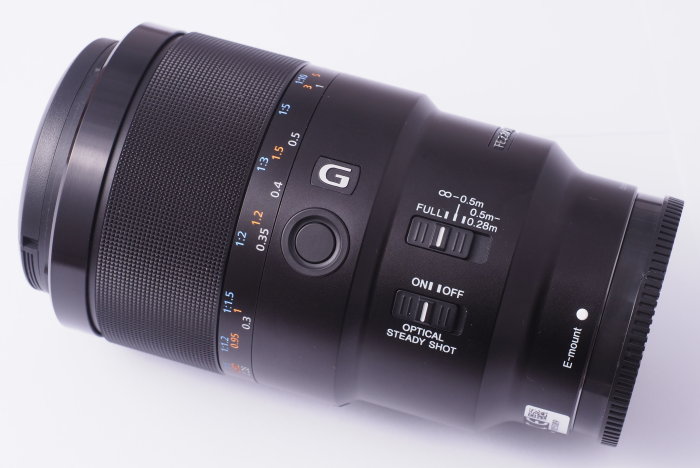
Sony FE 90mm f/2.8 Macro G OSS.
The Sony FE system offers a good but slightly antiquated 50 mm f/2.8 macro lens with a noisy AF motor, and
a modern 90 mm f/2.8 G macro lens. 50 mm is a bit too short a focal length for macrophotography at 1x.
Besides, I already have the CoastalOpt 60 mm f/4 Apo macro lens, which is
quite close to 50 mm in focal length. This made the 90 mm my only real alternative among Sony lenses.
Encouraged by a few very positive, and even enthusiastic, reviews of the 90 mm f/2.8 by
Ken Rockwell,
DxOMark
and
lensrentals.com, I purchased this lens. A modern macro lens capable of reasonably fast AF is potentially useful also for
portrait and close-up photography, in addition to macrophotography in the field. The lens also has
built-in optical image stabilization, an AF-stop button, AF-MF switching by sliding the focus ring fore
and aft, three-position focus limiter, and communicates with the camera (e.g. the camera switches to
high-magnification view while the focus ring is turned). The Sony 90 mm is quite expensive, another factor
that often (but not always) suggests a good overall quality.
My tests with this lens at 1x, however, showed a rather mediocre optical
performance between f/2.8 and f/5.6. Performance is slightly better at f/11, but on high-resolution
sensors f/11 already begins to be negatively affected by diffraction. The much cheaper Laowa 100 mm f/2.8
Apo 2x (which, admittedly, has no AF and no electronics) performs much better in the f/2.8-f/5.6 range.
Some Tamron and Sigma macro lenses in the same range of focal lengths also perform better than the Sony 90
mm, for a lower price. The legacy Nikon AF
Micro Nikkor 105 mm f/2.8 is another not-too-expensive lens that
performs optically better than the Sony 90 mm at 1x.
So, how did Ken Rockwell, DxOMark, lensrentals.com and other testers miss the mediocre lens performance of
the Sony 90 mm? A likely answer is that these sites do not focus on macrophotography and lack the
technology necessary to test lenses in the macro range. Ken Rockwell published test images of a group of
ceramic tiles, with a field of view probably half a meter or so diagonally.
On the other hand, lensrentals.com tested this lens on a test target 6 m away, then repeated the test at
0.6 m. They did not specify whether these measurements are the working distance (i.e. the distance between
subject and front of the lens), or focus distance (i.e. the distance between subject and the lens focal
plane). Since they mention that at 0.6 m the lens "does not quite reach" 1x, I am led to believe
that they are talking about focus distance. At a 0.6 m focus distance (as displayed in the camera with the
lens in manual focus mode), the actual working distance is approximately 45 cm and the magnification
approximately 0.49x. This can be regarded as already in the macro range.
At both 6 m and 0.6 m, lensrentals.com reported a significantly better MFT 50 for 6 samples of the Sony
lens, compared to 6 samples of the Canon 100mm f/2.8. They performed the test on a Sony Alpha 7R (34.7
Mpixel), while my tests are done with a 7RII (42 Mpixel). The different pixel count translates to an only
marginally increased resolution of the 7RII, not enough to substantially affect the test. It should also
be mentioned that their Sony lens samples were from a 2015 pre-production run, which might be
better than average lenses from the mass production line. Unfortunately, I have no direct experience with
the Canon lens. According to
closeupphotography.com, the
Sigma Art 70mm f/2.8 DG Macro Lens (together with four other tested lenses) is better than the Canon lens,
and the Canon lens itself is better than the Sony 90 mm, which was rated as "disappointing" at
1x on APS-C. This directly confirms my results with the Sony 90 mm at 1x. Unfortunately, by the time the
test on closeupphotography.com was published, I had already owned the Sony lens for more than one year.
On another page of my site, I openly mused whether the Sony 90 mm has
some redeeming qualities when used as a close-up lens, rather than in macrophotography. The purpose of the
present page is to test whether this is the case, and to help me to decide whether I should keep this
lens, or sell it and use only my numerous manual-focus macro lenses on Sony bodies.
The test
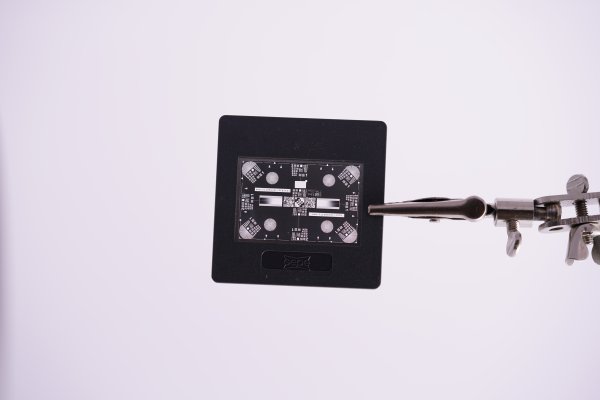
Resolution target shot with Sony 90 mm at 0.2x, reduced image. Resolution target shot at 0.6x, reduced image.
I performed the test on a Sony Alpha 7RII (42 Mpixel sensor) with a resolution target originally designed
for film scanners, identified on the target itself as film4ever.info and
film4ever.digital. Googling these target names reveals several sellers of these
resolution targets, both in the US and EU. Different types and sizes of scanning targets are available
from these and other makers (e.g. Vlads test target). The part of target used for this
test is at the top center in the slide, so nearly in the center of the frame.
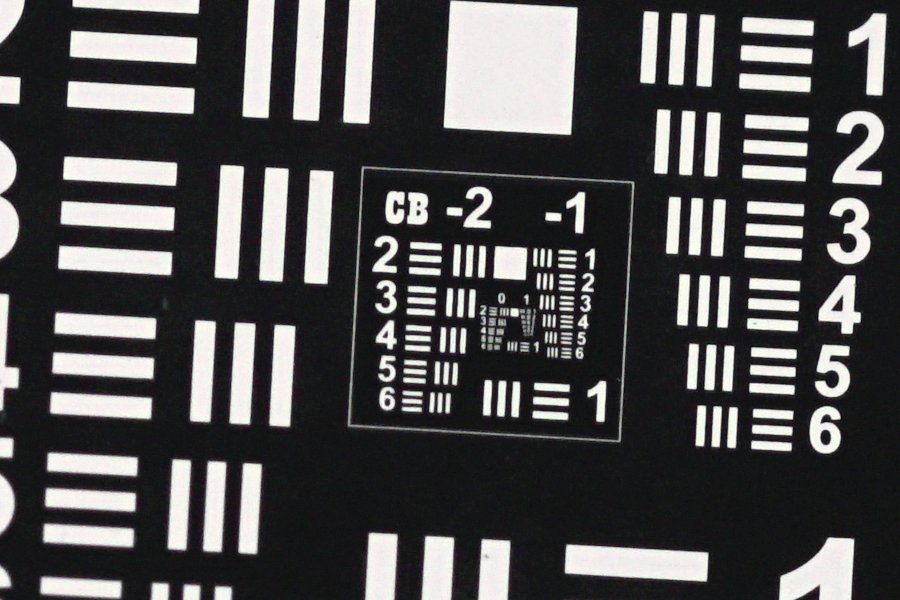
1:1 crop of test pattern at 1x with Printing Nikkor 105 mm f/2.8 A, as a test of target pattern
quality.
Since this is the first time I used this test pattern, I also took a quick series of shots at 1x with the
Printing Nikkor 105 mm f/2.8 A, which is my best lens at this magnification. The above figure does show
that the pattern is not perfectly perpendicular to the lens axis (the bottom left portion is clearly out
of focus). In optimal conditions, this lens can do much better. Nonetheless, the point of this test is to
show that the test pattern is sufficiently detailed to test the Sony 90 mm. In particular, the -1 group is
completely resolved, and the 0 group is partly resolved at this magnification, so the -1 group (and all
lower groups) are certainly adequate for testing at lower magnifications.
If you wonder why the test pattern is not perpendicular to the frame sides, I do this intentionally. This
helps to reduce aliasing and sharpening artefacts when sharp edges of the line pattern are imaged at a
resolution close to the sensor's Nyquist frequency.
1:1 crop of test pattern. Top row: at 0.6x. Bottom row: at 0.2x.
From left to right: f/2.8, f/4, f/5.6, f/8.
It can be seen that, at both magnifications, resolution at f/2.8 is not very good, and not quite
acceptable for a lens of this price. At 0.2x, resolution improves while stopping down, becoming acceptable
at f/4 and further slightly improving at f/5.6, while f/8 provides no perceptible advantage over f/5.6.
Group -2 is partly resolved.
At 0.6x, instead, stopping down from f/2.8 to f/8 does not perceptibly improve the resolution, which
remains rather mediocre. Group -1 element 6 is barely resolved at f/2.8, but is lost when stopping down.
Group -2 element 5 is resolved pretty much to the same extent within the whole aperture range from f/2.8
to f/8. This is equivalent to 44 lp/mm on the subject side, and therefore 73 lp/mm on the sensor side. The
sensor's Nyquist frequency is 110 lp/mm, so the sensor outresolves the lens by a significant margin, and
the image displayed at 1:1 pixel ratio is perceived as fuzzy. In fact, the test of this lens by
lenstips.com
gives even poorer results (MTF 50 of only 57 lp/mm at f/2.8, and 71 lp/mm at f/4).
At 0.2x, the lens at f/2.8 resolves group -2, element 3, or 17 lp/mm on the subject side. This translates
to 85 lp/mm on the sensor size. Thus, the lp/mm count on the sensor side is a little higher than at 0.6x,
which agrees with my qualitative judgement of a better sharpness. On the other hand, my qualitative
impression of a higher sharpness at f/5.6 is not confirmed by the lp/mm count, since at this aperture the
lens still resolves 17 lp/mm on the subject side.
This once more confirms that the 90 mm is not quite a good lens in the macro range of magnifications. It
also confirms my suspicion that this lens performs better in close-up and portrait photography than in the
macro range, so here we have the paradox of a macro lens not designed for the macro range around 1x, but
rather as a close-up lens. Of course, this lens subjectively performs better on a sensor with a
significantly lower pixel count, e.g. 24 Mpixel. However, the clear trend of Sony Alpha cameras is toward
higher and higher pixel counts, so this Sony lens, since its introduction in 2015, has not kept up with
the Sony cameras that can use this lens. Sony has also failed to provide a more modern macro lens that
matches the capabilities of its own cameras.
Alternatively, could it be that Sony, at some point after introducing this lens, discovered that it was
too expensive to produce this lens to standards matching its design parameters, and relaxed its acceptance
criteria to artificially reduce the number of specimens rejected or sent back for retooling?
I still do not understand why Sony did not go all the way and designed a macro lens as good as those of
many competitors throughout its focusing range. Given the remarkably high price of this lens, its optical
performance is not quite acceptable. At most, this lens should sell for one-third to one-half of its
actual price. Optically, there are better macro lenses even at this lower price, but the Sony 90 mm has
additional features that, at least for some users, could make it worth buying (specifically, if the lens
will mostly be used in close-up and product photography rather than macrophotography, and in situations
where in-lens image stabilization and AF are important). However, it is definitely overpriced for what it
offers when used as a macro lens.
Shall I keep this lens? Since I already own it and selling it on eBay is a hassle (and
eBay gets a significant slice of the price), for now I will keep it. It is my only lens capable on AF on
Sony cameras, so after selling it I would have to replace it with another AF macro lens. A few current
third-party macro lenses do offer a better optical performance, but their AF is often slow, with lots of
hunting back and forth. In the end, I
did sell this lens on eBay in 2022, since the Laowa 100 mm f/2.8 does
everything I need except AF, and produces better macro images for a much lower price (besides providing
twice the maximum magnification).
Do I recommend this lens?No, not as a macro lens. It is clearly
overpriced for what it offers. You should instead look into Laowa, Tamron or Sigma alternatives, which
are optically better and cost a lot less. If you already own this lens and use it mostly as a close-up
or portrait lens, then you may decide to keep it because of its reasonably good IQ and AF in these
ranges.
Conclusions
As I suspected, the
Sony FE 90mm f/2.8 Macro G OSS performs better in close-up photography than in the macrophotography
range around 1x. In this lens we have therefore
the paradox of a macro lens not designed specifically for macrophotography, or at least a
lens designed for sensors with much lower pixel counts than current cameras.


 In the end, I
did sell this lens on eBay in 2022, since the
In the end, I
did sell this lens on eBay in 2022, since the