PrimaLuceLab is an Italian company marketing
astronomical and radioastronomical equipment, mostly addressed to advanced astronomy amateurs and
comparatively low-budget professional use. Among other equipment, they offer a number of 1¼"
(31.8 mm) and 2" (50.8 mm) filters mounted in threaded metal cells.
While most of the PrimaLuceLab filters are designed for quite ordinary astronomical applications, for
which several alternative filter sources are available, they also offer a U filter, apparently named to
present it as an alternative to the Baader U filter for UV imaging. It was
pointed out to me that a "U" prefix or suffix is commonly used
to indicate UV-pass astronomic filters(dead link), and indeed it is also used in legacy UV-pass glass materials
like U360. Astronomy filter sets are also commonly called RGBU (for Red, Green, Blue and UV). However,
until recently the Baader U was the only modern UV-pass astronomy filter named just "U".
As far as I am aware, in addition to the Baader U and PrimaLuceLab U, there is only another currently
available UV-pass 1¼" and 2" astronomical filter, i.e., the
Astrodon UVenus. Venus is a favorite astronomical
subject for observation in near UV, which reveals fine structure in the topmost layer of clouds in the
atmosphere of this planet. Therefore, the "Venus" name is recurrent in the name of astronomic
UV-pass filters.
As a whole, for UV photographers, the PrimaLuceLab U filter is potentially interesting.
Spectral transmission
A comparison of the transmission spectra provided by the respective brands of these three filters shows
significant differences. These three filters are not equivalent to each other. Instead, they transmit
different, although largely overlapping, UV bands, and this, in turn, means that the visual results with
these filters are substantially different.
The Astrodon UVenus transmits longer wavelengths, with
a flat peak between roughly 330 and 390 nm (according to the transmission spectrum available on web sites
marketing this filter). In practical use, sunlit scenes produce mostly blue and some violet tones. The
transmission diagram shows the top of the transmission curve at or immediately below 100%, which is not
realistic if transmission is compared with the absence of any filter. Therefore, I assume that the
transmission curve is calibrated to display transmission as a percentage of the transmission peak instead,
and in the absence of more significant data, we cannot state exactly how well this filter transmits.
Ordinarily, broad-band UV-pass filters with well-designed coatings transmit between 75% and 85% at their
transmission peak.
The Baader U transmits a peak at 365 nm (where absolute transmission is around 78%) and a 50% relative
transmission band (defined as the band where transmission ≥ 50% of the peak transmission, i.e.,
not where absolute transmission ≥ 50% ) of approximately 320-380 nm.
The PrimaLuceLab U transmits a rounded 85% absolute transmission peak at approximately 330-350 nm, with a
50% (- 1 stop) relative transmission band at 290-375 nm.
Among the filters I often use for UV imaging, the
Asahi Spectra XRR0340 is, at least on paper, the closest
to the PrimaLuceLab U. The XRR0340 has a 74% rounded absolute transmission peak at 337 nm and a 50%
relative transmission band at 295-365nm. At least according to these diagrams, the XRR0340 has therefore a
narrower bandwidth than the PrimaLuceLab U. This filter is available only as unmounted 25 mm round and
unmounted 50 mm square, and therefore is not immediately usable "out of the box" for photography
or astronomy with ordinarily available equipment.
Filter construction
"Front" surface of filters
"Rear" surface of the same filters
UV-pass filters. Top left: Baader U. Top right: Astrodon UVenus. Bottom left: PrimaLuceLab U. Bottom
right: Asahi Spectra XRR0340. All re-mounted in standard photographic filter carriers.
The Baader U is an ionic glass substrate (probably U360) with different multi-layer dielectric coatings on
either side.
The Astrodon UVenus is a dielectric-only filter on a substrate (probably fused silica) transparent to both
VIS and NUV. The NUV-pass, VIS- and NIR-cut coatings are on one side only, and (unlike any other UV-pass
filter I have used, with the exception of specialty ones) silver-colored. The other side of the filter is
anti-reflection coated only.
The PrimaLuceLab U is an ionic glass (probably U340) substrate with different multi-layer dielectric
coatings on either side.
The Asahi Spectra XRR0340 is an ionic glass substrate (U340) with dielectric coatings on one side and
anti-reflection coatings on the other.
Because of the similarities of the PrimaLuceLab U and XRR0340, it is likely that both filters employ a
hybrid pigment-dielectric construction. Like in the XRR0340, the filter glass is most likely U340 with
different dielectric coatings on either side to reflect both NIR and red VIS radiation. This is made
necessary by the U340 substrate, which transmits significant amounts of red in addition to NIR.
With a a filter that has different dielectric coatings on either side, it may be asked which side is best
oriented toward the subject. This has been a matter of discussion on web sites. I have not seen convincing
evidence that the orientation has any effect on images, at least if one considers only the transmitted
radiation. From theoretical principles alone, the orientation does not matter (assuming that there are no
odd phenomena like UV-induced fluorescence of some of the glass layers or coatings, which is unlikely). It
might matter slightly, or might not matter at all, if one considers the effects of off-axis illumination
on the formation of flare or multiple reflections between filter and sensor, between multiple filter
layers, or between coatings on either side of the filter. This is difficult to prove since UV flare seems
to be an elusive phenomenon, ready to spoil images shot casually in the field but difficult to reliably
elicit in laboratory tests under controlled conditions. Therefore, I am writing "front" and
"rear" (i.e., in quotation marks) in the above figure caption. Use whatever orientation seems to
work best for you, but keep in mind that which face of the filter is outermost may not matter, so don't
loose any sleep on it. It is more important to use a lens shade narrow enough to
cut out as much off-axis illumination as possible without causing
a visible vignetting.
Prices
I found the following lowest prices by searching online, whenever possible on EU web sites. These filters
are available from multiple sources, albeit often at substantial price mark-ups.
Where the items were not available in the EU at reasonable prices, I converted US$ prices to € according
to the August 17, 2015, official exchange rate of 1.11 USD/€.
All prices quoted in € include sales tax. In most EU countries, sales tax is between 20% and 25%, so I
arbitrarily added a 22.5 % tax in the table below when converting from US$ to €. Actual prices for US
orders shipped to the EU may be higher than computed below, because of bank or exchange fees, import
duties and shipment costs.
The most interesting result of this comparison is that the PrimaLuceLab U is the cheapest of these filters
by a significant margin, regardless of size and mount. Legacy ionic filters like the U360 and U340 may be
even cheaper, but they cannot be used for UV imaging with digital cameras unless steps are taken to remove
IR radiation, either at the illumination source or at the camera end.
Historically, the price of the 2" Baader U increased significantly over a few years, since it became
the most popular filter for UV photography with digital cameras. We will see if the same is going to
happen with the PrimaLuceLab U.
As of
2021, I no longer recommend this filter, because I found that, especially in full sunlight, it leaks
enough NIR to veil UV images and substantially change their appearance and color balance.
As
expected, by early 2018, the price of the PrimaLuceLab 2" has increased to € 255. The 2" Baader
U, instead, is still € 295.
By early
2019, the PrimaLuceLab U is no longer available. However, PrimaLuceLab is now offering an Optolong Venus U
filter that is possibly the same filter (I did not test it). Its price has been cut from
€ 254 to € 215. Note, however that the Venus U page on the Optolong web site shows a transmission graph
displaying a troublesome NIR leak (about 3% transmission) around 880 nm and a smaller one (about 1%
transmission) around 990 nm. Both are large enough to qualify as significant and capable of producing
visible NIR contamination of UV images in sunlight or other NIR-rich illumination sources. A maximum NIR
transmission of OD 3 or less (0.1% transmission or less) is generally regarded as necessary in UV
photography.
Practical use
The amount of UV radiation contained in sunlight at ground level rapidly decreases with decreasing
wavelength. Much the same is true of the UV contents of electronic flash emission, because of a
combination of lower emission at shorter wavelengths and increased absorption by the glass of the flash
tube. The sensitivity of Bayer sensors also decreases rapidly at shorter UV wavelengths. These factors
combine together to require a substantially increased exposure time (for continuous UV sources), UV
intensity and ISO sensitivity as the wavelength decreases.
For the above reasons, although the Baader U and XRR0340 may not look too different when their
transmission spectra are compared, using the latter filter in full sunlight often requires exposure times
2-3 times higher (or 1-1.5 stops more open, or a correspondingly higher ISO) than with the Baader U.
Taking advantage of the full transmission band of the PrimaLuceLab U requires a "real" UV lens
(in practice, among full-frame lenses currently marketed, either the Tochigi Nikon UV 105 mm, CoastalOpt
Apo 60 mm, or CoastalOpt UV 105 mm) and a converted camera with a replacement window of a suitable
material, or no replacement window at all.
The best choice for such a replacement window is a fused silica or Spectrosil plate, optically flat to
λ/10 and anti-reflection treated with a UV-optimized coating. Edmund Optics and Thorlabs are typical
sources for these optical components. BK7 and similar glass types absorb too much UVB to be useful below
310-320 nm, if you really want to try and record these short wavelengths. For less demanding uses in UV
photography, BK7 may be fully adequate.
Test images
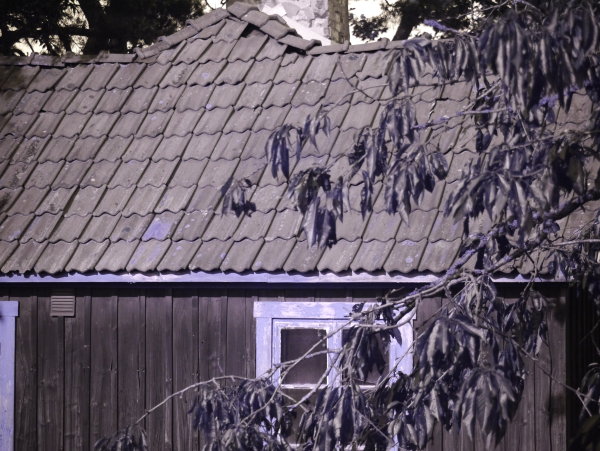
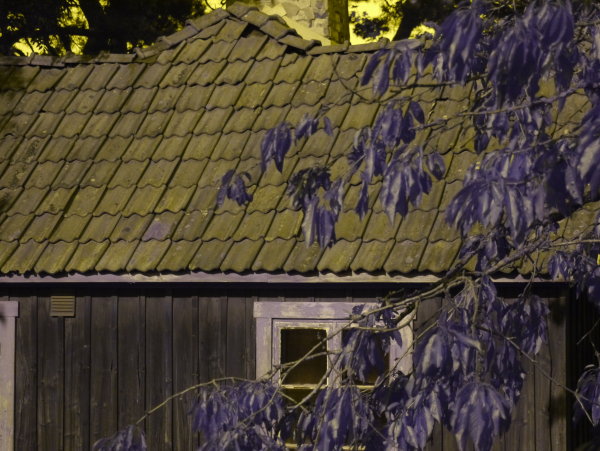
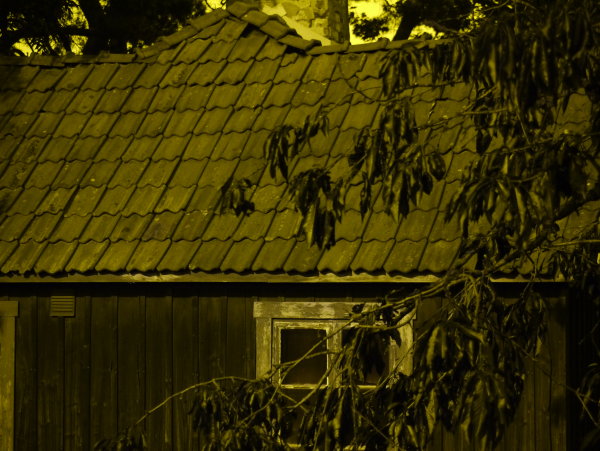
The following test images were shot with
multispectral-converted Panasonic G3 and
CoastalOpt 60 mm Apo in full sunlight in central Sweden in August. The
approximate time was 17:00. A usable amount of UVA is available in these conditions, although sunlight, as
a whole, remains relatively bleak all year round at this location. All filters discussed on this page were
used.
All images are straight out of the camera and use the same custom white balance. I initially set the
custom WB on the Panasonic G3, after multispectral conversion, with UVIR-cut Baader filter on a sunny
outdoor scene, and never changed it afterwards. This guarantees that VIS images are correctly
white-balanced (a gray card is correctly rendered as neutral gray), and I use no different in-camera WB
for UV and IR images.
Baader U
Astrodon UVenus
PrimaLuceLab U
Asahi Spectra XRR0340
Test: sunlit scene, automatic exposure.
The following test images were shot with high-power, UV-enabled electronic flash (0.75 KWs at 30 cm from
the flash tube).
Baader U
Astrodon UVenus
PrimaLuceLab U
Asahi Spectra XRR0340
PrimaLuceLab U with correct exposure
Test: UV-enabled electronic flash, same illumination intensity and exposure in all images except the
last.
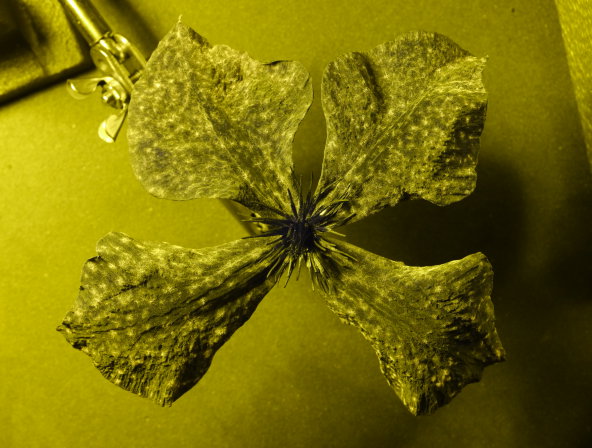
Images with the PrimaLuceLab U and Asahi Spectra XRR0340 are obviously different. The XRR0340 records no
false-color blue (which seems indicative of longer UVA wavelengths), while the PrimaLuceLab U transmits
plenty of these wavelengths. In this respect, the latter filter is more comparable to the Astrodon UVenus
than to any other of these filters. On the other hand, some subjects that reflect or emit strongly around
350-360 nm are imaged as yellow with both the XRR0340 and PrimaLuceLab U, while this happens more rarely
(i.e., only when the 350-360 nm wavelengths exceed by far the longer UVA wavelengths) with the Baader U,
and almost never with the Astrodon UVenus.
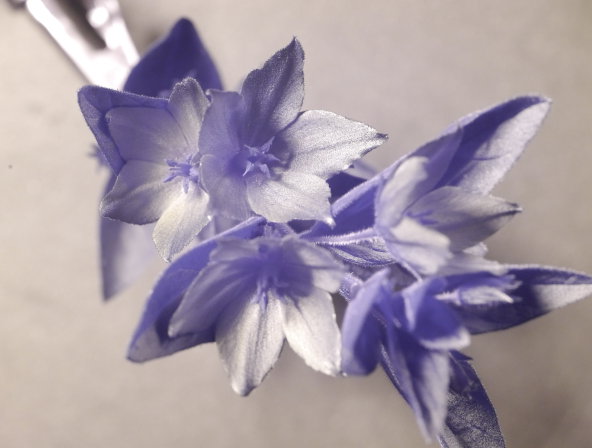
The white spots on the first of the flower subjects are mold clusters, not evident in VIS. All four
filters are successful in making them very visible in NUV.
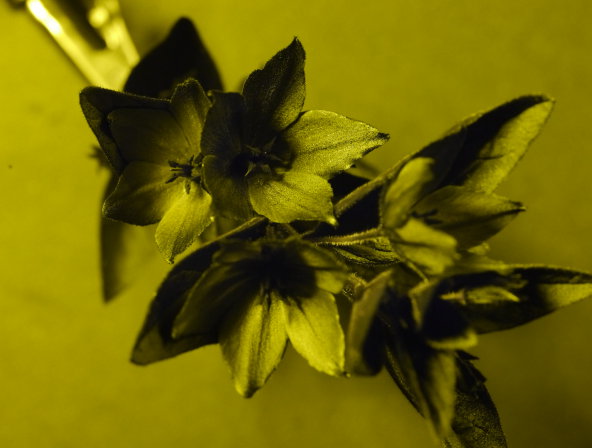
Although with PrimaLuceLab U the second flower subject looks washed out, this is partly caused by the fact
that, with some subjects, this filter requires a lower exposure than with the other three filters
discussed on this page. The last image shows the effects of correct exposure with PrimaLuceLab U. This
filter also seems to provide a slightly lower contrast than Baader U and XRR0340, but there is plenty of
dynamic range in the images that can be recovered by moderate post-processing.
A more troublesome interpretation
of the washed-out appearance of images with this filter is that this appearance results from a significant
NIR contamination. If so, users should be aware of it, and use this filter only when a "pure" UV
image is not required (the Baader U or XRR0340 should be used when UV-only images are required), or with
an illumination source already poor in NIR.
As long as the NIR leak is
understood and taken into account, these preliminary tests suggest that the PrimaLuceLab U may be a useful
filter to record UV specular reflections and iridescence, which with other filters may be difficult to
distinguish from diffuse reflectance. The last of the flower images shows specular reflectance/iridescence
as false-color yellow, and diffuse reflectance as false-color blue. The Baader U also works relatively
well in this respect, but neither the Astrodon UVenus nor the XRR0340 are successful in discriminating
between the two reflectance types.
Some of the other UV-pass filters of comparable UV transmission I tested on other occasions (e.g., Omega
Optics 340WB70 and 340WB80, which may have been superseded by newer types) show an even greater red and
NIR leak with some subjects. This red leak is usually recorded in images as red or pink, while NIR leak
around 800 nm is a pale violet.
Conclusions
The PrimaLuceLab U is different from other commonly used filters for NUV imaging, and
produces significantly different visual results. It is a welcome addition to the quite
limited range of UV-pass filters available for digital UV imaging, not the least for its
price, currently lower than that of any other comparable filter.
The Optolong Venus U filter may be
the same filter. Both filters, however, display a relatively small but already
troublesome NIR leak that must be taken into account in the interpretation of UV images.


 As of
2021, I no longer recommend this filter, because I found that, especially in full sunlight, it leaks
enough NIR to veil UV images and substantially change their appearance and color balance.
As of
2021, I no longer recommend this filter, because I found that, especially in full sunlight, it leaks
enough NIR to veil UV images and substantially change their appearance and color balance.






 A more troublesome interpretation
of the washed-out appearance of images with this filter is that this appearance results from a significant
NIR contamination. If so, users should be aware of it, and use this filter only when a "pure" UV
image is not required (the Baader U or XRR0340 should be used when UV-only images are required), or with
an illumination source already poor in NIR.
A more troublesome interpretation
of the washed-out appearance of images with this filter is that this appearance results from a significant
NIR contamination. If so, users should be aware of it, and use this filter only when a "pure" UV
image is not required (the Baader U or XRR0340 should be used when UV-only images are required), or with
an illumination source already poor in NIR.